
YELLOW CARD FOR THE FIRST PRESIDENTIAL REPORT: NARRATIVE ARROGANCE, SYSTEMIC CONTINUITY, AND THE WASTE OF A FIRST YEAR OF HOPE
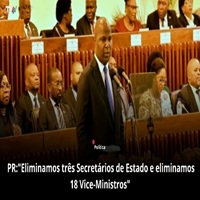
The first annual report of a President of the Republic always carries a particular political significance. It is not merely an administrative review; it is, above all, a symbolic act that founds a new governing cycle. It is the moment when the Head of State sets the tone for their governance, clarifies priorities, acknowledges difficult legacies, and establishes a minimum pact of trust with society. In a country like Mozambique, marked by recurring crises of political legitimacy, profound structural inequalities, and a long history of contested governance, this moment takes on added historical weight.
President Daniel Chapo's first annual address, however, proved to be a missed opportunity. Instead of a speech of institutional elevation, substantive reconciliation, and a clear break with practices that led the country to its current situation, what was heard was a defensive, self-justifying, and deeply polarizing narrative. The presidential speech did not contribute to healing open wounds in the social fabric; rather, it deepened divisions, shifted responsibilities, and fueled a dangerous interpretation of the relationship between the State and the citizenry.
One of the most worrying aspects of the report was the centrality attributed to the demonstrations as an almost exclusive explanation for government failures and economic stagnation. By adopting this approach, the President makes a clear diagnostic error. The demonstrations are not the cause of Mozambique's structural problems; they are their most visible symptom. They emerge from a prolonged context of structural unemployment, widespread impoverishment, lack of social mobility, discredit of electoral institutions, and a persistent feeling of political exclusion. Treating the symptom as the cause reveals analytical weakness and compromises any serious governance strategy.
There is also a clear political error in this narrative choice. By presenting the protesters as an obstacle to governance, the President symbolically positions himself against a significant portion of the population, denying the constitutional legitimacy of the protest and reducing social dissent to an act of national sabotage. A Head of State does not govern only for those who applaud him; he governs, above all, for those who question, disagree, and demand answers. By failing in this regard, the President abdicates his unifying role.
Even more serious is the ethical and democratic error underlying this discourse. The language used, directly or indirectly accusatory, contributes to the criminalization of dissent and the normalization of a friend-enemy logic in the public sphere. In a country with a recent history of political violence, this discursive choice is neither neutral nor innocent. It carries real risks of deepening social hatred and legitimizing repressive practices.
By attributing central responsibility for the economic and social crisis to the protests, the President is promoting selective political amnesia. The problems that are currently suffocating Mozambique did not originate in the last year, nor in the last few months. They are the accumulated result of decades of bad governance, systemic corruption, irresponsible indebtedness, capture of the State by partisan and economic elites, and the absence of public policies geared towards inclusive development. The plundering of public funds, the financial scandals that have never been fully clarified, and the erosion of internal and external trust predate this mandate by a considerable margin.
The refusal to clearly and unequivocally acknowledge this heavy legacy prevents the President from asserting himself as an agent of change. Moreover, by remaining silent about the responsibilities of outgoing governments—many of which were composed of the same political figures who continue to occupy central positions in the state apparatus—the President sends an unequivocal signal of continuity to society. The implicit promise of renewal is emptied of meaning when confronted with the reality of reproducing the same practices, the same actors, and the same power dynamics.
The repeated reliance on the political and administrative elites who were associated with the decisions that led the country to the current crisis blocks any serious attempt at political renewal. The absence of accountability and substantive renewal in decision-making centers fuels social skepticism and reinforces the perception that the State functions as a closed space, impervious to criticism and resistant to change. The logic of partisan self-preservation prevails, once again, over the logic of national interest.
This continuity becomes even more evident in the blatant contradiction between the official discourse of reconciliation and the concrete practices of the State. While the President calls for dialogue and national pacification, several citizens remain detained following the demonstrations, many of them without formal charges, without a swift trial, and in conditions that violate basic principles of human dignity. The refusal to grant pardons to these citizens, especially in the absence of proven formal guilt, profoundly undermines the moral authority of the presidential discourse.
There can be no true reconciliation as long as freedom is used as a political instrument. There can be no genuine dialogue when one of the parties speaks from prison. This dissonance between word and deed is not a minor detail; it is at the heart of the crisis of confidence that today separates the State from society.
The national dialogue process announced by the President, despite involving prominent figures, risks becoming a mere political charade if it fails to address the root causes of the post-election crisis, acknowledge the legitimacy of popular discontent, and produce concrete measures of justice, reparation, and inclusion. A dialogue that does not liberate, repair, or transform is perceived as an instrument for managing the image of power, not as a mechanism for social transformation.
Another element that negatively marked this first year was the perception of a shift in presidential priorities. The intense external activity, with multiple international trips, contrasted with the seriousness of the internal crisis, which demanded constant presence, active listening, and close leadership. Regardless of the financial values involved, the central problem is political and symbolic: in a context of widespread suffering, the prolonged absence of the Head of State from the domestic sphere is interpreted as a distancing from the reality experienced by the majority of citizens.
Simultaneously, the country witnessed the closure or downsizing of strategic economic units, the departure of important companies, and a reduction in the involvement of historical international partners. These phenomena cannot be explained solely by the demonstrations. They reflect an environment of political uncertainty, institutional fragility, and a lack of governmental predictability. Trust, a central element for any economy, is built on stability, coherence, and respect for the rules. No discourse that shifts responsibility to society will be able to restore it.
At the end of his first year in office, the President has still not managed to establish himself as the Head of State for all Mozambicans. His speeches, political choices, and omissions suggest a governance primarily focused on consolidating internal support within his party, treating criticism as hostility and dissent as a threat. This logic is incompatible with building an inclusive, mature, and resilient democracy.
This red card is not an act of personal hostility nor a rejection of the presidential institution. It is a well-founded act of democratic warning. The first year of governance has revealed worrying signs of narrative arrogance, systemic continuity, denial of historical responsibilities, and incoherence between discourse and practice. There is still time to correct course, but this will require a real break with the past, political humility, effective respect for fundamental rights, and the courage to govern beyond party lines.
Without this profound change, the risk is evident: another presidential cycle marked by the frustration of expectations, the deepening of the gap between the State and society, and the perpetuation of a governance model that has already demonstrated its historical exhaustion. This red card does not end the debate. On the contrary, it opens it, in the name of democracy, civic dignity, and the future of Mozambique.
Outras noticias
Culture
Launched at BCI, a book that immortalizes memories and humor of Zambézia
2026-10-02

Society
International Coffee Day
2026-10-02
Society
Minister Mathlombe squanders his term on empty promises
2026-10-02
policy
Constitutional Council Awards Purchase of Luxury Vehicles for 49.5 Million Meticais
2026-10-01

Culture
International Coffee Day: Aroma, Flavor, and History
2026-09-30
Copyright Jornal Preto e Branco All rights reserved . 2025