
Yellow Card for Maputo: Between Luxury and Trash, a City Growing Without Direction
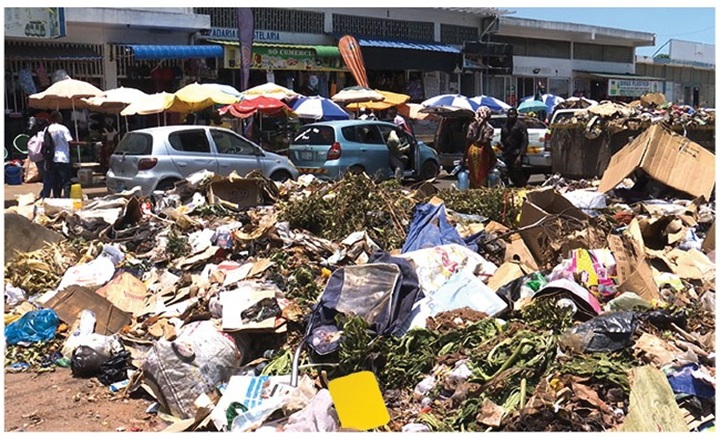
The city of Maputo is currently experiencing one of the most contradictory moments in its urban history. To those arriving, the Mozambican capital seeks to present itself as modern, cosmopolitan, and vibrant, showcasing luxurious buildings, sophisticated condominiums, elegant hotels, modern shopping centers, and an intense nightlife that aims to project the image of a city in constant development. However, one only needs to travel a few streets beyond the main urban corridors to realize that another city exists hidden behind the veneer of progress, a city marked by disorder, degradation, lack of sanitation, improvisation, and a chronic inability to plan urban growth in a humane, organized, and sustainable way.
Maputo has become a portrait of a city divided between glamour and squalor, between luxury and garbage, between discourses of modernity and the harsh reality of chaotic urbanization that grows without clear prospects. The problem is not only the accelerated growth of the city, because growth is natural and even desirable in a dynamic capital. The real problem lies in the fact that this growth occurs without adequate control, without effective oversight, and without public policies capable of keeping pace with the social and economic transformations that the city itself produces daily.
The sidewalks have disappeared. In many areas of the city, what should serve as safe pedestrian circulation has been transformed into makeshift markets, mechanic shops, mobile restaurants, informal storage facilities, or chaotic extensions of subsistence commerce. There are entire streets where citizens can no longer walk freely because the sidewalks have been occupied by stalls, tents, informal vendors, and improvised structures of all kinds. Pedestrians have been pushed onto the asphalt, forced to share space with cars, vans, motorcycles, and trucks, in a dangerous coexistence that exposes thousands of people daily to the constant risk of accidents and being run over.
The most serious issue is that this reality has ceased to provoke collective outrage. Urban chaos has been slowly normalized, as if it were inevitable that an African capital would have to function this way. The disorderly occupation of public spaces is no longer seen as a serious failure of urban governance, but as a natural consequence of poverty and unemployment. And it is precisely here that one of the greatest incapacities of city governments lies: the failure to find a balance between the need to organize the city and the structural inability of the State to generate enough formal employment to absorb thousands of young people and families who depend on the informal economy to survive.
The truth is that informal commerce has become a social escape valve in the face of rising unemployment and a lack of decent economic opportunities. Authorities seem trapped between two contradictory pressures. On the one hand, they know the city urgently needs order, sanitation, mobility, and respect for public spaces. On the other hand, they fear seriously confronting the phenomenon of informality because that would mean taking away the livelihood of thousands of families who survive thanks to the improvised occupation of streets and sidewalks. The result is urban management marked by hesitation, excessive tolerance, and a lack of political courage to find balanced, humane, and sustainable solutions.
Meanwhile, the city is transforming into a kind of territory without clear rules, where everyone occupies the space they can, sets up their business wherever they can, and survives however they can. Cars have been transformed into mobile restaurants. Sidewalks have become permanent markets. Improvised structures multiply before the eyes of the authorities. And public space, which should represent organization, coexistence, and citizenship, is slowly being consumed by the logic of improvisation.
The problem of urban mobility has worsened drastically in recent years. Getting around Maputo has become a daily exercise in patience, stress, and risk. The uncontrolled increase in motorcycles and motorcyclists without adequate training, discipline, and often without valid licenses has transformed the roads into a veritable silent war zone. Recklessness has taken hold in traffic in a frightening way. There are motorcycles driving against the flow of traffic, dangerous overtaking, speeding in busy areas, and almost complete disregard for basic traffic rules.
The consequences are visible and painful. Accidents, run-overs, and deaths on the roads are multiplying. There is a veritable rain of blood over the city, a daily tragedy that seems commonplace due to its constant repetition. Young lives are lost daily because of irresponsibility, lack of enforcement, and the absence of serious road safety education. Many families live with the constant drama of losing children, parents, and siblings in accidents that could be avoided if there were greater rigor in controlling road traffic.
At the same time, the lack of adequate basic sanitation continues to be one of the capital's greatest shames. It is unacceptable that a city that aspires to be the economic and political center of the region continues to coexist with clogged ditches, accumulated garbage in public spaces, deficient drainage, and wastewater running in the open in various neighborhoods. In some areas, garbage has become part of the urban landscape, creating unsanitary environments that threaten public health and profoundly degrade the population's quality of life.
And when the rains arrive, Maputo cruelly reveals all the fragilities of its disordered urbanization. Streets flood quickly, neighborhoods become isolated, houses are invaded by water, and collective suffering repeats itself year after year without consistent structural solutions. The problem of flooding can no longer be treated solely as a consequence of climate change or the intensity of rainfall. A large part of the problem stems from the absence of serious urban planning, the irregular occupation of vulnerable areas, and the inability of the authorities to guarantee effective drainage and sanitation systems.
Another worrying phenomenon is the accelerated growth of nightclubs, bars, and entertainment venues scattered throughout the city. Naturally, nightlife is part of the economic and cultural dynamics of any modern capital. The problem arises when this growth occurs without adequate oversight and without serious concern for the social impacts it produces. In many neighborhoods, establishments operating until the early hours of the morning are multiplying, frequently associated with excessive alcohol consumption, violence, crime, prostitution, noise pollution, and the degradation of social coexistence.
Entire communities are already held hostage by the constant noise, insecurity, and conflicts caused by the uncontrolled proliferation of these spaces. Young people are pushed into environments marked by alcohol, violence, and destructive behavior, while the authorities seem incapable of establishing clear boundaries between legitimate fun and social degradation. The city risks transforming the night into a permanent source of social instability, fueling problems that will later demand even greater costs from the State itself.
The most worrying aspect of this whole situation is the growing sense of a lack of strategic direction. Maputo seems to be growing without a collective vision for the future. Each new problem is dealt with in an improvised, temporary, and reactive way. There is a lack of an ambitious, modern, and inclusive urban project capable of reconciling economic development with human dignity, urban growth with organization, and modernization with social justice.
A capital city cannot be judged solely by the existence of tall buildings, luxury hotels, or multi-million dollar real estate investments. A truly modern city is measured by the quality of its public spaces, the safety of its citizens, the efficiency of its transportation system, the cleanliness of its streets, the protection of pedestrians, the discipline of traffic, and the ability of public institutions to prioritize the collective interest over the logic of constant improvisation.
The Municipality of Maputo therefore deserves a huge yellow card. Not as a gesture of destruction or pessimism, but as an urgent warning sign. Because a city that grows without adequate sanitation, without organized mobility, without serious oversight, and without human planning risks transforming development into an aesthetic illusion. The gleam of modern buildings cannot forever hide the disorder of the streets, the accumulated garbage, the occupied sidewalks, and the progressive degradation of urban life.
Maputo continues to be a beautiful, vibrant city, full of human and economic potential. It remains an important symbol of the country and a space of opportunity for thousands of people. But it is also true that the capital is dangerously beginning to get used to chaos. And when chaos ceases to be seen as a problem and becomes the norm, then the city slowly approaches an extremely dangerous point: the moment when disorganization ceases to be the exception and becomes the identity.
Outras noticias
Culture
Launched at BCI, a book that immortalizes memories and humor of Zambézia
2026-10-02
Society
International Coffee Day
2026-10-02

Society
Minister Mathlombe squanders his term on empty promises
2026-10-02
policy
Constitutional Council Awards Purchase of Luxury Vehicles for 49.5 Million Meticais
2026-10-01

Culture
International Coffee Day: Aroma, Flavor, and History
2026-09-30
Copyright Jornal Preto e Branco All rights reserved . 2025