
Yellow card to the Mozambican Bar Association
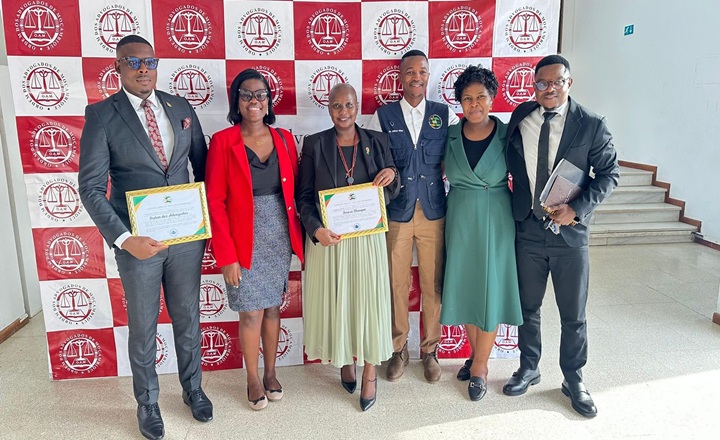
There are institutions whose greatness is not measured solely by what they say in solemn moments, but above all by what they do, or fail to do, when history enters a state of emergency. The Mozambican Bar Association is one of these institutions. Possessing a unique moral legitimacy, a high symbolic capital, and a strategic position in the architecture of the rule of law, the Bar Association cannot be evaluated only by its opening speeches at the judicial year, nor by the rhetorical brilliance of some carefully chosen public interventions. The relevance of the Bar Association does not reside in ceremony, but in the courage to remain present, firm, and active when the fundamental rights of citizens are threatened.
As Dr. Timbane rightly warned, in a critique that echoes the sentiment of many jurists and attentive citizens, the Bar Association has revealed a worrying tendency: in critical moments, it stealthily disappears, retreating into a prudent silence, while the State occupies the empty spaces left by its absence. And when the State occupies these spaces without institutional checks and balances, the result is almost always the same: injustice for the people, arbitrariness for the vulnerable, and impunity for the powerful. This institutional silence, in times of crisis, conveys a disturbing message: that the formal legitimacy of political power overrides ethics, justice, and the defense of the most vulnerable.
It is precisely because of the recognition of the central role of the Bar Association in defending democratic legality that this text neither discredits nor diminishes it. On the contrary: it issues a yellow card, a serious, firm, and public warning. It is not a matter of denying its historical struggle, but of affirming that this struggle is now proving insufficient in the face of the profound legal, social, and moral crisis that the country is experiencing. The Bar Association, by virtue of its tradition, political weight, and ethical authority, should assume a continuous and strategic role in defending the rule of law, and not just during moments of ritual or media visibility.
The Bar Association is neither a neutral association nor a simple body for professional self-regulation. In practice, it is a first-rate political-legal actor, called upon to intervene whenever the rule of law is threatened. Its strength lies precisely in its autonomy from political power and in the ethical authority derived from its mission to defend justice. When this authority is diluted by silence, the void is immediately filled by abuse. The state institutions that should serve as a counterweight become complicit in injustice, and the ordinary citizen is the main victim.
Mozambique has recently experienced one of the most turbulent periods in its democratic history. The past elections were marked by repeated allegations of electoral fraud, massive popular protest, and, tragically, the violent repression of citizens demanding electoral fairness. Hundreds of people lost their lives in circumstances that violate the most basic principles of the rule of law, while defense and security forces resorted to disproportionate force, directly affecting defenseless populations. In numerous cases, peaceful demonstrations and civil protest were criminalized, a clear demonstration that justice and civil rights were collapsing.
In this context, it was expected that the Bar Association would be a constant, incisive, and structured presence, defending the right to life, to protest, to dignity, and to electoral truth. However, the Association remained silent for much of the critical period, limiting itself to protocol statements or occasional interventions that do not alter the concrete reality experienced by the average citizen. This institutional silence is particularly worrying because it conveys a sense of permissiveness to the State and a sense of abandonment to citizens.
It is true that the Bar Association has a tradition of delivering incisive speeches at the opening ceremonies of judicial years. These speeches, often addressed to prominent state figures, including the President of the Republic, demonstrate an awareness of the gravity of the situation and rhetorical courage. But these moments are not enough. After the rhetoric, silence sets in. The Bar Association seems to hibernate until the following year, allowing the most critical events in the country to unfold without counterbalancing power. The result is a persistent feeling that criticism has become ritual and that the Bar Association, even while respected, is incapable of exerting consistent influence over justice and legality.
The situation becomes even more serious when one observes the concrete reality of judicial and penitentiary institutions. Overcrowded prisons, full of citizens who have never been tried, who have been waiting for years for a sentence, or who are serving expired sentences; prisoners convicted in manifestly unjust trials; an obsolete penitentiary system, incapable of fulfilling its rehabilitative functions. Child labor carried out in broad daylight and even at night, violating fundamental rights and the dignity of children in the 21st century. These structural problems cannot be ignored. They represent a systemic failure of the rule of law, which should be denounced and combated by the Bar Association.
From a theoretical point of view, Law is not limited to the letter of the law. From Plato, through Aristotle, to modern theorists, it is known that a formally valid but unjust law does not fulfill its assigned ethical and social function. Plato warned that unjust laws do not produce order or harmony; they only produce the appearance of legality, serving the interests of the strongest. Law that oppresses instead of liberating is a corrupt law that has lost its essence. Mozambique finds itself precisely in this tension: a legal system that functions formally, but systematically fails in material justice.
The Bar Association should be the institutional counterweight that prevents the proliferation of this structural injustice. It should act as the legal arm of the most vulnerable citizens, as a defender of human rights, a promoter of legal reforms, and a denouncer of judicial corruption. The absence of this constant action contributes to the country approaching a situation of judicial dictatorship, where justice is slow, unequal, and incapable of protecting citizens.
The public image of the Bar Association, however, tends to reinforce a perception of elitism and detachment. The legal profession in Mozambique is still perceived as inaccessible to the poor, highly professionalized, and centered on corporate interests. This perception is reinforced by the lack of systematic intervention in the country's structural problems, such as overcrowded prisons, procedural injustices, child labor, and serious deficiencies in the penitentiary system. When the Bar Association fails to act, its omission is interpreted as strategic complicity, harming not only its reputation but the very justice it should be defending.
The silence surrounding the deaths of fearless lawyers and jurists, committed to ethics and truth, is another critical factor. Each death represents an open wound in the rule of law. When the Bar Association fails to react consistently, robustly, and indignantly, it ceases to be merely negligent and becomes morally complicit. The legal profession only fully exists when it protects the values it upholds, even in the face of personal or institutional danger. Institutional disinterest or passivity weakens the ethical authority of the Bar Association and undermines public confidence in justice.
It is in this context that this yellow card is justified. It is not merely criticism: it is a serious warning, a call to action. The Mozambican Bar Association must cease to be merely a ceremonial institution, present only at solemn speeches, and transform itself into a constant, vigilant, and proactive actor. It must systematically denounce human rights violations, closely monitor electoral justice, oversee critical processes, intervene in the protection of vulnerable groups, and actively contribute to the reform of the prison and judicial systems.
The Bar Association must also assume civic and legal education as a strategic mission. The defense of ethics, justice, and equal access to legal services must be constant, systematic, and visible, becoming an integral part of the country's institutional and social life. It should not limit itself to advising, but must act, mobilize, and demand accountability from legal professionals, authorities, and the State itself. The relevance of the Bar Association depends on its ability to act before, during, and after crises, and not only at protocol-appropriate moments.
This yellow card, therefore, is not merely a criticism, but a call to the Order's historical responsibility. A call for the institution to reassume its role as guardian of justice, defender of the oppressed, and ethical counterweight to the State. The Order still has the opportunity to write a page of institutional courage that will be etched in the history of Mozambique. But the time to act is now. Justice that accommodates itself to inertia ceases to exist. Advocacy that ignores barbarity loses its soul.
History does not absolve neutral institutions in times of injustice. The Mozambican Bar Association can no longer stand idly by while social collapse, violence, and corruption occur. The moral and ethical legitimacy it holds demands continuous, courageous, and transformative action. May this yellow card serve as a warning and a commitment, reminding us that law without justice is empty, that advocacy without ethics is useless, and that a Bar Association that remains silent in the face of barbarity contributes, even unintentionally, to the perpetuation of injustice.
Justice that does not react with indignation to injustice ceases to be justice. And the legal profession that accommodates itself to barbarity loses its soul.
Outras noticias

Culture
Launched at BCI, a book that immortalizes memories and humor of Zambézia
2026-10-02

Society
International Coffee Day
2026-10-02

Society
Minister Mathlombe squanders his term on empty promises
2026-10-02
policy
Constitutional Council Awards Purchase of Luxury Vehicles for 49.5 Million Meticais
2026-10-01

Culture
International Coffee Day: Aroma, Flavor, and History
2026-09-30
Copyright Jornal Preto e Branco All rights reserved . 2025