
YELLOW CARD FOR THE FRELIMO GOVERNMENT: FROM MILLION-DOLLAR PERKS FOR THE 3 FORMER PRESIDENTS TO THE NORMALIZATION OF POVERTY IN MOZAMBIQUE
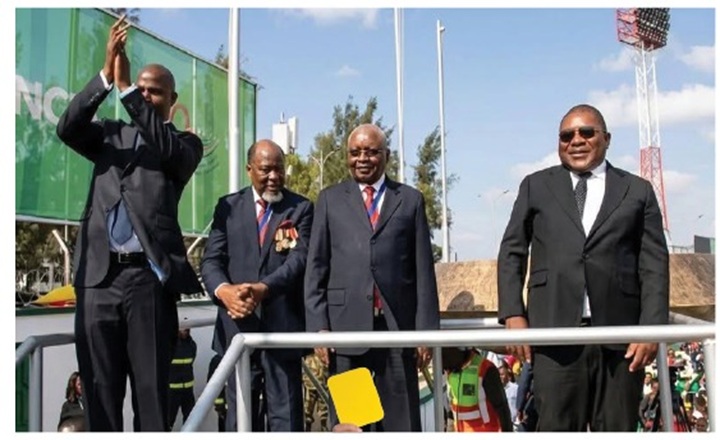
Mozambique is currently experiencing one of the most delicate moments in its recent history. Not due to a lack of resources, nor a lack of potential, but because of the growing disconnect between those who govern and those who are governed. In a country endowed with natural gas, arable land, and a young population full of energy and hope, a path to prosperity would be expected. However, reality imposes itself harshly: poverty persists, inequalities worsen, and trust in institutions diminishes.
It is in this context that the decision by the government led by Chapo to approve a package of multimillion-dollar perks for former presidents emerges, a measure that almost perfectly symbolizes the crisis of priorities and ethics that has taken hold in the state apparatus. It's not just about numbers; it's about choices. Choices that reveal who matters and who is left behind.
While the government insists on a discourse of austerity, appealing for sacrifices, spending cuts, and financial discipline, it decides to allocate approximately 30 million meticais annually to guarantee additional comfort for three former heads of state. And here lies the central problem: the inconsistency. How can sacrifices be demanded from an already vulnerable population when, in practice, privileges are perpetuated for an elite that already concentrates wealth and influence?
The gravity of this decision becomes even more evident when we translate this value into concrete social impact. Considering an average cost of between 3,000 and 4,000 meticais per school desk, assuming the use of national wood and local labor, the same 30 million meticais could produce between 7,500 and 10,000 school desks. This represents dignified conditions for 15,000 to 20,000 students, many of whom currently study sitting on the floor, in overcrowded classrooms without the minimum comfort.
This exercise is not merely rhetorical; it is profoundly political. It clearly exposes the hierarchy of priorities of the State. Between investing in the dignity of thousands of children or reinforcing the comfort of an already privileged elite, the choice made speaks for itself. And what it says is not encouraging.
According to analyses by the World Bank, Mozambique continues to face high levels of poverty, with a large part of the population living in conditions of extreme vulnerability. Even more worrying is the increase in inequality, which creates an increasingly visible divide between a minority that accumulates wealth and a majority that struggles for daily survival. This reality is not accidental; it is, to a large extent, the result of political decisions like this one.
The perception of social injustice is one of the most corrosive factors for any society. When citizens feel that the system is not fair, that the rules are not the same for everyone, and that effort is not rewarded, trust in institutions begins to crumble. And without trust, there is no lasting stability.
In this context, governance ethics ceases to be an abstract concept and becomes an urgent necessity. Governing is, above all, an act of moral responsibility. It demands sensitivity to the difficulties faced by the population, commitment to the public interest, and the courage to make decisions that, even if difficult, are just. The approval of million-dollar benefits in a context of widespread poverty reveals a serious failure in this commitment.
This failure is not isolated. It is part of a broader pattern of governance marked by a lack of transparency, favoritism, and corruption. Mozambique has consistently ranked poorly in international indices that assess the business environment, such as Doing Business. Excessive bureaucracy, legal uncertainty, and the perception of corruption deter investors and limit economic growth.
Investors seek predictability, clear rules, and strong institutions. When a country is associated with opaque practices and arbitrary decisions, risk increases, and with it, the cost of investing. The result is a vicious cycle: less investment, less employment, less growth, and more poverty.
Corruption, in turn, acts as an invisible tax on the poorest. It increases the cost of services, diverts public resources, and compromises the quality of public policies. In Mozambique, it has become a structural problem, rooted in various levels of administration. And unless it is seriously addressed, it will continue to undermine any attempt at sustainable development.
The most paradoxical thing is that all this is happening in a country with enormous potential. Mozambique could be a regional leader in energy, agriculture, and tourism. It could generate jobs, reduce poverty, and significantly improve the quality of life for its population. But for that to happen, a real commitment to good governance would be necessary—something that, until now, has been inconsistent.
However, something is beginning to change. A new generation of young people and intellectuals is emerging, more informed, more critical, and less willing to passively accept decisions they consider unjust. This critical mass represents an important force for the transformation of the country. It questions, debates, mobilizes, and demands accountability.
This phenomenon is both a sign of hope and a warning. Hope because it demonstrates that there is awareness and a desire for change. A warning because, if these voices are ignored, discontent can grow and translate into social instability.
Recent history shows that countries with high levels of inequality and low trust in institutions are particularly vulnerable to social tensions. When the population feels voiceless, unheard, and that the system does not respond to their needs, frustration builds. And this frustration, when it reaches a critical point, can explode in unpredictable ways.
That's why decisions like granting million-dollar perks are not only morally questionable; they are politically risky. They fuel the narrative that the state has been captured by an elite that governs for itself, to the detriment of the collective interest. And that narrative, when it gains traction, is difficult to counter.
Mozambique's political and social stability will depend, to a large extent, on the government's ability to recognize these signs and act accordingly. This implies more than speeches; it requires concrete actions. It demands a review of priorities, an effective fight against corruption, the strengthening of institutions, and serious investment in fundamental sectors such as education and health.
It is also necessary to break with the culture of privilege that has taken root at the top of the State. Public service cannot be seen as a path to personal enrichment or the perpetuation of benefits. It must be, above all, a commitment to the common good.
The “yellow card” presented here is, therefore, a clear warning sign. It is not a gesture of hostility, but of civic responsibility. It is the expression of legitimate discontent, grounded in facts and principles. It is a call for reflection and change.
Mozambique cannot continue down a path where the wealth of the few contrasts sharply with the misery of the many. It cannot accept as normal a government that preaches austerity for the people while practicing abundance for the elite. It cannot resign itself to a system where merit is secondary and proximity to power is decisive.
The country's future is uncertain. And that future will be shaped by the decisions made today. Decisions that must be guided by justice, equity, and a genuine commitment to inclusive development.
If the government chooses to ignore these signs, the cost will be high, not only economically, but also socially and politically. Because a country that loses the trust of its people loses its foundation. And without that foundation, no governance is sustainable.
This is, therefore, a moment of choice. A moment to correct course, to listen to society, and to build a new social contract based on transparency, accountability, and equity.
The Mozambican people deserve more. They deserve a state that functions, that respects, and that serves. They deserve leaders who understand that governing is, above all, an act of service.
Until that becomes a reality, the yellow card remains raised, not as a symbol of rejection, but as an expression of vigilance, awareness, and hope for a more just, ethical, and truly inclusive Mozambique.
Outras noticias
Culture
Launched at BCI, a book that immortalizes memories and humor of Zambézia
2026-10-02

Society
International Coffee Day
2026-10-02

Society
Minister Mathlombe squanders his term on empty promises
2026-10-02
policy
Constitutional Council Awards Purchase of Luxury Vehicles for 49.5 Million Meticais
2026-10-01

Culture
International Coffee Day: Aroma, Flavor, and History
2026-09-30
Copyright Jornal Preto e Branco All rights reserved . 2025