
YELLOW CARD FOR INGD AND THE MOZAMBICAN STATE
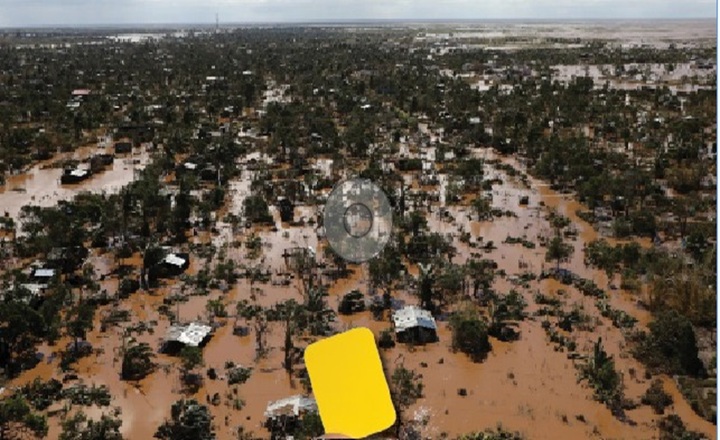
Due to the amateurish, reactive, and politicized management of floods in Mozambique
This yellow card is not a witch hunt nor a childish attempt to find culprits for natural phenomena. Floods are not selective divine punishment, nor a conspiracy against Mozambique. They are a structural fact of our geography, our climatology, and our history. The country is located in a vulnerable river basin, crossed by large international rivers, with vast low-lying areas and an extensive coastline. It has always been this way and will continue to be so. Mozambique's water vulnerability is not new, it is not a surprise, and it is not a technical mystery. What is scandalous, however, is the persistent institutional inability to transform this knowledge into serious, structured, and lasting public policies for disaster prevention, mitigation, and response.
The National Institute for Disaster Risk Management and Reduction (INGD) exists precisely for this purpose. It was created to anticipate, plan, coordinate, and lead the national response to natural disasters, based on science, data, accumulated experience, and inter-institutional collaboration. It is not an improvised NGO, nor an ad hoc emergency committee. It is a permanent public institution with its own budget, staff paid by public funds, and a clear legal mandate. Therefore, it is unjustifiable that, year after year, faced with the same predictable floods, the INGD continues to act as if it were always caught by surprise, as if each rainy season were a new and unpredictable phenomenon.
Mozambique has already experienced devastating floods in 1977, 2000, 2001, 2007, 2013, 2015, 2019, and in several other years. Each of these tragedies should have served as an institutional lesson, a learning laboratory, and a basis for more sophisticated plans. However, the pattern repeats itself almost mechanically: intense rains, overflowing rivers, isolated communities, avoidable deaths, destroyed infrastructure, displaced populations, and then a parade of official speeches, vague promises, appeals for international solidarity, and a disorganized distribution of donations. Once the media frenzy has passed, everything returns to normal until the next flood, as if nothing had been learned.
What is failing here is not nature. What is failing is risk governance. What is failing is the chronic absence of a culture of prevention. What is failing is the inability of the INGD (National Institute for Disaster Management) to reinvent itself as a modern, proactive, and technically robust institution. It is unacceptable that a structurally vulnerable country continues without public, detailed, tested, and updated contingency plans by district, river basin, and risk zone. It is unacceptable that there are no permanent community rapid response teams in the historically most affected areas. It is unacceptable that populations continue without basic training in evacuation, first aid, risk signaling, and self-protection.
It makes no sense that the INGD (National Institute for Disaster Management) does not have functional local committees in at-risk areas, equipped with basic rescue resources, boats, life jackets, communication radios, first aid kits, and clear action plans. It makes no sense that, in the 21st century, the institutional response continues to depend almost exclusively on belated appeals for international aid and logistical improvisations. It makes no sense that an institution created to manage disasters has, in practice, become a mere repository of donations, without autonomous operational capacity, without technical expertise, and without a strategic vision.
The solutions offered by INGD are almost always disconnected, fragmented, and reactive. Precarious accommodation centers are set up when the water has already swept away homes, crops, and lives. Bags of rice, blankets, and tents are distributed when the trauma has already taken hold. SMS campaigns are launched when the problem is structural, urban, environmental, and institutional. Text messages do not replace elevated bridges, containment dikes, urban drainage systems, planned resettlements, or serious land-use planning. SMS messages do not save communities trapped by water without access roads, rescue boats, or safe shelters.
This yellow card is shared, by extension, with the central government and the respective municipalities. One cannot seriously discuss flood management while ignoring the criminally negligent role of the State in land-use planning. During dry periods, when there is time to plan, study, build, and prevent, local authorities do not bother to reinforce bridges, clean drainage ditches, upgrade access roads, or create urban systems that can withstand intense rainfall. They allow construction in floodplains, on unstable slopes, in areas of obvious risk. They allow uncontrolled urban expansion, without urban planning, without basic infrastructure, without respect for master plans that often do not even exist.
The Mozambican state, at all levels, has been an active accomplice to the vulnerability of the population. By allowing construction in inappropriate areas, by turning a blind eye to urban chaos, by failing to supervise, and by not proactively resettling at-risk communities, a social time bomb is created that explodes every rainy season. Then, when tragedy strikes, surprise is feigned, public lamentations are made, and abstract blame is placed on "the force of nature," as if the state had no structural responsibility for the problem.
It must be said, bluntly, that our geographical location already makes us vulnerable and that, for that very reason, we cannot continue to be caught unprepared. Lack of preparation is no longer an excuse, since improvisation is no longer responsible for sowing grief and property destruction on a national scale. The excuse of lack of resources must be deconstructed and is deplorable, especially when we see officials squandering benefits and driving expensive cars whose cost could be compared to large quantities of barges and intervention equipment to save people and their property. There is not only scarcity, but also mismanagement, high salaries for administrative staff, and a lack of consistent plans; it ceases to be a budgetary problem and becomes a moral and political problem.
The INGD (National Institute for Disaster Management) has a cumbersome, expensive, and opaque management structure. There is a growing public perception that it is an institution with high administrative costs and comfortable salaries for managers and technicians, but without corresponding concrete results on the ground. Its effective presence throughout the country is superficial, episodic, and media-driven. There are no widely publicized long-term strategic plans. There are no publicly available performance evaluation reports explaining what went wrong in each disaster and what was corrected afterward. There is no clear agenda for innovation in risk mitigation, the use of technology, digital mapping of vulnerable areas, or the integration of universities and research centers into national planning.
The populist spectacle we have witnessed, with the President of the Republic appearing in rescue helicopters alongside his wife, is living proof of the failure of disaster management institutions. When the Head of State has to personally embody the response to calamities, this is not a sign of strong leadership; it is a sign of weak institutions. It is a sign that the system does not function without political theatrics. It is a sign that disaster management has been captured by the logic of propaganda and image, instead of being guided by technical and operational criteria.
Even more serious is the blatant politicization of rescue operations. Seeing personnel involved in rescues dressed in party emblems is an ethical and institutional affront. This clearly reveals what is at stake: transforming human tragedies into stages for political marketing. It is no coincidence that many populations are beginning to reject these interventions, aware that they are unstructured, inefficient, and essentially propagandistic actions, typical of election periods. Communities realize that these are not serious public policies, but short-term staged events for media consumption.
This yellow card is, therefore, a stark warning. The INGD needs profound, not cosmetic, reform. It needs to transform itself into a technical, non-partisan, proactive, and data-driven institution. It needs to abandon the culture of reaction and adopt a culture of prevention. It needs to create permanent local brigades, invest in community training, establish public contingency plans, map risk zones with scientific rigor, and seriously engage with municipalities, the private sector, universities, and local communities.
The government, in turn, needs to acknowledge that flood management is not charity or a media event; it is a structural public policy. It needs to invest in land-use planning, resilient infrastructure, dignified resettlement, urban monitoring, and modern drainage systems. It needs to stop allowing construction in at-risk zones and then feigning surprise when the water sweeps everything away. It needs to treat climate vulnerability as a permanent national priority, not as an occasional emergency.
This yellow card serves as a tool for debate, critical reflection, and a call to national attention. Because preventable deaths are not natural accidents, they are institutional failures. Because predictable floods are not inevitable disasters, they are poorly managed disasters. Because a state that resigns itself to improvisation condemns its citizens to a repetition of the tragedy.
Mozambique doesn't need more helicopters for photographs, more late-night text messages, or more emotional speeches. It needs serious, competent, and courageous institutions. It needs an INGD (National Institute for Disaster Management) worthy of its historic mandate. And it needs a government that treats the lives of its citizens with the same seriousness with which it treats its own image.
Outras noticias
Culture
Launched at BCI, a book that immortalizes memories and humor of Zambézia
2026-10-02

Society
International Coffee Day
2026-10-02

Society
Minister Mathlombe squanders his term on empty promises
2026-10-02
policy
Constitutional Council Awards Purchase of Luxury Vehicles for 49.5 Million Meticais
2026-10-01

Culture
International Coffee Day: Aroma, Flavor, and History
2026-09-30
Copyright Jornal Preto e Branco All rights reserved . 2025