
The lyrical flights of the presidency amidst the hardship of populations suffering from floods and inundations
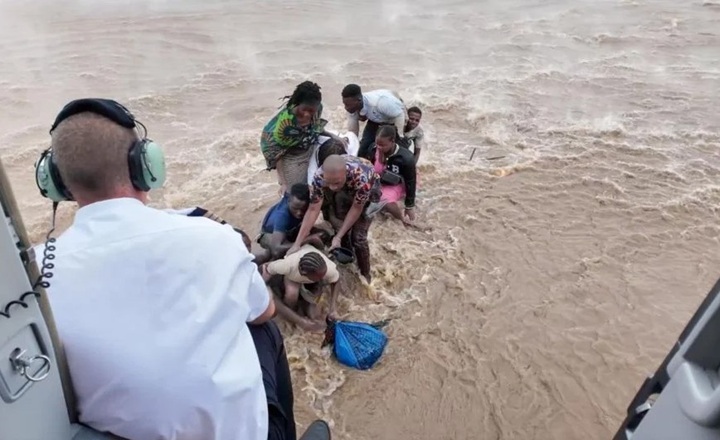
At a time when Mozambique is facing the devastating effects of floods, the President flew over Gaza Province in only one specific area, the Limpopo region, with the intention of assessing the damage caused by the floods and inundations. This assessment, based on a symbolic aerial view, disregarded the rest of the country. The President of the Republic, assuming risks as Head of State and generating additional operational costs, made this operation questionable in terms of logistical efficiency and transparency. This operation occurred at a time when drones acquired with provincial funds from Nampula, intended for emergency situations (insurgency?), were not mobilized for rescue operations or to support presidential oversight in the Limpopo Valley.
Gathering opinions on the intervention of the Operations Room on Floods in Mozambique (2026).
1. In your analysis, does it make sense to have a presidential operations room instead of the INGD?
The overwhelming rejection of the presidential operations room was 87.5%, with respondents stating that it reflects a critique of institutional duplication and the centralization of executive power. Those surveyed perceive the presidential room not as strengthening coordination, but as a symbolic and functional emptying of the INGD, the legally mandated body for disaster management. According to Osborne and Gaebler (1992), effective administrative systems depend on clarity of functions and the valorization of existing technical institutions. This interpretation aligns with the theory of hyper-presidentialization, common in post-colonial African regimes (Van de Walle, 2003).
2. The current Head of State holds several positions. In your view, does this constitute good governance or a concentration of the management of public affairs?
The respondents showed a trend of 71.4%, a clear indication that they interpret the accumulation of functions as a concentration of power, and not as good governance. This dominant interpretation suggests a perception of weakening institutions to the benefit of the leader, a phenomenon widely discussed in the literature on African neopatrimonialism (Bayart, 2009). This confirms that the population associates political centralization with risks of arbitrariness and administrative inefficiency. Max Weber (1978) warns that the excessive personalization of power weakens bureaucratic rationality and compromises the predictability of public decisions.
3. In your opinion, was the decision to charter a presidential aircraft for this evaluation the right one?
The predominance of negative responses was 62.5% compared to positive responses of 37.5%, revealing a critical judgment by the public regarding the rationality of using state resources in a disaster context. The majority disapproval suggests that respondents perceive the presidential flyover as a symbolic act of power, and not as a functional intervention aimed at mitigating the disaster.
This result can be interpreted in light of the theory of administrative rationality, according to which public decisions should maximize efficiency and social utility, especially in scenarios of scarcity (Simon, 1997). And this reading is aligned with studies on performative governance in crisis contexts, where political image tends to override operational effectiveness (Hood, 2011).While drones sponsored by the Nampula government remain unseen on the ground, the population of central and southern Mozambique may wonder where the invested resources have gone, resources that do not serve presidential and national emergencies.
4. Considering the support the country has received during disasters since 2000, do you believe Mozambique will be free from these disasters in the coming years?
The almost linear trend towards disbelief (87.5% stating that Mozambique will not be free from disasters) reflects a collective feeling of structural vulnerability. This reveals that respondents do not interpret disasters as exceptional events, but as a systemic and predictable phenomenon, associated with the institutional inability to plan for the long term. According to Ulrich Beck (1992), societies marked by recurring risks develop a social awareness of permanent insecurity, especially when the State fails in prevention and adaptation. This reinforces the thesis that risk management in developing countries is perceived more as a reaction than as prevention (UNDRR, 2015).
5. In past disasters, such as the 2000 floods or cyclones Idai and Kenneth, there were international recommendations that were not implemented. What explains this situation?
Approximately 75% of respondents reported clear trends pointing to corruption rooted in the state as the main explanation for non-compliance with international recommendations, far surpassing the justification of lack of funds. This perception is supported by the literature on state failure, where corruption is considered a central obstacle to transforming technical assistance into effective public policies (Rose-Ackerman, 1999). These data demonstrate that the population distinguishes between legitimate financial limitations and structural governance deviations, highlighting a level of political awareness relevant to studies of accountability and transparency in Sub-Saharan Africa (Bratton & Van de Walle, 1997).
6. The Minister of Transport has been speaking on behalf of the Minister of Public Works, raising questions about the ministerial appointment. In your opinion, what is behind this?
The opinions of the respondents presented multiple distributed but convergent trend lines on the idea of ministerial subordination to central power. The sum of the responses related to presidential orders, institutional interference, and power relations far exceeds explanations of a technical nature. According to Peters (2010), when ministers cease to act with functional autonomy, a phenomenon of political capture of public administration occurs, reducing the quality of governance. It can be concluded that there is a social perception that ministerial decisions do not obey clear institutional criteria, but rather informal logics of power, a central aspect in studies on weak governance and state informality.
Taken together, the opinions demonstrate internal consistency in perceptions, reinforcing the interpretative validity of the survey. According to Bardin (2016), the repetition of critical meanings in different analytical categories indicates the presence of a structured social discourse, and not merely isolated opinions. Thus, the data reveal a public opinion marked by institutional distrust, awareness of risk, and criticism of the centralization of power, offering a solid basis for academic analyses on governance, disaster management, and state legitimacy in Mozambique.On the other hand, the results reflect a clear skepticism among the population regarding disaster management and the power structure. The predominance of responses pointing to corruption, concentration of functions, and logistical inefficiency suggests a disconnect between government actions and the real needs of the affected communities.
The Presidential assessment of the 2026 flood operation is met with criticism and exposes flaws in Disaster Management.The Mozambican presidency seems increasingly detached from the concrete reality of the people it governs, while the country plunges into natural, social, and moral crises. The presidency, which should be a symbol of leadership close to the people, is not merely a spectator of the dramas plaguing the country. The feeling is that we have a president in office, but not someone who "is there" without truly "being there." The country doesn't need more international trips and promises; it needs leadership, presence, and a real commitment to the suffering of the people. As long as the presidency continues to oscillate between symbolic being and mere appearance, the people will continue to pay the price for a state that seems to govern itself, leaving Mozambicans to improvise and rely on faith.
Outras noticias

Culture
Launched at BCI, a book that immortalizes memories and humor of Zambézia
2026-10-02
Society
International Coffee Day
2026-10-02

Society
Minister Mathlombe squanders his term on empty promises
2026-10-02
policy
Constitutional Council Awards Purchase of Luxury Vehicles for 49.5 Million Meticais
2026-10-01

Culture
International Coffee Day: Aroma, Flavor, and History
2026-09-30
Copyright Jornal Preto e Branco All rights reserved . 2025