
Yellow Card to the Mozambican Football Federation: Amateurism, Empty Promises and National Shame
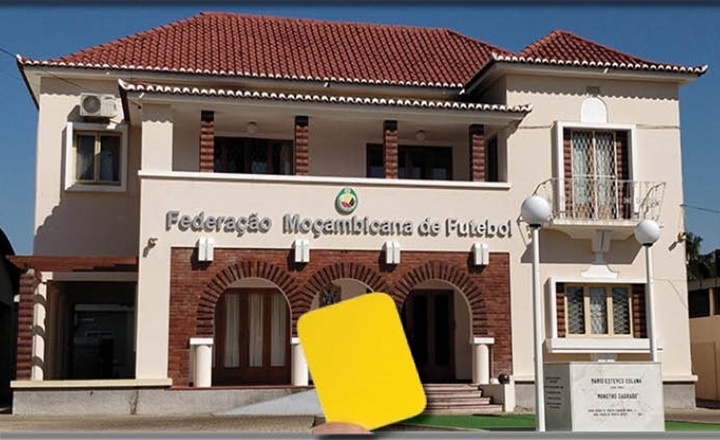
There are moments in a country's life when silence ceases to be prudence or diplomacy and becomes complicity with decadence. What has been happening at the Mozambican Football Federation demands that we speak frankly, without beating around the bush and without fear of hurting sensibilities. Mozambican football is being led down a dangerous path, where amateurism has become the norm, lack of planning has gained the status of institutional culture, and national dignity itself has been dragged down by the erratic decisions of a leadership that seems more concerned with its own image than with the effective development of the sport. And when I mention leadership, it is impossible not to direct criticism at the most visible face of this collapse: Mr. Feizal Sidat, president of the FMF.
The federation, which should be the nerve center of all strategic thinking in national football, has become a faltering organization, incapable of guaranteeing the basics, such as the dignified participation of the national team in continental competitions. The recent public statements, claiming that "there is no money" to cover the costs of attending the Africa Cup of Nations just weeks before the start of the tournament, are not only regrettable—they are an explicit confession of chronic disorganization. We are not talking about an unforeseen event or an emergency; we are talking about a competition whose date is known years in advance, for which any minimally functional federation would prepare rigorously, professionally, and with foresight. What we saw was the opposite: a leadership caught off guard by a calendar that it should itself control.
This isn't the first time. When Mozambique was left out of the last CHAN, the argument used was the same. The same lack of money, the same inability to plan, the same normalization of incompetence. It seems the FMF (Mozambican Football Federation) lives perpetually in a state of improvisation, as if national football were a last-minute exercise. And this raises inevitable questions: where is the strategy? Where is the foresight? Where, above all, is the responsibility of those who lead an institution that, contrary to appearances, has formal duties to the nation?
What is becoming increasingly clear is that the management of the Mozambican Football Federation (FMF) has transformed into a kind of personal stage for its president. The national teams, instead of being solid national projects, have become instruments of propaganda, media showcases that serve more to enhance Sidat's image with international organizations than to raise the level of Mozambican football. The positions and invitations he has received at CAF—which, shamefully, have even involved family members—demonstrate that the federation is not being run according to the needs of the country, but rather according to the interests of those who lead it.
It is no coincidence that the same president forced changes to the FMF statutes just to allow him to run for another term. This obsession with perpetuating power, in a scenario of visible institutional decay, only reinforces the suspicion that the federation has become a personal instrument, and not an organization dedicated to strengthening internal competitions, grassroots training, or the professionalization of clubs. The reality is clear: the championships remain weak, the infrastructure is dilapidated, the clubs lack support, youth development is neglected, and the FMF insists on operating as if everything is fine, as if criticism were a whim and not a cry for help.
The recent incident in Morocco is one of the greatest symbols of national humiliation. Players from the senior national team, representing the country abroad, were forced to threaten to boycott a game because the Moroccan Football Federation (FMF) failed to pay the promised subsidies. What should have been a simple administrative matter became an international scandal. Even more serious is the widely reported information that the Moroccan Federation had provided funds to the FMF to cover precisely these expenses. The stark question is: where did that money go? How is it possible to turn professional athletes into beggars? How can an institution responsible for the country's sporting honor allow the national team to experience such embarrassment?
The answer is harsh, but necessary: this only happens because the FMF (Mozambican Football Federation) has completely lost its sense of responsibility and decency. The country seems to have lost all shame, accepting that leaders treat the national team as a disposable tool, paying when they want, promising when they need to, and abandoning when it suits them. The national team, which should be the greatest symbol of national unity and pride, is reduced to a group of professionals who have to collect what belongs to them "by force."
And if there is any place that better illustrates the depth of this collapse, that place is the Zimpeto National Stadium. The main stage of Mozambican sport has become a garbage dump, an unfenced space, given over to vandalism, delinquency, and immoral acts that shame any minimally conscious citizen. How can a country that wants to be respected allow its national stadium to be in this state? And how can the FMF (Mozambican Football Federation) continue to operate as if nothing is wrong, while this national symbol degrades to the point of absurdity?
Zimpeto is not just an abandoned stadium; it's a living metaphor for Mozambican football: deteriorated, disorganized, without maintenance, without direction, and without dignity. And yet, the president of the FMF remains comfortable, accepting international invitations, posing for photographs, and speaking as if he were leading a healthy and functional institution.
The yellow card raised here is not a symbolic gesture; it is an urgent warning. The patience of Mozambicans is running out. The credibility of the FMF (Mozambican Football Federation) is compromised. The athletes no longer trust it. The fans are disillusioned. The clubs survive as best they can. And the country is repeatedly shamed because of a management that no longer demonstrates capacity, seriousness, or even the will to change.
It's time to ask, with all firmness: until when? Until when will Mozambique accept that the federation that governs its most popular sport is run by amateurs? Until when will we allow private interests to prevail over the interests of the country? Until when will football be treated as a political toy, and not as a national heritage?
This yellow card is clear. It's strong. And it's deserved. But if the FMF continues to ignore the facts, shirk its responsibilities, and destroy what remains of national footballing dignity, then the next step will be inevitable: a red card.
Because Mozambique can no longer tolerate further shameful behavior. It has no more room for improvisation. It has no more time for amateurism. And above all, it has no more patience for leaders who use the federation as an extension of their own vanity. The country demands change, seriousness, and respect. And it demands them now.
Outras noticias
Culture
Launched at BCI, a book that immortalizes memories and humor of Zambézia
2026-10-02

Society
International Coffee Day
2026-10-02
Society
Minister Mathlombe squanders his term on empty promises
2026-10-02
policy
Constitutional Council Awards Purchase of Luxury Vehicles for 49.5 Million Meticais
2026-10-01

Culture
International Coffee Day: Aroma, Flavor, and History
2026-09-30
Copyright Jornal Preto e Branco All rights reserved . 2025