
Yellow Card for Chapo: What the Lies of Truth tell us, told by His Excellency, the highest Magistrate, the Commander in Chief of the FDSs
.jpg)
“Presidential trips to the Metropolis and their caricatures - men almost always reveal themselves in the diaspora: a case in point - Gentlemen Presidents, if you go to Portugal, drink wine and do not accept to give interviews, that way you will spare us from collective shame”
“A president does not lie. A president represents. When he lies, he betrays the people. When he pretends, he renounces his mandate. When he ignores the suffering of his people, he declares war on the future”
When the president falls prey to the media's traps, it's common for people to judge, even though the president would have missed a prime opportunity to answer that simple question with the class expected of an honest statesman. Accepting the social crisis and illegitimacy of his government wouldn't be so bad; on the contrary, it would be the most sensible way to demonstrate awareness of the challenges he faces and his commitment to reconciliation, and to demonstrate what concrete actions he intends to take to achieve this goal. However, he sought to emulate the arrogance that characterizes his predecessors, especially the last one, who regaled us with laconic and tragicomic speeches that didn't recall any president, even in the most irrational terms. This week, we couldn't turn a blind eye to the presidential debacle in the diaspora, and we awarded President Chapo the Yellow Card of the Week, not only for his words, but for what they silence. The interview recently given to a Portuguese television station, also broadcast nationally by the regime's official television channel, showed us a fabricated narrative, a rhetorical coherence, carefully rehearsed, but brutally dissonant with national reality.
In several passages of his speech, the Head of State categorically denied the existence of a divided Mozambican society, downplayed the outcry from the streets, downplayed electoral protests, and even attempted to justify the lack of celebrations for the 50th anniversary of independence by comparing them to the day of the proclamation of independence, showing the world that what everyone saw was unrealistic, a collective optical illusion. However, the absence of crowds in Machava was a silent cry from the people against the regime's political hypocrisy and, more than that, a collective denial of neo-imperialism.
Chapo's stance in that interview says more than any technical analysis could convey. It was a portrait of the arrogance of a power that considers itself absolute, above criticism, above truth, and, above all, above the people.
By asserting that "there is no division" within Mozambican society, the President engages in political denialism. He denies the glaring evidence of a social fracture fueled by a flawed electoral process, a centralized governance system, an instrumentalized justice system, and a Defense and Security Force that, instead of protecting the people, has established itself as an instrument of the regime's repression.
Chapo doesn't just deny the divisions: he denies the pain. He denies the hunger, the fear, the bullets, the arbitrary arrests, the hundreds of deaths that are already a living memory of a state that has lost its way and is hostage to its own illegitimacy.
It's impossible to ignore the security detail accompanying the President on the streets of the capital. It's a symbolic image of a country under siege from within, where power no longer walks alongside the people, but rather within walls of fear, in armored vehicles, surrounded by soldiers who, paradoxically, were trained to defend the citizenry.
The truth is that the President knows his mandate was obtained under the banner of contestation. The streets don't lie. The ballot boxes were tampered with. The dead don't speak, but they do accuse. More than 500 souls fell so that Chapo could be inaugurated. It's a baptism of blood that will haunt him throughout his term, like a ghost hovering over a castle built on bones.
The 50th anniversary of independence celebrations were supposed to be an occasion for national unity. But they became a sad reflection of the distance between power and the people. The image of the empty Machava Stadium was more powerful than any speech. It revealed the failure of a state project that had lost touch with its citizens.
Chapo tried to justify the masses' absence with unrealistic, not to mention false, and unfounded excuses. But what he didn't say is that Frelimo lost its popular soul and social base, tore apart its designs, and the people didn't forgive. The strategists of yesteryear were replaced by careerists and bootlickers, who have no choice but to show their service to the party, killing through death squads and other coercive means. The guardians of party morality were silenced by opportunistic executioners. The capitalist race replaced the socialist ideal. And, as a result, the people simply didn't show up.
Another sensitive point in the interview was the President's attempt to present a conciliatory image. He spoke of "progress" in dialogue with the opposition, although none of this progress was publicly acknowledged. He spoke of national reconciliation, but denied pardon to the young protesters who remain imprisoned without charge.
Meanwhile, those who killed, beat, and tortured in the name of the regime remain free, in public office, accumulating wealth, and displaying power. There is no justice. There is no equality. And without it, there is no peace.
The Yellow Card also goes to the party that sustains this state of affairs. Frelimo, once a liberating party, now seems like a foreign body, devoured by time, incapable of reinventing itself, and profoundly disconnected from youth and the peripheries.
The concept of "people" for current leaders is vague, selective, almost metaphysical. For them, the people are only those who applaud, venerate, and obey. Anyone who questions, challenges, or disobeys is an enemy. And thus a state without a nation is being built.
This is not about denying the President's legal investiture. It's about recognizing that legality, without legitimacy, is futile. And legitimacy, in a democratic system, is granted by the people, not by the courts or other electoral bodies.
This Yellow Card is a wake-up call. It's an attempt to give the people back their voices, to affirm that truth matters, that the memory of the victims will not be forgotten, that the future cannot be built on lies.
History demands it. The people are watching. And the books of tomorrow are being written today, in the squares, in the markets, in the prison cells, in the trenches of public opinion.
President Chapo, this Yellow Card is not an insult. It's a mirror. And perhaps your last chance to look at yourself with courage.
Outras noticias
Culture
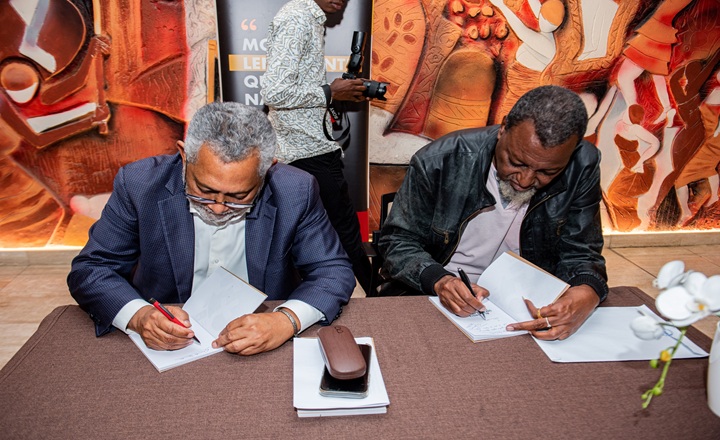
Launched at BCI, a book that immortalizes memories and humor of Zambézia
2026-10-02
Society
International Coffee Day
2026-10-02
Society
Minister Mathlombe squanders his term on empty promises
2026-10-02
policy
Constitutional Council Awards Purchase of Luxury Vehicles for 49.5 Million Meticais
2026-10-01

Culture
International Coffee Day: Aroma, Flavor, and History
2026-09-30
Copyright Jornal Preto e Branco All rights reserved . 2025