
The last slaves: THE “Madjermanes” dossier and the complicit impavity of the Germany Government
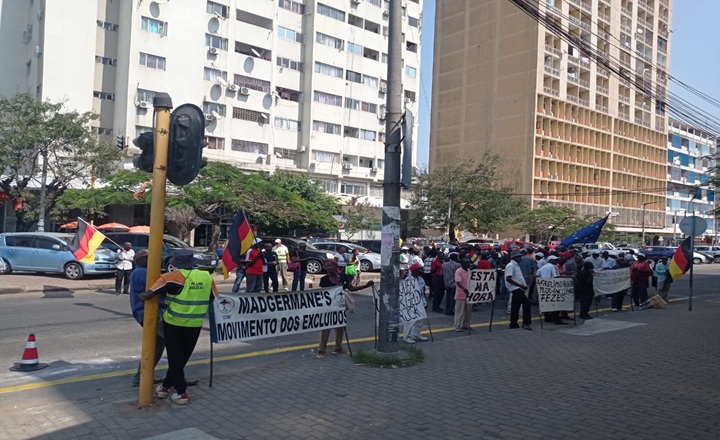
In the heart of the Mozambican capital, every Wednesday, a group of men and women walk towards the city center, heavily escorted by the police of the Republic of Mozambique.
There were many, but their numbers are dwindling, and there are fewer and fewer of them. The few who still resist bear on their faces the weight of a history that stained two nations: Mozambique and Germany. Even when the issue is ignored in global diplomatic corridors and domestically, resistance seems to have ended only with the grave, according to what they themselves steadfastly advocate, as the chances of receiving their money fade with each passing Wednesday, with each loss of a militant. They call themselves Madjermanes, a term popularly attributed to the Mozambican workers sent to the German Democratic Republic (GDR) in the late 1980s, who were driven by the promise of decent employment, vocational training, and the accumulation of savings that would guarantee them a better life upon their return. A dream turned into a nightmare.
The reality, however, was brutally different. Approximately 60% of these workers' salaries were deducted monthly and sent, according to the official agreement, to Mozambique. The understanding was that upon their return, they would receive the accumulated amount. But nothing arrived. Decades later, the truth began to emerge: the money had been used to pay off debts owed by the Mozambican state to the German government after the unification of the two Germanies.
The central question, which resonates like an unanswered accusation, is simple: how could two states dispose of the labor of thousands of citizens as if they were mere exchangeable commodities to pay off sovereign debts? The answer is harsh and points to a complicity that, under international law, resembles a modern form of slavery.
Next we give the testimony of a former worker of the Ex GDR who explains in simple terms what happened to them:
"In Germany, we only received 40% of our salary, and 60% was deducted to be paid back home. None of us realized we wouldn't receive this amount. When we returned, each of us brought our own savings account, but it was confiscated at Mavalane airport. We discovered, too late, that we had been used to pay debts owed to the Mozambican state. We were the last slaves." – Carlos Vasco Chuma, 57.
Chuma's story is not isolated. Similar testimonies abound: men who returned empty-handed, families torn apart, dreams cut short. Many were unable to reintegrate into the job market, victims of social stigmatization, seen as "lazy" or "too smart for the system." Others emigrated again, unsuccessfully, in search of dignity.
Trauma spans generations. Children and grandchildren of the Madjermanes are participating in Wednesday's marches today, reminding the country and the world that the debt of history has not yet been paid. Since 1990, without rest, they have turned Wednesday into a day of protest. They march in front of the parliament, the Ministry of Labor, and the German embassy. They have been repelled, persecuted, and in some cases shot dead in broad daylight. In the garden where they gather, stones mark the places of those who fell.
It's not just an economic demand. It's about dignity. "We leave here with money or in a coffin," Chuma summarizes. The phrase, repeated in chorus, is both a cry of despair and an act of resistance. Three decades later, the struggle persists. But each year the procession grows smaller: not because they've given up, but because age and poverty claim lives.
Berlin's official narrative is evasive. It acknowledges the existence of labor agreements, admits the transfer of funds to Mozambique, but denies responsibility for the final destination of the money. However, documents and testimonies suggest that German authorities knew the funds would not reach the workers. Furthermore, they actively participated in the negotiation that used the labor of Mozambican citizens as currency to pay interstate debts. This silence, at the very least, constitutes a violation of the basic principles of human rights protection enshrined in international conventions ratified by Germany.
If Germany was complicit, the Mozambican state was a protagonist. It accepted the agreement, confiscated passbooks, repressed demonstrations, and, on many occasions, declared the matter "closed." The silence of successive governments, from Joaquim Chissano to Filipe Nyusi, is proof of the deliberate strategy of emptying the issue from public debate. But the human cost is clear: families disorganized, generations without access to education or adequate healthcare, and marginalized workers.
In light of international labor law, the Madjermanes case sets a disturbing precedent. It raises fundamental questions: none of the workers were informed that the cash they withheld would be used to pay sovereign debts, which violates their right to property over their labor income. Even more seriously,
falls within the practices classified as forced labor and modern slavery. Both Mozambique and Germany have violated international commitments to worker protection.
ILO Convention No. 29 defines forced labor as any labor exacted under threat and without voluntary consent. Although the Madjermanes agreed to go to Germany, they did not consent to the appropriation of their wages for state purposes. ILO Convention No. 105 expressly prohibits the use of forced labor for economic development or payment of state debts, making the conduct of both governments a direct violation.
The Universal Declaration of Human Rights and the International Covenant on Economic, Social, and Cultural Rights also establish the right of everyone to fair and favorable remuneration. By depriving the Madjermanes of the fruits of their labor, Mozambique and Germany violated these international commitments. Furthermore, international law recognizes that victims of violations have the right to full reparation, including financial compensation, rehabilitation, and guarantees of non-repetition.
The drama isn't just past. It's present. Children and grandchildren have inherited not only poverty but also stigma. Young people who should have grown up in economically stable families now march through the streets, chanting slogans they inherited as a curse. Each march is also a cruel reminder that time cannot be reversed. "No matter how much money they give us, time can't be recovered. Thirty-five years is no joke," laments Chuma.
That Germany, a European power and model of liberal democracy, has participated in this historical stain is a painful contradiction. More was expected from a state that presents itself as a guardian of human rights. Likewise, the Mozambican government continues to ignore the Madjermans' struggle, even when there is evidence that it has converted citizens into bargaining chips. This scenario is a testament to the lack of ethics of Mozambican political elites and the type of regime that has been established.
The Madjermanes case is, therefore, a mirror. It reflects the distance between civilizational discourse and the actual practice of states. It shows how, in the name of reason of state, human lives can be traded like mere numbers on a foreign debt spreadsheet.
More than financial compensation, what's at stake is the dignity of thousands of citizens. It's the credibility of two nations. It's the strength of international law.
in the face of modern exploitation. While Berlin and Maputo, despite officially acknowledging their complicity, fail to initiate a process of reparation, the wound will remain open among future generations of this group that is slowly disappearing, leaving a trail of profound sadness.
The Madjermanes dossier is not just a conflict between the state and its citizens. It is a chapter in a larger story: how power, in alliance with debt and diplomacy, can crush anonymous lives. The Madjermanes' struggle is, at once, a fight for local justice and a global wake-up call. It reminds us that, as long as workers can be used as currency, the world will continue to produce new slaves. Mozambique and Germany owe answers. And not only to those still marching, but also to those who have already died waiting.
The question that remains is simple and brutal: how much is a worker's life worth?
Outras noticias
Culture
Launched at BCI, a book that immortalizes memories and humor of Zambézia
2026-10-02

Society
International Coffee Day
2026-10-02

Society
Minister Mathlombe squanders his term on empty promises
2026-10-02
policy
Constitutional Council Awards Purchase of Luxury Vehicles for 49.5 Million Meticais
2026-10-01

Culture
International Coffee Day: Aroma, Flavor, and History
2026-09-30
Copyright Jornal Preto e Branco All rights reserved . 2025