
Mozambique Airlines (LAM): Pride Turned to Shame — Yellow Card to the Government for its proven inability to stabilize the aviation sector
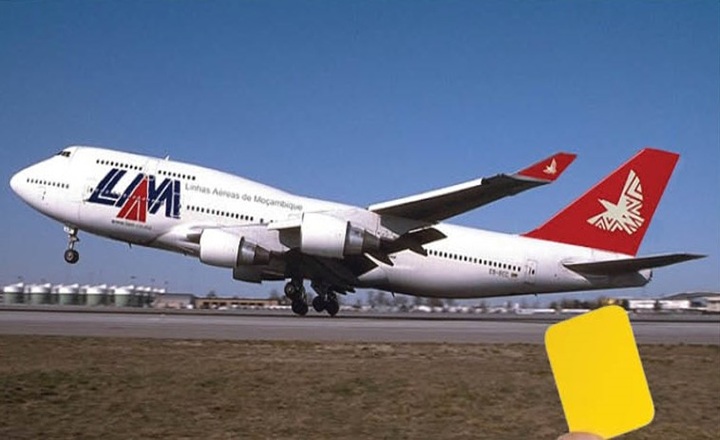
This yellow card is directed at the Mozambican government for its blatant inability to bring order to Mozambique Airlines (LAM), the national flag carrier. This failure isn't just a matter of corporate management; it reflects a rudderless state that inherited an entire infrastructure built by the colonists and, instead of developing it, chose to plunder it, politicize it, and destroy it until it collapsed. The LAM case is just one visible example of a widespread regression affecting all vital sectors of the country. After independence, LAM was a symbol of sovereignty and modernity. It inherited a solid fleet and, throughout the 1980s and 1990s, operated large, intercontinental-range aircraft such as the Boeing 707, Boeing 737-300, Boeing 767-200 ER, Lockheed L-1011, McDonnell Douglas DC-10, Douglas DC-8, Fokker 27, Fokker 28, Fokker 100, Embraer 190, and even the Il-62. It was a company that could pride itself on being among the largest on the African continent, with the capacity to fly to Europe, the Middle East, and other strategic points. Mozambique's name circulated around the world through LAM, which transported thousands of passengers and projected a positive image of an emerging country opening itself to international trade and diplomacy. LAM at the time was not just an airline: it was an emblem of the Mozambican state, a source of national pride, and a bridge to the world. Its fleet was diverse, its destinations numerous, and its management, though marked by the constraints of the Cold War and domestic economic difficulties, maintained standards that ensured stable operations and passenger safety. There was a clear awareness that civil aviation was a strategic sector for development. What we see today is a caricature of an airline that has lost its relevance internationally, ceased to be competitive, reduced to a fleet of just five aircraft, almost all of them aging, constantly breaking down, and incapable of even minimally meeting national and regional mobility needs. The company relies on temporary leasing contracts and poorly designed partnerships that, instead of solving problems, only exacerbate them.
As of August 2025, LAM's active fleet consists of five aircraft: a Bombardier Q400, a leased Boeing 737-500, a CRJ 900 and two Embraer 145s.
This is a short, limited fleet with limited capacity and no longer suitable for long-haul flights. To make matters worse, the attempted modernization through the acquisition of a Boeing 737-300F freighter resulted in a monumental fiasco: the aircraft never entered service and was returned, generating an estimated loss of 71 million meticais. It's a financial scandal that, in any serious country, would have led to the immediate resignation of the entire board of directors and the criminal prosecution of those involved. In Mozambique, however, impunity reigns. The crisis worsened in 2024 and 2025 so much that LAM reduced its operations to just three aircraft in April 2025, canceling flights, stranding passengers, and destroying consumer confidence. The chaos was so great that the company had to rush to acquire a small Embraer 145, an improvised measure that demonstrates a complete lack of strategic planning. A flag carrier cannot live on improvisation; it cannot be permanently dependent on patchwork. What's at stake isn't just internal mobility: it's the entire country's credibility. The crisis at LAM cannot be understood without pointing the finger at the partisanship of the entire state apparatus. The company has been transformed into a FRELIMO fiefdom, where administrators receive astronomical salaries and enjoy lavish perks, while workers face delayed pay and poor working conditions. Free travel for party members, the political use of the fleet, and the exploitation of the company for purposes unrelated to its mission have eroded any possibility of sound management. The succession of political dismissals and appointments, without any criteria of technical competence, has destroyed administrative stability. Managers change like shirts change, each interested in extracting personal benefits while in office. There is no consistent strategic plan for the company, only isolated measures, improvised patches, and disastrous decisions. Even more serious is the issue of safety. Passenger reports reveal planes taking off with malfunctions, flights forced to land at unscheduled stops, endless delays, and sudden cancellations. We are facing an imminent threat to the lives of Mozambicans and foreigners who rely on LAM for their transportation. Civil aviation management cannot be treated as a joke, because human lives are at stake. The government has an obligation to ensure safety and quality standards, but what we face today is a scenario of improvisation and irresponsibility.
After independence, despite the difficulties, LAM expanded and became one of the most respected airlines in Southern Africa. It was competitive, a source of pride for the country, and a source of foreign exchange. Today, it is a financial burden, a source of national and international embarrassment. The contrast could not be greater. What was inherited, ready to be managed and developed, was destroyed by the greed, corruption, and incompetence of a government uncommitted to development. It's not just LAM that is in ruins. The case of the flagship airline is merely the most visible face of a failed state, incapable of managing its railways, national roads, ports, hospitals, or schools. Everything inherited from the colonists is falling apart. The difference is that, in the case of LAM, the degradation is impossible to hide, because passengers experience it daily, because the international press reports it, because aviation does not allow for indefinite improvisation. LAM's situation is more than just an airline crisis: it symbolizes the failure of Mozambique's governance model. A government that cannot manage its own flagship airline, which it inherited with an established fleet, routes, and reputation, is incapable of managing the country. What is at stake is Mozambique's future. A state that fails to ensure decent, safe, and competitive air transport for its citizens and the world cannot speak of development, industrialization, or regional integration.
This yellow card is, therefore, a serious warning: the country is being driven to the abyss by government incompetence. LAM is just one example, but a glaring one. The government has failed miserably and has shown no sign of being able to reverse course. Without radical changes, the company will disappear, and with it, a piece of national sovereignty.
The responsibility is unequivocal: the Mozambican government, with the complicity of FRELIMO, destroyed what it inherited. There are no excuses. The yellow card has been issued, and the country demands accountability, transparency, and a new direction so as not to watch helplessly as what little remains of our collective heritage is destroyed.
Outras noticias

Culture
Launched at BCI, a book that immortalizes memories and humor of Zambézia
2026-10-02

Society
International Coffee Day
2026-10-02

Society
Minister Mathlombe squanders his term on empty promises
2026-10-02

policy
Constitutional Council Awards Purchase of Luxury Vehicles for 49.5 Million Meticais
2026-10-01

Culture
International Coffee Day: Aroma, Flavor, and History
2026-09-30
Copyright Jornal Preto e Branco All rights reserved . 2025