
Mothers lose children in Cabo Delgado, says Josias Marques Raul
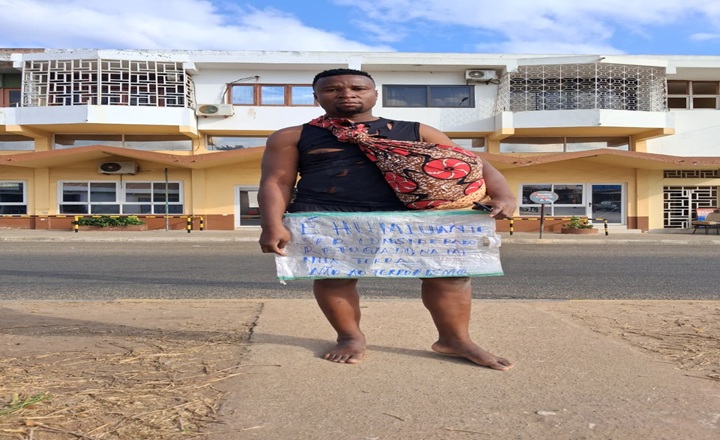
He is a 28-year-old social activist and human rights defender with a special focus on displaced people in Cabo Delgado. He is from Murrupula, Nampula, and has lived in Montepuez, Cabo Delgado, for 10 years. He is currently implementing an activity called Dialogue for Peace and Local Justice, an initiative that focuses on strengthening trust and community cohesion between Montepuez residents and local community leaders, specifically in the Matuto neighborhood, through dialogue sessions based on a manual of good practices and community coexistence.
What have we experienced over the last 7 to 8 years in Cabo Delgado?
Well, actually, insurgency, terrorism, is what I've been experiencing throughout this period. And what I have to tell you about terrorism is that it worries me greatly, not because of its causes but because of the factors that give rise to it and the effects on the harmless and defenseless people.
This is my biggest concern, because the deepest issues of terrorism itself fall to the Mozambican state, because it is the one responsible for revealing and managing state security issues.
So, as a Mozambican citizen, what concerns me are human lives.
Some say that the only safe places in Cabo Delgado are Mueda, Montepuez, and Chiure. Want to comment?
Yes, in fact we have places such as: Montepuez, Mueda, Pemba, Metuge, Chiure and Balama
These were considered safe places because they were districts that welcomed displaced families. There, we have villages that we currently call reception centers, and now, as some families return to their areas of origin, we return to calling them villages for people in a situation of displacement.
We have learned that last week, approximately 15 kilometers from the accommodation center in Chiure, there was an attack.
We follow any situation among friends, informally and through social media. For those of us who are somewhat informed, we have the privilege of receiving this information. Not in a more complete or conclusive way, but we have had our best guesses.
At this moment, could these signs of terrorists approaching mean that the accommodation centers are only a few days away from being attacked?
In fact, the situation is worrying to me, because if we're experiencing attacks at least 15 kilometers away from our accommodation center today, it clearly shows how vulnerable we are and how vulnerable we are to attack. In a conversation with friends, I said that no part of Cabo Delgado is safe.
Yes, even in 2022, around early November, we experienced a situation where Gemrock was invaded. Gemrock is one of the multinational mining companies in Montepuez. So, it's close to the municipality.
Just last week, reports circulated, including videos, claiming that the village of Empaka, in the Balama district, had been attacked. People were murdered, others were injured. Videos are circulating on social media platforms.
This shows how vulnerable we are as the population of Cabo Delgado. This worries me a lot, because we are takingWe've been dealing with this for a long time, and it's increasingly unclear what the outcome will be and how to overcome it. And it seems like we've normalized the situation in Maputo.
The whole country is taking this lightly. I say this because there's little engagement, especially in publicizing the socioeconomic, and even political, situation in Cabo Delgado. And we've normalized deaths.
So, when the situation affects our family and friends, we look with concern at the situation in Cabo Delgado.
The right to information is enshrined in the Basic Law. But looking at the current case in Cabo Delgado, for example, you have at some point limited access to information, and journalists should not be allowed to carry out their work. What can you say about this?
It's regrettable. In fact, I believe the right to information is a fundamental right. For example, some young people in Cabo Delgado have been taking part in this advocacy movement in recent days. One of these movements is demanding that information about the situation in Cabo Delgado be withheld.
It may seem like a minor situation, but let me state that the omission of information, the right to information, is associated with shouting at the press, because there is no information if journalists don't work. It's not safe for journalists in Cabo Delgado. This makes us more vulnerable.
I speak of this in the following words, which I will now quote. Between the 7th, 8th, 9th, and 10th, a brother of mine, who worked in Macomia, says there were attacks, during which they fled, but then returned to the village. After returning to the village, a family problem arose, and he felt compelled to return to Pemba to resolve the family issue.
He returned to Pemba. A week later, planning to return to Macomia, he received calls from his boss and colleagues warning him that he couldn't make the trip because the Macomia and Mocimba da Praia regions were experiencing attacks. So, I'm beginning to think that withholding information not only undermines knowledge, the information that allows people to know what's really going on, but that withholding information also paves the way for innocent people to die.
People don't know what's going on. Let's imagine if my brother had been to Macomia or Mocimba, that week, those days, he could have obviously been involved in an incident.
Therefore, the consequences of omitting information endanger the lives of Cabo Delgado residents themselves, and not only that, but also misinform the community—the Mozambican and international community.
Even because there are those who say that, by informing, it could attract more national and international support to look at what is happening.
Final considerations
It's more fluid when questions are asked. It's difficult to do so arbitrarily. I want to thank you for the opportunity to talk and share, because I feel that's my job, as an activist and as a Mozambican citizen.
We, as young people, need to create a network. We also need to win, to seize this opportunity to encourage other young people from Cabo Delgado, and beyond, to expand this network. Being an activist isn't about confronting the state.
Being an activist means bringing up community problems, together creating conditions and proposing solutions for the State to take charge. I say this. I would really like to invite other young people, just like us, young people from Cabo Delgado and, especially, from Montepuez, for example, on October 4th, when we celebrated Peace Day.
We took to the streets, and the Montepuez District government accepted our request. I also want to thank them very much. They accepted our request to be present in the square with our slogans, our messages of immigration and rejection.
And it happened, without any problems, we were given the space to read our protest and the message of encouragement to the security forces who have been working hard since 2017 until today. Eight years have already passed.
And believe me, these are years of intense mourning for people both inside and outside Cabo Delgado. That's why I urge young people to build an advocacy network. Mothers are losing children in the Cabo Delgado Operational Theater.
Mothers who are outside Cabo Delgado, who have military sons. So these are mothers who lose their sons.
"It's the children who lose their parents. It's the siblings who lose their relatives. So, if the Cabo Delgado conflict directly affects all Mozambican citizens, directly, I think we need to create this network," he said.
Outras noticias
Culture
Launched at BCI, a book that immortalizes memories and humor of Zambézia
2026-10-02
Society
International Coffee Day
2026-10-02

Society
Minister Mathlombe squanders his term on empty promises
2026-10-02
policy
Constitutional Council Awards Purchase of Luxury Vehicles for 49.5 Million Meticais
2026-10-01

Culture
International Coffee Day: Aroma, Flavor, and History
2026-09-30
Copyright Jornal Preto e Branco All rights reserved . 2025