
Modjeiros: the face of urban poverty, youth unemployment and moral degradation
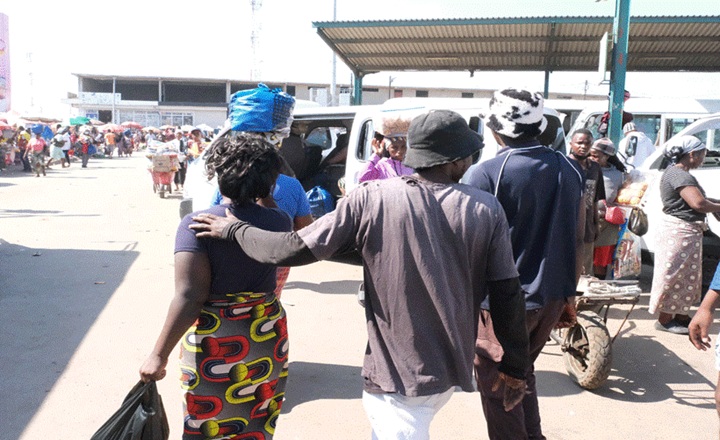
On the hot, dusty streets of Mozambican cities, the sun beats down with a weight that isn't just heat—it's the weight of survival. There, amidst honking horns and shouts, the Modjeiros rise up: the voices of a faceless, homeless class that has become a mirror of urban poverty. They are young people pushed by the waves of unemployment, by the disillusioned promise of a future that never arrived. Amidst the chaos of traffic and the rush of others, they survive with every scream, every stalled car, every metical earned through sweat and desperation.
Urban poverty in Mozambique isn't just a lack of money. It's an open social wound, visible on street corners where concrete mixes with mud, and where dreams mingle with bottles. According to recent data from the National Institute of Statistics, more than 42% of young people between 18 and 35 in Mozambican cities are unemployed or underemployed. Of these, the majority survive on informal activities: carrying bags, selling at dumba-nengues, washing cars, or calling passengers at terminals—the Modjeiros. Others have subsistence jobs, so precarious that their wages barely cover the cost of a modest dinner.
Modjeiro is, therefore, the starkest face of this reality. He is the result of an economic system that excludes and a State that pretends not to see. He is the son who had no godfather in the party or a place in the civil service exam. He is the survivor of a country that raised him to dream, but gave him no ladder to climb.
José Jorge, 26, lives in the Jardim neighborhood. He's been a modja for eight years—a term that, in urban slang, means calling out passengers at terminals, pointing to cars, and vying for attention with a hoarse voice and firm gestures. "I've tried several companies, but everything's a scam there," he says with a bitter smile. "At least here I earn a thousand meticais a day, when the day goes well." A thousand meticais—less than twenty dollars for a full day of shouting, shoving, and humiliation.
José has seen it all. Plainclothes police arresting Modjeiros without reason, torture in police stations, humiliation in the name of public order. "Days later, they release us, but it's too late. The shame remains. The anger too." But alcohol is his greatest companion. "Alcohol takes away the shame and gives me the courage to continue Modjar," he says, without looking at the recorder. A drink is the anesthetic of the defeated.
And it's not just him. At the Junta terminal, Manuel Alberto, 38, also drinks before starting his day. "I was a thief. I was arrested several times. Here I found a way to survive without stealing. But the work is hard, the heat is intense, and the police's anger is worse. So we drink." Alcohol, they say, helps endure hunger and humiliation. It's a formula as old as poverty.
The Modjeiros phenomenon is deeply linked to the youth employment crisis. In Maputo, Matola, Beira, and Nampula, more than 70% of urban jobs are informal, according to the World Bank. It's the empire of improvised survival. And when the State is absent, chaos becomes institutionalized. Young people who should be the engine of development become pieces on an invisible board, where every day is a battle against oblivion.
Daniel Nasson, 34, a former military man, became a Modjeiro after two years without a job. "I finished my military service and thought I'd get a job in some ministry. I waited and waited, and nothing. I stopped by, saw the guys working, and joined." Today, he earns an average of 500 meticais a day, when the movement helps. He lives with his parents, divorced, and has two children. Alcohol is also part of the ritual. "It helps us forget that we failed."
The truth is that many of these young people didn't fail: they were failed by the system. A system that pushes them into informality and, at the same time, criminalizes them. The arbitrary arrests, reported by almost everyone, show how much the Modjeiro is a victim of a State that wants him invisible. When robberies occur at bus stops, the police arrest the Modjeiros—not based on evidence, but on presumption. The next day, they are released, and the cycle begins again. They are guilty for existing.
The drama goes beyond economics. It's also a matter of public health and moral degradation. Alcohol consumption among urban informal workers has increased significantly in the last decade. According to the National Health Observatory, almost 60% of young informal workers consume alcohol regularly, and in 25% of cases, excessively. Alcohol has become the social lubricant of misery: it unites, consoles, and destroys.
In the terminals, the smell of cheap gin mingles with the smoke from the cars and the sweat from the bodies. It's the perfume of survival. Some drink in the morning, others at the end of the day, but everyone drinks. Alcohol isn't just an addiction, it's a language of resistance—a silent cry against a country that has forgotten them.
Behind this phenomenon lies a larger problem: the lack of effective public policies for youth employment. Government integration programs are often propaganda-based and short-lived. They promise training but offer illusions. Small local entrepreneurial initiatives are swallowed up by bureaucracy and institutionalized corruption. And meanwhile, the Modjeiros continue to shout out destinations, not because they believe in them, but because they have no other option.
Urban poverty, in this context, isn't just economic: it's moral, it's existential. It's not just empty pockets, it's a weary heart. It's the father who can't afford his son's uniform, the mother who takes refuge in church, the young person who chooses alcohol because the dream has become unbearable. The city that should welcome, expels. And the terminals become refuges, veritable trenches of everyday life.
In Mozambique, there's much talk of economic growth, foreign investment, and megaprojects. But little is said about what this means for the young man who wakes up at five to build his own house. Progress is a concept that doesn't fit into his reality. The man who lives in Mozambique doesn't see the light of the gas pipelines or taste the gold of Cabo Delgado. His is a different country: one of broken sidewalks, broken promises, and empty bottles.
The moral degradation that many associate with drinking is also a reflection of a state that has lost its sense of social justice. When young people need to get drunk to get through the day, we're not facing a problem of character, but of human dignity. When a citizen is arrested for trying to make a living from their own efforts, the problem isn't the street—it's the system.
Modjeiro is the sad poet of Mozambican cities. His verse is a scream, his stage is the terminal, his microphone is the bottle. He lives in a cycle that mixes rage, resignation, and courage. There is no union to represent him, no law to protect him. But there is a raw beauty in him, an ancestral strength that makes him return the next day, even knowing the future is not there.
Until the state addresses the Modjeiros, urban poverty will continue to be a specter that haunts cities. Because they are not the problem—they are the symptom. They are the mirror of a country divided between those who have everything and those who have nothing. The Modjeiro is the face of this contradiction: poor, marginalized, but stubbornly alive.
And perhaps this is the lesson the Modjeiros leave us: dignity cannot be bought, inherited, or decreed. It can be built, even with hoarse voices and weary steps. At the end of the day, when the sun sets on the hot asphalt, they remain there, calling for cars, defying oblivion. Not because they believe in a future, but because giving up would be death.
And in the country of urban poverty and moral degradation, staying alive is the most revolutionary act left to them.
Outras noticias
Culture
Launched at BCI, a book that immortalizes memories and humor of Zambézia
2026-10-02
Society
International Coffee Day
2026-10-02

Society
Minister Mathlombe squanders his term on empty promises
2026-10-02
policy
Constitutional Council Awards Purchase of Luxury Vehicles for 49.5 Million Meticais
2026-10-01
Culture
International Coffee Day: Aroma, Flavor, and History
2026-09-30
Copyright Jornal Preto e Branco All rights reserved . 2025