
“I use art as a means of communication”- Fredy Uamusse
.jpg)
In the context of the growing awareness of environmental awareness in Mozambican society, it is essential to promote reflections that contribute to the adoption of more sustainable practices in the treatment of solid waste. This challenge is particularly sensitive in urban centers, where garbage containers assume a dual function: on the one hand, the final destination for household waste; on the other, a source of survival for many people in situations of extreme need.
This is the setting for the art of young Fredy Uamusse, a 24-year-old Mozambican visual artist from Maputo. Umusse has used his art as a powerful tool for raising social awareness. In one of his most recent works, he portrays a family sitting next to a garbage container, sharing a meal. The image makes a direct appeal: to think twice before throwing away poisoned food, as it can pose a real danger to people who, without alternatives, resort to urban garbage to ensure their daily sustenance.
The artist does not point the finger. On the contrary, he acknowledges that many of the housewives who throw away contaminated food do not do so out of malice. Often, they are not even aware of the consequences that their actions can have on an invisible and infinite chain of people who depend on what others throw away.
More than just a denunciation, Fredy Umusse's work is an invitation to empathy, social responsibility and the construction of shared solutions. Throughout this great interview, the reader will have access to valuable insights into how art can transform consciousness, provoke reflection and inspire profound social change.
Who is Fredy Umusse?
I am a Mozambican artist, originally from Maputo, and I am currently 24 years old. Recently, I have been developing innovative techniques, working with conventional and unconventional materials. I have been standing out on social media as a social artist, with the aim of representing my country nationally and internationally.
According to your latest post, it depicts a family sitting next to a garbage bin having a meal. Who is your target audience?
The target audience for this work is the general public. We live in a society with profound inequalities, where there are people with good living conditions, but also many who live in the open, without any shelter. This image aims to raise awareness about the way food is discarded, and how this directly affects people in vulnerable situations. The work received mixed opinions. Some people questioned why someone would eat from the trash, as if this choice were simple. But the truth is that there are those who have no other option. The trash can sadly becomes a resource. I am not supporting this practice, but portraying a harsh reality that many prefer to ignore. Therefore, it is important to develop awareness. We have seen, for example, at parties, where there is a lot of food left over. There are people who already have the practice of storing this food in clean bags, aware that others may need it in the future. We should not assume that only irrational animals feed on trash — there are human beings there too, and this needs to be taken into account.
Looking at this image, what is your expectation?
As an artist who works with social causes, I use art as a means of communication. Instead of simply sharing a phrase that said “don’t throw poisonous food in the trash, because there are people who eat it there”, I chose to illustrate it. With this, I wanted to touch hearts, even the hardest ones, and awaken a sense of responsibility. Many people are aware of the need for good, but don’t know how to practice it. Art serves to provoke this reflection.
Your publications revolve around everyday life and situations such as the post-election period or the vulnerability of many Mozambicans. Why?
My art is my form of expression, my cry. Others write songs, protest, I draw. Some people think that I only depict negative situations to make an impact, but I also portray positive attitudes. For example, I have drawn a police officer helping a child cross the street, or a driver who has stopped to give way to pedestrians. I do this to encourage good.
What do you think should happen between those who deposit and those who collect garbage?
There is a saying that education does not change the world, but it changes people — and people change the world. We have basic hygiene rules, with colored bins for different types of waste. The brown one is for food scraps. If we all used these bins correctly, we could create an organized system where discarded food is separated from hazardous products.
We could also identify trash cans with universal symbols such as “danger,” so that even those who cannot read can see the risk. This would bring more safety to the most vulnerable. It is the role of the City Council to promote this organization.
In some contexts, waste generates wealth. Want to comment?
My spiritual leader, Apostle Onório Gabriel Cutane, says that we should use circumstances to our advantage. For example, poisoned food could be collected for laboratory study, creating scientific knowledge about food poisoning. Recyclable waste can also generate sustainability. I myself use recycled plastic in my works — what was thrown away becomes art and can be sold. This is not only a personal advancement, but a contribution to the development of my country.
Final considerations.
I am grateful for the opportunity to present theoretically what I express in practice through my art. I believe that the path is always forward. And that, with respect and positive intention, we can build a better country for everyone.
Outras noticias
Culture
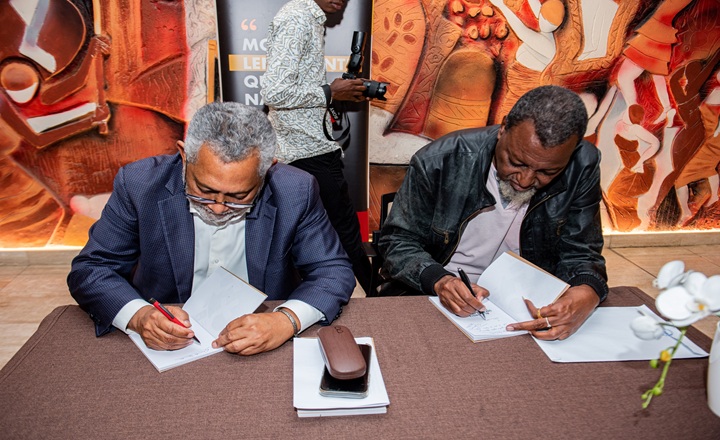
Launched at BCI, a book that immortalizes memories and humor of Zambézia
2026-10-02
Society
International Coffee Day
2026-10-02

Society
Minister Mathlombe squanders his term on empty promises
2026-10-02
policy
Constitutional Council Awards Purchase of Luxury Vehicles for 49.5 Million Meticais
2026-10-01
Culture
International Coffee Day: Aroma, Flavor, and History
2026-09-30
Copyright Jornal Preto e Branco All rights reserved . 2025