
“Children of the Traffic Lights”: Childhood lost at Maputo’s intersections
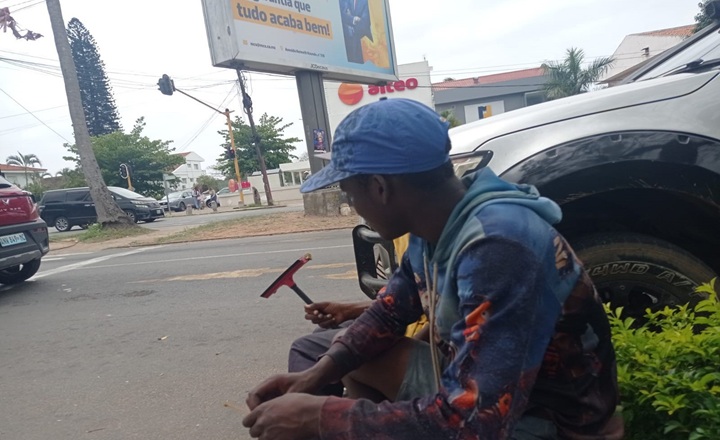
Under the blazing sun of the Mozambican capital, amid the roar of engines and the impatient flashing of red lights, a silent scene of struggle and survival unfolds. Boys and teenagers cleaning car windows at traffic lights—anonymous faces of urban poverty that has become part of the landscape of Maputo's main avenues.
Among them is Armando José Marcos, 16, a resident of the Costa do Sol neighborhood. For a year and a half, he's been wielding a rag and a bucket of water, a makeshift job that helps him earn his daily bread. "My earnings vary," he tells us. "Some days I make three or seven hundred meticais, but when someone comes along who appreciates our work, I make up to a thousand meticais."
Armando studied at the Triunfo neighborhood school, but poverty hindered his progress. "I couldn't afford school supplies. I stayed home for a while, until I saw other kids leaving in the morning and returning in the afternoon with groceries. I went to see what they were doing and realized they were cleaning windows at traffic lights."
With his gaze fixed on the horizon, the young man reveals a paradox that only poverty can explain: "While the peasants pray for rain, here we pray to the heavens that the sun never fails. Rain is our greatest enemy."
Despite his apparent courage, there's regret in his tone. Armando dreams of returning to school. "I want to go back to school. I want to learn so I can face life differently," he says, a silent plea for social support.
The generation of crosses
Another young man, known only as Pai, is 18 years old and experiencing the same situation. He leaves the Maxaquene neighborhood every day for the main avenues, where he spends hours among cars. He's been cleaning windows for three years. "I dropped out of school in ninth grade, for no particular reason. I just stayed on the streets," he confesses.
On good days, he takes home about three hundred meticais. On bad days, he returns empty-handed and with stories of violence. "When the weather is bad, it's difficult. Some drivers insult us and say we're dirtying their cars. And lately, the police have been taking almost everyone to the station. After two days, they release us, but we always come back because we have nowhere else to go."
The portrait of urban poverty
The stories of Armando and Pai are just two among hundreds of children and adolescents who survive on the streets of Maputo, a direct result of urban poverty fueled by unemployment, abandonment, and structural inequality.
The Mozambican capital has become the epicenter of a silent rural exodus. Entire families are abandoning the countryside, driven by drought, lack of opportunities, and precarious basic services. They arrive in the city with hope, but find a different kind of desert—that of exclusion. Without access to education, formal employment, or decent housing, many young people end up at the mercy of fate, becoming small-scale street entrepreneurs: street vendors, porters, car park attendants, and window cleaners.
These occupations, though illegal, represent the last bastion of dignity for those the state has forgotten. These are children who should be in school, but who have found in traffic lights a makeshift classroom where the lesson is simple and cruel: survival.
Between risk and addiction
Life on the streets takes a heavy toll. Many of these young people end up trapped in a cycle of addiction and marginalization. Alcohol, prostitution, and drugs serve as an anesthetic against the cold, hunger, and fear. "Some kids sleep at bus stops, others gather in groups to share their earnings. At night, the danger is different: robberies, abuse, and violence," says a resident of the Malhangalene neighborhood, who observes the window cleaners' routine.
According to unofficial data collected by social organizations, the number of minors engaged in informal activities in Maputo has grown significantly in the last five years, coinciding with the worsening economic crisis and the rising cost of living.
Vulnerability is even greater among orphans and children of single-parent families, often left to their own devices after the death of their parents due to illness, accidents or forced displacement.
A childhood hijacked by inequality
The phenomenon of window cleaners is, in fact, a reflection of a society in moral and structural collapse. It represents the failure of public social protection policies and the helplessness of a state that, instead of welcoming them, criminalizes poverty. When the police take these young people to police stations, the problem isn't solved; it simply postpones their inevitable return to the streets.
The city, which claims to be modern and touristy, lives daily with a child begging for dignity at intersections. They are the children of exclusion, broken promises, and soulless urbanization. In every wet rag and clean window, there is a story of resistance, but also a muffled cry of hope.
Tomorrow it might rain
Before saying goodbye, Armando looks up at the cloudy sky and says, half joking, half seriously: “I hope the sun comes back tomorrow. If it rains, there will be no bread.”
Her innocent smile hides the tragedy of a generation that learned too early what it means to fight for survival not by choice, but by abandonment.
On the corners and at the traffic lights of Maputo, the future of Mozambique awaits a second chance.
Outras noticias

Culture
Launched at BCI, a book that immortalizes memories and humor of Zambézia
2026-10-02

Society
International Coffee Day
2026-10-02

Society
Minister Mathlombe squanders his term on empty promises
2026-10-02

policy
Constitutional Council Awards Purchase of Luxury Vehicles for 49.5 Million Meticais
2026-10-01

Culture
International Coffee Day: Aroma, Flavor, and History
2026-09-30
Copyright Jornal Preto e Branco All rights reserved . 2025