
Bobole: Between Nghalundi Xikocamani and Post-Election Violence
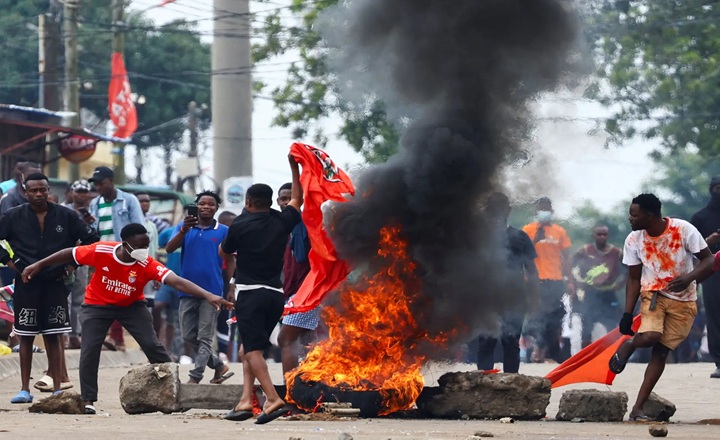
A territory marked by the memory of war, the arrival of the “winds” and the abandonment of the State
For a long time, Bobole was merely a stopover on National Road No. 1 (EN1), a trading post shaped by the oral history of its founders and the harshness of the civil war. Today, the name Bobole resonates in another context: that of violence in post-election protests. What explains this shift from a "safe haven" during the war to a stage of destruction and confrontation? To understand this phenomenon, we revisited Bobole's origins and spoke with two guardians of its memory: Rodrigues Xirindza (77), founder of the local market, and Rafael Gaduane Manhiça (69), counselor and founder of the commercial space.
Nghalundi Xikocamani: before being Bobole
The story of Bobole doesn't begin with its current fame, but with the original name given by the community itself. According to Rodrigues Xirindza, "this area is actually called Nghalundi. The name Bobole came from the influence of the Portuguese, due to the river that flows here. But we always call it Nghalundi Xikocamani, because the water here flows in a special way." The Bobole market was established in 1983, on the banks of the Incomáti River, but was soon moved to the border area between Marracuene and Manhiça. Disputes between neighboring communities delayed its permanent establishment. Only in 1985, along the EN1, did the market find its place—and there it remains as the economic heart of the area.
War and the mark of the commandos
During the armed conflict, Bobole assumed a peculiar status. According to Rafael Manhiça, "with the arrival of the Commandos, Bobole became a safe zone. There was a large camp here for displaced people." Security, however, came at a high price: local militiamen died defending their homeland, the police suffered heavy casualties, and only the Bobole Commandos managed to discipline the 'Armed Bandits.' Many of these commandos ended up putting down roots in the community, forming families that still live peacefully with the natives today. This memory of collective resistance still shapes Bobole's identity: a space of struggle, where survival was achieved through force.
Disorderly urbanization and the “winds”
Over time, Bobole ceased to be merely a refuge and became a destination. Urban growth brought new inhabitants from neighborhoods like Maxaquene and Mafalala in Maputo, as well as other areas of Matola. According to the elders, the arrival of these groups altered the social dynamics: "The people who cause problems in the protests are not native to this area. They are outsiders, people who came with a different mentality. The government gave them space to settle. Our children, unfortunately, adopt this behavior and then return home bringing shame to their families," explains Xirindza. The disorderly urbanization, marked by precarious buildings, poor sanitation, insufficient schools, and a lack of basic services, created increasing social pressure. The traditional community, structured by the cohesion of local values, found itself mixed with new cultural codes brought from outside. This fusion did not always translate into harmony; on the contrary, it opened the way for social tensions and an increase in violence.
Bobole and post-election violence
In recent years, Bobole has been frequently cited as the epicenter of violence in post-election protests. Burned cars, destroyed businesses, clashes with police, and episodes of vandalism are common. But, according to the elders, the explanation cannot be reduced to political confrontation: "When my son participates in these protests and comes back, I feel ashamed. He might have burned his neighbor's car. It's not just the government's or the police's fault. It's also the mentality of these young people, which has already germinated here in Bobole," Xirindza laments. The state's neglect—reflected in the lack of investment in infrastructure and public services—fuels this climate of frustration. Young people, lacking clear alternatives for employment, leisure, or civic participation, find expression in the protests, albeit a violent one. This scenario cannot be seen solely as a result of the signs of post-election violence but also as evidence of a growing political culture, especially in a democratic context marked by political intolerance and a tragic governance that has left many young people unemployed. Aware of the importance of National Highway No. 1 in the country's economy, the population of this location uses its strategic position to make itself heard by blocking the passage of goods and passenger vehicles, leaving an image of chaos.
Between memory and future
The story of Bobole shows how memories of war, disorderly urbanization, and the absence of effective public policies intertwine to shape a tense present. The space that was once synonymous with collective security is now seen as a hotbed of instability. But it's not just about violence. It's about understanding the deep roots that fuel it. By revisiting Nghalundi Xikocamani and listening to the voices of its guardians, we realize that Bobole is more than the label of violence attributed to it. It is also a territory of resistance, of shared memories, and of communities searching for a dignified place in the present. Reflecting on Bobole can thus lay the foundation for a broader debate on the challenges of urban growth in Mozambique, on the state's responsibility in providing basic services, and on the impact of historical memory on how communities relate to violence.
Bobole, therefore, is not just a dot on the map. It is a living metaphor for the complexities that permeate the country: the struggle for survival, institutional fragility, the arrival of new social actors, and the need for reconciliation between past and present. Understanding Bobole requires a critical look at the margins of the EN1 and the Mozambican nation itself.
Outras noticias
Culture
Launched at BCI, a book that immortalizes memories and humor of Zambézia
2026-10-02
Society
International Coffee Day
2026-10-02

Society
Minister Mathlombe squanders his term on empty promises
2026-10-02
policy
Constitutional Council Awards Purchase of Luxury Vehicles for 49.5 Million Meticais
2026-10-01
Culture
International Coffee Day: Aroma, Flavor, and History
2026-09-30
Copyright Jornal Preto e Branco All rights reserved . 2025