
A YELLOW CARD FOR THE GOVERNMENT OF SOUTH AFRICA AND CYRIL RAMAPHOSA
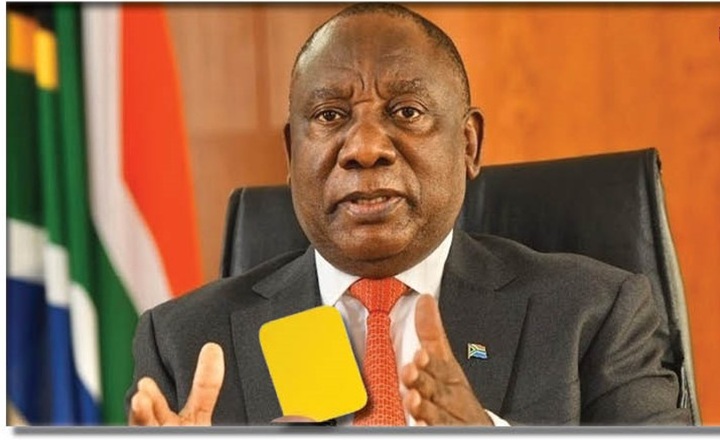
Southern Africa has carried, for decades, a legacy of joint struggle, solidarity among peoples, and the patient building of political and social bridges that sustained the survival of many states during apartheid, the Cold War, and the harshest periods of political instability. However, this legacy has been called into question by the way the South African government, under the leadership of Cyril Ramaphosa, has conducted its relations with neighboring countries, especially Mozambique. This yellow card is not a manifestation of diplomatic disagreement, nor an exercise in gratuitous hostility; it is a necessary wake-up call for a government that seems to forget that economic weight can never replace the moral weight of history, nor the political responsibility of leading with balance a region as sensitive as Southern Africa.
The structuring economic agreements, celebrated with great enthusiasm in public forums, are always presented as proof of regional integration and development. But such agreements lose legitimacy when, at the same time, social and human relations between peoples are neglected and, in practice, deteriorated. Political discourse promises cooperation, but the Lebombo border and other entry points tell a different story: endless queues, recurring humiliations, unequal treatment, and attitudes that often go beyond the simple defense of sovereignty and dangerously approach implicit declarations of superiority. It becomes difficult to ignore the contrast between the affable discourse of the South African President and the daily practice of his border control institutions, which continue to treat Mozambican citizens and those of other African countries as a nuisance to be kept at a distance, almost as if they were not an essential part of the South African economy itself.
This is where the greatest paradox is revealed: South Africa depends, and always will depend, on its neighbors. It depends on them for trade, for the movement of labor, for regional security, and for internal political stability. Even so, the South African government seems to manage these relations with a mixture of arrogance and political calculation, as if it knows that its neighbors, fragile and economically vulnerable, lack the capacity to confront injustice openly. And it is precisely this posture—this complicit silence of the other governments in the region—that causes a political problem to transform into a profound social problem, with a direct impact on the dignity of the people.
The deterioration of social relations between Mozambique and South Africa is neither accidental nor the result of isolated perceptions. It is materialized in concrete episodes, and one of the most serious is the infamous Operation Dudula. Driven by dangerous populism and rhetoric that incites hatred, the operation has served as a catalyst for violence against foreigners, masking internal frustrations with the false narrative that South Africa's socioeconomic problems originate from immigrants, particularly Africans from the region. It is a fragile narrative, built on prejudices and a total disconnect from the facts, but one that found fertile ground in a permissive and, at many times, complicit political environment.
Operation Dudula demonstrated how violence can be normalized when there is no firm leadership and when the State tolerates, even indirectly, movements that endanger human lives and fuel unnecessary resentment. Mozambicans and Zimbabweans have become frequent targets of aggression, persecution, and intimidation campaigns. These actions not only harm individuals; they wound the very history of South Africa, which once depended on the solidarity of these same peoples to free itself from apartheid. It is alarming to observe that this collective memory seems to be being erased, replaced by nationalist discourses that fuel divisions instead of building bridges.
The yellow card also extends to the way the South African government uses border management as a political tool. The constant difficulties imposed on Mozambican travelers are not merely administrative problems; they are forms of disrespect that are repeated to the point of becoming an undeclared policy. Differential treatment, abusive inspections, automatic distrust, and excessive bureaucracy are signs that regional integration is still far from being a reality. A truly integrated region cannot allow the border to function as a place where human dignity is optional.
Cyril Ramaphosa, as leader of a regional power, should assume the responsibility of promoting an environment of genuine cooperation, where freedom of movement, respect for regional treaties, and the valuing of human relations are priorities. However, what we see is ambiguous behavior: on the one hand, formal meetings reinforcing the commitment to SADC; on the other, internal practices that contradict these commitments. When discourse does not match reality, trust is lost, and leadership becomes merely symbolic, without the capacity to inspire or unite.
The governments of the region, including Mozambique, bear part of this responsibility. They watch, with worrying impassivity, the degradation of the well-being of their own citizens on South African territory, as if it were an inevitable price to pay for maintaining economic relations. This passivity becomes even more serious when one realizes that the suffering of the citizens, the so-called common people, is treated as a minor issue. While money circulates among the elites and agreements are signed with pomp, the populations are left to their own devices, facing discrimination, violence, and humiliation.
A yellow card serves as a warning before the game escalates into a larger conflict. This warning is not only for South Africa, but also for the governments of the region that prefer silence. Regional integration cannot be built solely on protocols of intent; it requires political courage, mutual respect, and a firm commitment to human dignity. The violence of Operation Dudula is a symptom of a deeper illness: the inability of states to protect the principles they claim to defend.
The historical relations between Mozambique and South Africa are too important to be left to the mercy of social tensions that could be avoided with responsible leadership. It is necessary to reclaim the spirit of solidarity that marked the liberation of the region. South Africa needs to understand that its leadership will only be recognized if it is exercised with humility, respect, and a sense of community.
This yellow card is, therefore, an urgent appeal to Ramaphosa and his government: that they react, that they rethink their stance, and that they rebuild relations with neighboring countries based on respect. If the region is to move towards a future of true integration, then the people need to be seen as protagonists, not as obstacles. Only in this way can Southern Africa be transformed into a space of real cooperation, where human dignity is non-negotiable and where the history of shared struggle is not betrayed by political arrogance or diplomatic indifference.
Outras noticias
Culture
Launched at BCI, a book that immortalizes memories and humor of Zambézia
2026-10-02

Society
International Coffee Day
2026-10-02

Society
Minister Mathlombe squanders his term on empty promises
2026-10-02
policy
Constitutional Council Awards Purchase of Luxury Vehicles for 49.5 Million Meticais
2026-10-01

Culture
International Coffee Day: Aroma, Flavor, and History
2026-09-30
Copyright Jornal Preto e Branco All rights reserved . 2025