
Philosophy as secular prophecy and public responsibility
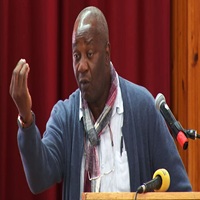
Severino Ngoenha"
When the public temple is in ruins, silence ceases to be prudent
During the presentation of the Memento for Mozambique, there was a phrase that, due to its symbolic and philosophical depth, immediately transcended the context of the event.
Dom Ernesto Maguengue stated that I should continue to be our "secular prophet": not a king, not a priest, but a prophet.
The phrase is powerful. And it's even more powerful because it comes from a bishop. At first glance, it might seem like just a happy image, an elegant metaphor, a generous way of characterizing the public function of a philosopher. But that's not what happened. Dom Ernesto's formulation carried a much deeper conceptual architecture. It didn't just say something about me. It said something about philosophy itself. It said something about what philosophy should be when it is born in a wounded country, in a time of uncertainty, and in a society that is still searching for its common language.
Dom Ernesto spoke not only as a theologian. He spoke as someone who, having traversed theology, never abandoned philosophy. In his intervention, one sensed the rigor of an intellectual formation marked by the discipline of the concept, by attention to the right word, and by the requirement not to confuse emotion with thought. Those who listened to him realized that they were not witnessing a pious or perfunctory reading of a book, but a true philosophical exercise.
His presentation was, in that sense, extraordinary. He didn't just say what the book was about. He went further. From the height of his episcopal chair, Dom Ernesto seemed to be telling us what philosophy in Mozambique should be. He seemed to be reminding us that philosophy is not academic ornament, nor a luxury for specialists, nor a belated importation of foreign vocabularies. Philosophy is a form of public responsibility.
In saying that the philosopher must be a secular prophet, Dom Ernesto rejected two temptations. The first is the temptation of the king. The king represents power, administration, command, proximity to the system. The king governs, decides, distributes, preserves, or transforms through institutional authority. The second is the temptation of the priest. The priest represents the guardianship of the rite, the administration of symbolic continuity, the consecration of an order.
The philosopher, however, when faithful to his most demanding vocation, should not aspire to rule like a king, nor to be consecrated like a priest. He should remain in that difficult, external, and necessary place, from which he can say to power what power does not want to hear, and to the community what it often prefers to forget.
This is where the image of the prophet becomes crucial.
The prophet is not one who predicts the future like a fortune teller. The prophet is one who reads the present with such intensity that he makes visible the future that is being prepared within it. The prophet is one who breaks with false normality. He is one who interrupts collective anesthesia. He is one who reminds the people of their responsibility when the people take refuge in forgetfulness. He is one who reminds the powerful of their debt when the powerful hide behind the language of order.
That is why the evocation of the prophet Haggai became fruitful. Haggai is the prophet of the temple. His word is brief, but incisive. He does not need grand systems to say what is essential. He finds a community returned from exile, divided between rebuilding their private lives and abandoning their common home, and he compels them to ask: how can each one comfortably inhabit their own house while the temple remains in ruins?
When transported to Mozambique, the question takes on a particular significance.
The temple, here, is not just a religious place. The temple is the public thing. It is the common space. It is the Republic. It is the school, the hospital, the road, justice, public discourse, shared memory, the dignity of citizens, the possibility for every Mozambican to recognize themselves in the country that names them. The temple is everything that does not belong to anyone in particular because it must belong to everyone.
And it is precisely this temple that is so often found in ruins.
When Dom Ernesto speaks of the secular prophet, he is indicating that philosophy has a public function of reconstruction. Not a technical, administrative, or partisan reconstruction, but a reconstruction of language through which a people comes to understand itself again. A society is not reconstructed only with roads, bridges, institutions, and elections. It is also reconstructed with words. It needs an alphabet, vocabulary, and grammar. It needs names for its wounds. It needs concepts for its injustices. It needs categories to distinguish peace and armistice, conciliation and reconciliation, belonging and exclusion, State and Republic, power and service, memory and forgetting.
This was one of the highest dimensions of Dom Ernesto's reading. He understood that the Memento for Mozambique is not simply a book that offers information. It is a book that provokes. It doesn't add data to what we already know. It forces us to acknowledge what we know and yet prefer not to admit.
That is why the issue of forgetting becomes central.
There are innocent instances of forgetfulness, inherent to human frailty. But there are also instances of forgetfulness that are manufactured, organized, and managed. There are instances of forgetfulness that marginalize. There are instances of forgetfulness that protect privileges. There are instances of forgetfulness that structure social, political, and economic life. When a society becomes accustomed to forgetting its excluded, its vanquished, its dead, its humiliated, and its abandoned, forgetfulness ceases to be a failure of memory. It becomes a form of governance.
Dom Ernesto understood this with rare clarity.
Therefore, her intervention was not limited to presenting a book. She raised a larger question: what kind of philosophy is needed for a country like Mozambique? The implicit answer was demanding. We don't need a philosophy that asks for permission. We don't need a philosophy that comes from outside to confirm our legitimacy. We don't need a philosophy that merely repeats foreign vocabulary to appear universal. We need a philosophy capable of thinking from within Mozambique, not against the world, but in the face of the world; not as intellectual provincialism, but as an exercise of cognitive sovereignty.
Mozambique is not just an object of study. Mozambique is a place for thought.
This statement is crucial. For too long, many African peoples have been transformed into raw material for the knowledge of others. Others came to observe, classify, interpret, name, and explain. We appeared as experience, as a case, as a problem, as territory, as statistics, as suffering. But we rarely appeared as the originating place of concept.
Dom Ernesto's intervention breaks with this hierarchy. It affirms that thinking from the perspective of Mozambique does not diminish philosophy. It restores to it one of its oldest tasks: to question the concrete existence of men in their time, in their city, in their pain and in their hope.
There is a profound proximity here between true theology and true philosophy. Both know that the word is not neutral. Both know that to name is to hold accountable. Both know that a community that loses its language also loses part of its public soul. But the greatness of Dom Ernesto's intervention lies precisely in not confusing the roles. He did not seek to Christianize philosophy. He did not reduce reflection to catechesis. He did not transform the book into an occasion for religious moralism.
On the contrary, he recognized the need for a secular prophecy.
This expression is highly intelligent. It preserves the critical force of the prophetic tradition, but removes it from the confessional temptation. Secular prophecy does not speak in the name of religious revelation. It speaks in the name of the public demand for truth, justice, memory, and responsibility. It is a mature form of relationship between faith, reason, and the public sphere. Faith does not seek to dominate reason. Theology does not seek to capture philosophy. But neither does it remain silent in the face of the degradation of the common word.
Perhaps this is the greatness of Dom Ernesto's gesture: from the place of his episcopal chair, he came not only to say who I am. He came to say what a philosopher should be.
The philosopher must create language where public language has degraded. They must create vocabulary where propaganda has replaced thought. They must create grammar where coexistence has lost its syntax. They must remember where forgetfulness has become comfortable. They must ask who is protected by the umbrella of the Republic and who remains exposed to the rain. They must question who holds the handle of that umbrella, which way it leans, who is covered, who is left outside, and why exclusion repeats itself even when the discourses change.
But the philosopher must do all this without becoming a king and without taking refuge in the priesthood.
If one becomes king, one loses critical distance. One begins to speak from the logic of conservation, administration, calculation, and convenience. If one becomes priest, one risks consecrating the existing order, transforming order into destiny, offering consolation where interpellation would be necessary. The secular prophet, on the contrary, inhabits a responsible exteriority. He is outside the system, but not outside the people. He is distant from power, but not indifferent to the common destiny. He speaks from the margins, but speaks to the center of collective life.
Mozambique needs this figure.
We need philosophers who are not mere functionaries of legitimation. We need intellectuals who do not confuse prudence with silence. We need academics who do not transform rigor into escapism. We need a public voice capable of uniting lucidity and responsibility, criticism and hope, memory and the future.
That is why Dom Ernesto's intervention should be welcomed.
Not only because it was brilliant. Not only because it was eloquent. Not only because it involved a profound reading of a philosophical work. But because it offered a demanding picture of the relationship between philosophy, country, and public responsibility. It showed that theology can encounter philosophy without diminishing it. It showed that a bishop can recognize, in a philosophical work, not a threat to faith, but an ally of human responsibility.
The phrase "secular prophet" will likely remain one of the strongest formulations of that moment. But it should not be read as personal praise. It should be read as a summons. It is not about saying that one man alone should occupy this place. It is about understanding that philosophy in Mozambique, if it wants to be up to the task of its time, must accept this difficult vocation: to be a word that remembers, a thought that unsettles, a language that reconstructs, a critique that does not destroy for pleasure, but that dismantles falsehood to make a common home possible.
The prophet Haggai called the people to rebuild the temple.
The secular prophet, today, calls us to the reconstruction of the Republic.
And the Republic is not rebuilt solely through legal reforms, political agreements, or institutional promises. It is also rebuilt when we courageously ask ourselves: what words are missing to tell the truth about our country; what grammar is lacking for us to live together again; what memory do we need to recover; what forgetting do we need to interrupt; what umbrella do we need to straighten so that no one continues to be condemned to live outside the common protection.
Dom Ernesto understood that the Memento for Mozambique is a small book with a great demand. Like Haggai, it doesn't need many verses to touch on the essential. His gesture is simple and radical: to remind. To remind that the Republic is only a Republic when it encompasses everyone. To remind that philosophy is only philosophy when it doesn't ask permission to think. To remind that Mozambique is not only a place of suffering or crisis, but also a legitimate place of thought, conceptual creation, and public prophecy.
That is why Dom Ernesto's message must be prolonged.
It doesn't belong merely to the event of a book launch. It belongs to the larger debate about what Mozambique expects from its philosophers, its theologians, its universities, and its intellectuals. It expects them not to be kings. It expects them not to be priests of the existing order. It expects them to be, each in their own way, restless guardians of common possibility.
Because when the public temple is in ruins, silence ceases to be prudent.
It becomes complicity.
2025/12/3
Copyright Jornal Preto e Branco All rights reserved . 2025
Copyright Jornal Preto e Branco Todos Direitos Resevados . 2025
Website Feito Por Déleo Cambula