
Fight for MoçAmbique today
severino Ngoenha"
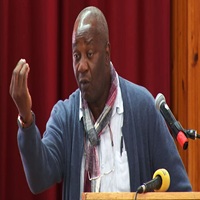
Dialogue with Edson Cortez: institutionaļões, merit, produçion and citizenship I. From growth without transformation to the search for a common project The Philosophical Workshop continued its 2026 cycle dedicated to the theme "Fighting for Mozambique Today," inspired by Eduardo Mondlane's emblematic book. The intention was never to repeat the struggle of a past generation, but to ask what it means, in the present, to continue building the country. The methods have changed, the adversaries no longer have the same appearance, and the challenges have become more diffuse. Today's struggle is not against a clearly identifiable colonial power; it is against everything that prevents Mozambique from transforming its resources, its institutions, and its human potential into a better life for the majority of its citizens. It was within this context that we welcomed Edson Cortez, director of the Center for Public Integrity - CIP. His selection wasn't solely based on his status as a civic activist. It was primarily about hearing from someone accustomed to working on public policy, corruption, the functioning of the state, transparency, and the relationship between economics and citizenship. The starting point was simple: if Mozambique possesses resources, receives large investments, and hosts mega-projects, why does such a significant portion of the population continue to live in poverty? The question is more profound than it seems. For years, the country has been presented as a case of accelerated economic growth. But growth, when it doesn't concretely change people's lives, can become a statistical abstraction. A GDP that grows without producing social mobility, employment, decent public services, and trust in institutions is not yet development. The question then shifts from how much we produce to what that production allows people to do with their lives. It was precisely from this point that Edson Cortez organized his intervention. His argument can be summarized in four main demands: building a collective societal project, strengthening institutions capable of resisting capture, restoring value to merit and equal opportunities, and transforming the economy into a productive one. To these demands he added a transversal political condition: citizenship only truly exists when the citizen can question power without being treated as an enemy. II. The voice of Edson Cortez: six struggles to realize the possibilities of citizens Edson Cortez began with a paradoxical observation: “Mozambique has resources, receives large investments, and hosts mega-projects, but a significant portion of the population remains poor. The question is: why doesn't the wealth of the territory translate sufficiently into prosperity for the people?” For him, the first requirement is to abandon the idea that economic growth and development are synonymous. The economy only acquires political meaning when it concretely increases the life possibilities of citizens. "The true measure of an economy is not just what it produces, but what it allows people to do with their lives." This leads to a second idea: economic discussion cannot be the monopoly of specialists. Exchange rates, currencies, public finances, employment, wages, and investment directly affect daily life. Questioning these policies is not opposition; it is exercising citizenship. “Critically questioning political power is part of citizenship. If we remain silent, we allow others to make decisions that will affect our lives tomorrow.” The second central theme of his speech was merit. A society begins to weaken when citizens believe that effort, study, and competence are worth less than connections, party affiliation, or access to power. "If a young person believes that studying and being the best doesn't open doors for them, but that proximity to power does, they will rationally adapt to that system." The problem is not just moral. It is political and economic. When merit ceases to organize opportunities, trust in society is lost, resignation is encouraged, and social mobility is blocked. Edson Cortez then insisted on a third struggle: the creation of strong and independent institutions. “We need institutions that prevail over individuals. The law cannot change according to who is in power or who is close to it.” A strong institution is not one that concentrates power, but one that limits power. It is one that can say no to those who govern, protect the citizen, guarantee contracts, oversee economic interests, and ensure that the rules apply to everyone. It was also at this point that he linked the future of natural resources to institutional quality. Gas, rubies, or other resources will not automatically produce development. "Gas alone won't produce school desks, build roads, or bring medicine. Everything depends on the institutions that will oversee, collect taxes, distribute, and transform this resource." The fourth requirement was to build a productive economy. The criticism here was particularly harsh. For Edson Cortez, a significant portion of the Mozambican economic elites prefer speculation, proximity to power, and unproductive accumulation to investment capable of creating jobs, transforming raw materials, and expanding the country's productive base. "We don't just need wealth. We need wealth that produces." A luxury house, a car, or several apartments may represent accumulation, but not necessarily development. Productive investment creates jobs, skills, taxes, economic circulation, and a future. The fifth struggle is for equal opportunities. The country can only mobilize its citizens if they feel that they truly belong to the same political space and that the future is not predetermined for a select few. "It is important for every Mozambican to know that, regardless of their political affiliation, origin, or relationships, they have the opportunity to participate and grow." Finally, Edson Cortez insisted on a sixth fight: the right to disagree without criminalization. "Questioning power doesn't make anyone a leader of the opposition. It makes us citizens." No democracy matures without independent investigation, a free press, critical universities, an active civil society, and citizens capable of dissent. Silence may produce apparent tranquility, but it never produces a strong Republic. His conclusion was clear: “Fighting for Mozambique today doesn’t necessarily mean fighting against someone. It means fighting against what prevents the country from realizing the potential of its citizens: weak institutions, corruption, state capture, inequality of opportunity, unproductivity, and resignation.” III. From the wealth of the territory to the wealth of the Republic Edson Cortez's intervention forces us to make a fundamental distinction between having resources and having a societal project. A country can possess gas, rubies, land, logistics corridors, coastline, youth, and still remain poor. Resources do not constitute a destiny; they only constitute possibilities. Between possibility and realization there is always a decisive mediation: the institution. That is why the central problem is not strictly economic. It is political. A society develops when it creates institutions capable of transforming wealth into the common good, merit into mobility, knowledge into productive capacity, and citizenship into effective participation. This was perhaps the most important point of the meeting: Mozambique lacks a sufficiently credible collective project to justify common sacrifices. One cannot ask the population for restraint when those in power fail to set an example. One cannot ask for trust when the rules seem to change according to the protagonists. One cannot ask for patriotism when political affiliation weighs more than competence. A Republic is only consolidated when citizens can recognize in its institutions something greater than the individuals who temporarily occupy them. This is where political philosophy meets economics. Aristotle already knew that politics exists not only to allow people to survive, but to create conditions for a good life in common. Amartya Sen would reformulate this intuition centuries later by showing that development is, above all, the expansion of capabilities: what people are actually capable of being and doing. From this point of view, Edson Cortez poses an extremely demanding question: what capabilities are we really expanding in Mozambican citizens? But the problem has an even deeper republican dimension. Merit, institutional independence, and freedom of criticism are not separate elements. They depend on each other. Where institutions are captured, merit loses value. Where merit loses value, clientelism grows. Where clientelism grows, the citizen learns that he must seek protection instead of rights. And when rights depend on proximity to power, the Republic begins to transform itself into a network of favors. It is precisely against this transformation that we must fight. Citizenship is not just about voting. It also consists of monitoring, questioning, disagreeing, proposing, and demanding accountability. A society that transforms criticism into political enmity slowly destroys the possibility of self-correction. Karl Popper reminded us that an open society is not one in which no one makes mistakes, but one that possesses mechanisms to identify and correct its errors without destroying those who denounce them. Perhaps that is why the issue of productivity is equally political. To produce does not only mean to manufacture goods. It means creating autonomy. A country that imports what it could produce, exports raw materials without processing them, and is structurally dependent on resource income remains vulnerable, even when it experiences economic growth. True sovereignty lies not only in flags or borders. It lies in the ability to transform knowledge into production, resources into development, and institutions into trust. Perhaps we can then summarize the challenge posed by Edson Cortez in a simple formula: it is not enough for Mozambique to be rich; the Republic must be able to transform that wealth into real opportunities for Mozambicans. And perhaps this is one of the most concrete meanings of continuing to fight for Mozambique today: to build institutions that belong to no one because they belong to everyone, an economy that produces instead of merely extracting, a society where merit counts more than proximity, and a public space where disagreeing ceases to be a risk and becomes once again an elementary form of citizenship.2025/12/3
Copyright Jornal Preto e Branco All rights reserved . 2025
Copyright Jornal Preto e Branco Todos Direitos Resevados . 2025
Website Feito Por Déleo Cambula