
Dialogue with Fatima Mimbire
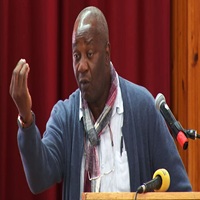
Severino Ngoenha"
Fight for MoçAmbique today: dignity as a conditioņion of the Republic
The Philosophical Workshop continued its cycle of reflections dedicated to the theme "Fighting for Mozambique Today," inspired by Eduardo Mondlane's work of the same name. From the outset, this journey sought to affirm a simple idea: the struggle for independence does not belong solely to the past. Each generation is called upon to reinterpret it in light of the challenges of its own time. National liberation was a historical achievement; the construction of the Republic remains a permanent responsibility.
It was within this context that we welcomed Fátima Mimbire.
Recognized for her reflections on governance, development, and citizenship, her intervention stood out for returning to the founding question of the national project: what kind of Mozambique did we intend to emerge from independence, and to what extent have we remained faithful to that promise?
The response inevitably led to Eduardo Mondlane. In Fighting for Mozambique, liberation never appears as an end in itself. Its true meaning lies in the creation of a society founded on the dignity of the person, social justice, citizen participation, and the primacy of the common good. Political independence opened a historical horizon; it did not conclude the task of nation-building.
It is precisely this distinction that structures all of Fátima Mimbire's reflection.
Fifty years later, the essential question is no longer about celebrating independence, but about whether we have been able to realize the political and moral project that gave it meaning. The gap between the freedom won and the freedom actually lived continues to mark the Mozambican experience.
His intervention thus shifts the debate from the administrative level to the fundamental level. The question ceases to be merely how to govern better and becomes more demanding: what kind of Republic do we want to continue building and what values should underpin its future?
It was precisely from this question that Fátima Mimbire organized her presentation. Her argument developed around five fundamental ideas which, articulated with each other, seek to explain why political independence continues to require patient work in building the Republic.
II. The voice of Fátima Mimbire: completing independence through the construction of the Republic.
Fátima Mimbire's speech revolved around five ideas that are articulated within a single concern: political independence only acquires full meaning when it transforms into a Republic capable of guaranteeing dignity, justice, and participation for all citizens.
The initial idea was to return to Eduardo Mondlane. He recalled that, in "Fighting for Mozambique," liberation was never conceived as an end point. Independence inaugurated a much more demanding historical task: to build a society where political freedom translated into social justice, human development, and civic participation. The question that arises today is therefore inevitable: to what extent do we remain faithful to that founding project?
The second idea placed human dignity at the center of the reflection. It drew attention to the trivialization of violence, exclusion, and poverty, warning that a society begins to lose its moral compass when it ceases to be outraged by what threatens the life and dignity of its citizens. The quality of a Republic is measured, above all, by the way it pays the greatest attention to respect for the human person.
The third idea focused on the autonomy of the State. It observed that many structural options remain conditioned by external dynamics and international financial institutions. Without denying the importance of international cooperation, it questioned to what extent sovereignty can be considered fully realized when a country has a limited margin to define, on its own, the priorities for its deepening national development.
The fourth idea focused on public trust. It warned of the effects of the concentration of wealth, influence, and power, which tends to alienate citizens from institutions and weaken the bond between the state and society. Without trust, it stated, democracy loses consistency; and when the state ceases to be experienced as a common good, the very idea of a republic begins to weaken.
Finally, he defended the need for a new national compromise. Not a compromise based on the logic of victors and vanquished, nor on the perpetuation of past divisions, but a pact broad enough to open a new stage in republican life. A compromise founded on responsibility, the integrity of institutions, mutual trust, and the mobilization of common resources.
In concluding his speech, one particularly strong idea remained: Mozambique's challenges will not be solved solely through institutional reforms or political alternation. They require rebuilding the trust that allows a people to recognize themselves as a community of destiny and to renew, in each generation, the sense of their independence.
It is precisely at this point that philosophical reflection becomes necessary. Because the five ideas presented by Fátima Mimbire lead to a question that goes beyond political diagnosis: how does a community maintain the moral reasons that justify its continued existence as a Republic? This is the question that is now important to develop.
III. Reopening the Republic: Fidelity to the Promise of Independence
The five ideas presented by Fátima Mimbire lead us to a question that goes beyond political diagnosis. Mozambique's problem is not just about how to reform the State or how to improve governance. The deeper question is another: what allows a community to remain faithful to the reasons that justified its birth as a Republic?
This is where philosophy becomes necessary.
A Republic does not live solely on its institutions, its laws, or its administrative capacity. These realities are indispensable, but they do not constitute its ultimate foundation. What truly sustains a political community is the existence of a common moral heritage, strong enough to lead citizens to recognize themselves as co-responsible for the same historical destiny.
It is precisely at this point that Fátima Mimbire's intervention reveals its full depth. In speaking of human dignity, public trust, social justice, state autonomy, and the need for a new national commitment, she is not merely proposing a governance program. She is recalling the principles without which no Republic can remain true to itself.
It was this same concern that I sought to develop in essays dedicated to what I called "thinking together."
A memento is not an exercise in memory nor an invitation to nostalgia. It is an ethic of responsibility. It recalls what a community cannot forget without beginning to lose itself. Because nations do not disappear only when they enter an economic crisis or when their institutions weaken. They begin to disappear when they cease to recognize the values that legitimize their common existence.
Perhaps this is Mozambique's greatest challenge fifty years after independence. It's not just rebuilding infrastructure, reforming institutions, or accelerating economic growth. The decisive challenge is to rebuild trust, restore a sense of the common good, and return the Republic to its moral foundation.
That is why the consensus that Fátima Mimbire speaks of deserves to be understood in a more demanding sense. It is not reduced to an understanding between political forces, nor to a circumstantial compromise between elites. True consensus consists in recognizing that there are principles that precede any dispute for power and that no majority can legitimately destroy: the dignity of the person, the integrity of institutions, justice, public responsibility, and the primacy of the common good.
It is upon these ethical minimums that a community rediscovers its unity. And it is also from them that independence ceases to be merely a historical event and becomes a permanent task.
Perhaps this, after all, is the true meaning of fighting for Mozambique today. Not to repeat the struggles of the independence generation, but to remain faithful to the deepest meaning of its victory. Because independence opened the possibility of the Republic; it is now up to each generation to give it content, direction, and a future.
A Republic remains alive not only through the memory of its founding, but through daily fidelity to the values that justify its existence. It is this fidelity – more than any circumstantial victory – that transforms independence into a perpetually unfinished work and makes the future a shared responsibility.
2025/12/3
Copyright Jornal Preto e Branco All rights reserved . 2025
Copyright Jornal Preto e Branco Todos Direitos Resevados . 2025
Website Feito Por Déleo Cambula