
Xenophobia: Strengthening State Ties, Mozambique - South Africa
Paulo Vilanculo"
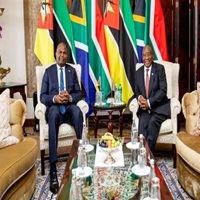
The wave of xenophobic violence that has re-emerged in South Africa since the end of April has reignited an old ghost that continues to mark the country's recent history: the hostility of attacks perpetrated by groups associated with the Zulu ethnic group, with the violence threatening to spread to strategic urban centers such as Johannesburg and Pretoria, this time against all African migrants. Thousands of Mozambicans have once again been turned into scapegoats, in a context of Mozambican economic fragility, high unemployment, and growing social inequality. The President of the Republic of Mozambique, Daniel Chapo, was in Pretoria, the political capital of the Republic of South Africa, for a working visit to the Republic of South Africa as part of the deepening of the historical cooperation relations between Mozambique and South Africa, and especially on security issues between the peoples of the two countries. However, behind the scenes, the Head of State's trip to that neighboring country is interpreted as if the top of the agenda was not only in strengthening cooperation, but also with an emphasis on boosting strategic partnerships in key areas, particularly promoting a safe business environment.
"We are here to talk about our economic cooperation... No country can progress without peace."Daniel Chapo said after the meeting.
Although politically correct in their discourse, in a context marked by recurring xenophobic crises and tensions, they starkly expose the vulnerability and dependence of Mozambicans on South Africa and historical asymmetries. Paradoxically, this tense scenario should open a window for strategic reflection for Mozambique, especially regarding the repositioning of its economy and the redefinition of bilateral relations with its powerful neighbor. With the climate of instability weakening confidence in the South African economic environment, the Mozambican government should rethink its excessive dependence on the South African market, focusing on diversifying trading partners within and beyond the SADC region, motivating Mozambican entrepreneurs to create more robust internal production chains, encouraging local industrialization, and strengthening the domestic market.
It would be legitimate to expect that sensitive issues such as the review of the terms of participation and dividends of Sasol, Eskom and EDM, the contours of the energy agreement in gas exploration in Mozambique, as well as the real fiscal and industrial benefits of Mozal, which is now separating from Beleluane, and the absence or opacity surrounding the perception that bilateral economic cooperation continues to be conducted under an unbalanced logic, where Mozambique frequently assumes a peripheral position, exporting resources and energy at low cost while internalizing few structural gains, which raises an unavoidable concern for a concrete debate on the transparency of Mozambique's structural economic interests in its relations with South Africa, should be frankly addressed and made known to Mozambican society.
“We have always been a people like brothers, it is not in the nature of South Africans to attack other peoples… President Chapo and I are here, we will join our efforts to work together to solve this problem,” Ramaphosa stated in turn.
Cyril Ramaphosa's conciliatory statement, affirming that "we have always been a people like brothers," is in stark contrast to the recurring episodes of xenophobic violence in South Africa, many of which directly affect Mozambican citizens. This narrative of brotherhood clashes with recent historical facts, where the current scenario is not an isolated incident but a cyclical pattern that includes previous attacks associated with local groups, as well as the mobilization of movements like Operation Dudula, whose rhetoric and practices have always fueled hostility against foreigners, especially Mozambicans. The contradiction arises because xenophobia in South Africa is not a direct product of diplomatic failures between countries, but rather of internal structural tensions, including: massive unemployment, persistent inequality, and a feeling of exclusion among sectors of the South African population who see migrants as direct competitors.
The South African crisis is not merely a problem of ethnic or cultural intolerance. It is deeply rooted in internal economic issues, such as chronic unemployment, urban poverty, and the social frustration of a population that, decades after the end of Apartheid, has still not fully reaped the benefits of democracy. The paradox arises when attempting to resolve, at the level of presidential diplomacy, a problem that is essentially socioeconomic, identity-based, and internally political, while ignoring concrete policies within South Africa itself that combat the root causes of xenophobia and hold its perpetrators accountable. The paradox becomes even more evident when the solution to a phenomenon with deep social, economic, and even identity-based roots is reduced to a bilateral political compromise. This approach can also be interpreted as a political strategy in which both leaders demonstrate control of the situation and commitment to regional stability, without necessarily confronting the internal political costs of harsher measures, such as direct repression of anti-immigration movements or profound economic reforms.
“…the expulsion of emigrants is not for Mozambicans and Zimbabweans.”Nguizwe Mchunu, leader of the Zulu,Operation Dudula
Information circulating on social media indicates that the "Dudulas" held a meeting in Nongoma seeking to calm tensions and reach consensus with representatives of black African foreigners.The apparent moderation in Nguizwe Mchunu's discourse, in excluding Mozambicans and Zimbabweans from potential expulsions, should be read with critical caution. Far from representing a structural change, such a position may constitute a strategy of discursive repositioning in the face of internal and international pressure, seeking to soften the image of movements associated with xenophobic violence without altering their ideological bases. The implicit selectivity of "sparing" certain groups does not eliminate the problem, it only reorganizes it, keeping intact the logic of exclusion that sustains hostility against African foreigners. Similarly, the attempt to build "snow pacification" does not necessarily signify a genuine commitment to coexistence, and may serve as a temporary damage control mechanism, while the root causes of inequality, unemployment, political manipulation, and social discontent remain untouched. This is a symbolic shift in a strategic recalibration of the narrative that seeks to legitimize itself without relinquishing its discriminatory territorial core.
Why is it that, paradoxically, the Dudula case against all African migrants will find a solution based on an agreement between Chapo and Ramaphosa?
It seems that Daniel Chapo and Ramaphosa are underestimating or diplomatically circumventing the structural depth of the problem. Acting firmly against radical groups like Operation Dudula could lead to internal political wear and tear, and in the Mozambican case, excessive pressure could weaken strategic economic relations. Any understanding between Chapo and Ramaphosa will likely be more of a gesture of intent than a structural solution. The "solution" anchored in dialogue between Chapo and Ramaphosa tends to be more symbolic and diplomatic than effective on the ground. It is a top-down response to a crisis that originates from the bottom up. It plays an important role in calming bilateral relations, reaffirming political commitments, and avoiding institutional escalation, but it hardly addresses the core of the problem.
Historically, the Mozambican economy has maintained a relationship of dependence with South Africa, whether through the export of labor or the import of goods and services. It is worth remembering that the Secretary of State for Mozambican Communities Abroad, Maria de Fátima Manso, stated until Sunday that there was no information about Mozambican citizens being victims of xenophobia; however, steps are already being taken to support those who may wish to return, with the creation of a transit center at the Ressano Garcia border, in the Moamba district, Maputo province. This potential return flow, far from being merely a social problem, could represent an economic opportunity, provided there are effective public policies for reintegration. Recurring xenophobia cannot continue to be treated as isolated episodes; it is a structural problem that demands structural responses. The situation requires a more assertive political and diplomatic stance from the Mozambican state. Without robust internal policies, effective accountability for perpetrators, and a redefinition of the political narratives that directly or indirectly legitimize exclusion, the discourse of cooperation risks remaining symbolic, while the reality on the ground continues to contradict it.
2025/12/3
Copyright Jornal Preto e Branco All rights reserved . 2025
Copyright Jornal Preto e Branco Todos Direitos Resevados . 2025
Website Feito Por Déleo Cambula