
When will the evaluation of Pinocchio's promises regarding transport and logistics in Mozambique take place
Paulo Vilanculo"
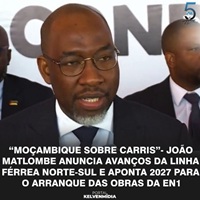
The Minister of Transport and Logistics, João Matlombe, announced on the sidelines of the celebrations of the 51st anniversary of National Independence and in an interview with TV Miramar, that the Government is conducting studies for the implementation of the North-South Railway Line. This is a strategic project that aims to connect the country by rail, strengthening economic integration and improving mobility between different regions.At the time, Matlombe argued that, after political independence, Mozambique should focus its efforts on achieving economic independence.The construction of a railway linking the north to the south of the country has an estimated cost of approximately $7.2 billion. The project historically refers to the Mac Mahon Award, an 1875 arbitration of the border dispute over the Bay of Lourenço Marques/Maputo. On another occasion, the Minister announced the end of the exclusivity of the Mozambique Railways (CFM) in freight management, allowing private companies to directly operate the infrastructure. For the executive branch, the reform aims to "eliminate current inefficiencies and prepare national entrepreneurs" for increasing regional competition, especially from South Africa.Joint work between the State, the private sector and "society", with a view to building a stronger, more inclusive and sustainable economy.Breaking the CFM monopoly opens railways to private operation to "overcome inefficiencies." When promises become excessive, serving only as campaign material for the working class and smelling of conflicts of interest, even the poor become suspicious.
In Matlombe's approach, highlighting the results achieved in the implementation of the Plan during the first 100 days, the strategic projects defined for the 2025-2029 five-year period, some of which are already aligned for implementation in the Economic and Social Plan and State Budget for this year (PESOE - 2025), were discussed. According to the Minister, the Government is giving the Logistics Sector increased responsibility, as its scope of action has been broadened to include road infrastructure, roads and bridges (which encompass public works and housing). For the Minister, this decision completes the functionality of logistics, anchored in maritime, rail, air and road transport. The government requested a review of the Economic and Social Plan to readjust targets and ensure that resources translate into real impacts on citizens' lives. Among the government priorities of the Ministry that Matlombe represents are the improvement of secondary access roads, the construction of storage silos/warehouses, and the direct connection of small producers to large supply markets and national industries. Regarding the National Road (EN1), the minister assures that the contracting process is proceeding normally and that the expectation is to "select the responsible company by the end of this year." According to the Minister, the EN1 works could begin in 2027 and should have an estimated duration of about three years in 2029, which indicates that the current government project will be limited to simple pen-and-paper projects, contracts, and selections that will serve as fallacies and government promises for the governed until the end of the current five-year term. How long will the Ministers continue to sleep in the shadows of paper projects from their rise to power in 2025 until today?
According to a chronicle in Canal de Moçambique, a cardinal sin called "Consulting" has just been invented in the Ministry of Transport and Logistics, headed by João Matlombe. It is said that around 300 million meticais are happily circulating among multi-million dollar consulting firms, while the people continue to only check the price of rice before deciding not to buy it. There's even a consulting firm for "young professionals" valued at almost one hundred million. Almost one hundred million to train young people, as if it were a new partnership and parallel branch of a new "youth and unemployment" program in a country where thousands of young people have already earned doctorates but are proliferating in unemployment. It is said that in the ministry, they ask the minister, "Your Excellency, how does this happen?" The answer: "I didn't know." When two aircraft were detained in South Africa and the company's management confirmed the fact, the official communication went so far as to classify the news about the immobilized planes in South Africa as false, justifying that the planes were undergoing maintenance and repainting to adopt the new corporate image, in addition to adjustments in the company's internal procedures. It is worth remembering that the Minister of Transport and Logistics has been avoiding giving details about the acquisition contracts and the situation of the aircraft, having publicly stated that he was unaware of the financial injection of 2 billion Meticais made into the company. When confronted by the press about the budget for the first Coordinating Council event of his Ministry, the Minister publicly stated that he did not know and justified his lack of knowledge by arguing that financial matters and the signing of checks are not within his direct competence.
These revealing cases involving top figures in Mozambican governance raise serious doubts about the government's ability to guarantee integrity and competence in administrative management. After all, what does Minister Matlombe know about the Ministry he represents? Are we witnessing Pinocchio's Blue Fairy telling lies, making his nose grow with each untruth, turning the people into children? To combat the history of unfulfilled promises and prevent plans from remaining merely on paper, President Daniel Chapo implemented the signing of program contracts, requiring ministers to set concrete goals and responsibilities. The Head of State would then evaluate ministers based on formally signed governance targets, allowing for the measurement of executive performance. What is the schedule for the ministers' performance evaluations? The story of Pinocchio narrates the journey of a wooden puppet carved by the kind carpenter Gepetto. The Blue Fairy gives life to the puppet, granting him the ability to walk and talk, but his nose grows every time he tells a lie. In one of his escapes, Pinocchio ends up on Pleasure Island, where disobedient children turn into donkeys. Trying to avoid truancy, he lies to the Blue Fairy, causing his nose to grow with each untruth. This classic story revolves around moral lessons, mischief, and challenges to turn Pinocchio into a real boy. While patience holds sway, the "dominoes" keep praying.
2025/12/3
Copyright Jornal Preto e Branco All rights reserved . 2025
Copyright Jornal Preto e Branco Todos Direitos Resevados . 2025
Website Feito Por Déleo Cambula