
Twinning of the resilient municipalities of the cities of Beira and Vilanculos, an example of possible local governance
Paulo Vilanculo"
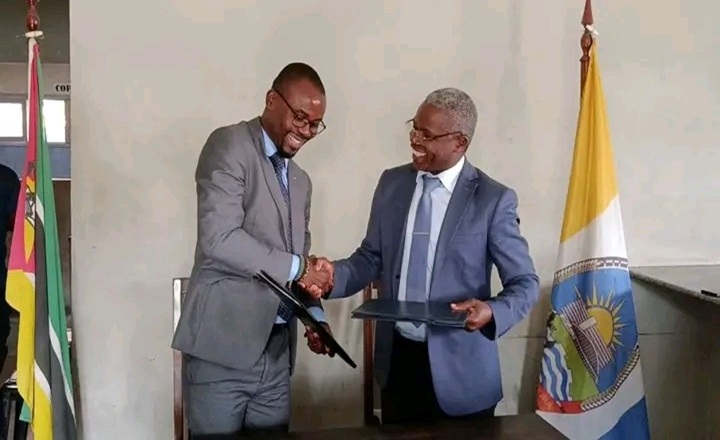
On the 23rd of this month, the cities of Beira and Vilanculos signed a twinning agreement, initialed by their mayors, Albano Carige and Quinito Vilanculo. More than just a formal act, this agreement symbolizes a strategic partnership between two highly relevant hubs for Mozambique: Beira, a rail-port hub of regional and international importance, and Vilanculos, a satellite city of global tourism significance. In a context where decentralization still presents operational shortcomings, twinning proves to be a smart and resilient local governance strategy, capable of designing unique solutions, attracting international partnerships, and creating synergies that boost the country's economic, logistical, and tourism development. On the 23rd of this month, the autonomous city of Beira and Vilanculos took a historic step by signing a twinning agreement, initialed by their respective mayors, Albano Carige (MDM) and Quinito Vilanculo (RENAMO). This agreement, more than a mere formality, represents a bridge of strategic cooperation between two regions that, although geographically distant, share common challenges and convergent ambitions for local development. In a country where decentralization continues to be marked by weaknesses and contradictions, where operational funds are often funneled centrally, and where municipalities rely on insufficient budgetary resources, this twinning arrangement emerges as a smart and unquestionable partnership. This alliance demonstrates that municipalities can, even faced with a deficit, create their own solutions to ensure local development, without being held hostage by the slow pace or limitations imposed by the center. Twinning is an administrative instrument that aims to strengthen the sharing of experiences, cultural exchange, investment mobilization, and the promotion of inclusive and participatory governance practices. Beira, with its importance as an economic and port hub, and Vilanculos, with its internationally recognized tourism, find in this agreement an opportunity for complementarity, capable of generating synergies in areas such as the blue economy, tourism, sustainable urbanization, and environmental risk management. The signing of the twinning agreement also reveals a strategic foundation of convergent interest in the common social good. Beira and Vilanculos, despite their different partisan affiliations and political realities, find in cooperation a space to overcome ideological barriers in favor of the populations they represent. This gesture demonstrates that local governance can be conducted from a broader perspective, where what matters is not party affiliations, but rather the search for concrete solutions to the social, economic, and environmental challenges that directly affect residents. More than that, the act reveals the two councilors' strategy of administrative resilience. Albano Carige and Quinito Vilanculo have shown that, in times of financial and institutional adversity, the solution lies not simply in waiting for central funds, but rather in seeking smart partnerships, both domestically and internationally. By connecting Beira, a city marked by its expertise in climate risk management and its economic centrality, to Vilanculos, a municipality emerging as an international tourism hub, the two leaders open doors to future collaborations with global partners, in areas ranging from environmental sustainability to investment in urban and tourism infrastructure. In a world of profound social and economic challenges, initiatives like this demonstrate that the future can be built collaboratively, sharing knowledge, resources, and visions. It's worth remembering that the city of Beira currently represents one of the most important strategic rail and port hubs in central Mozambique. Due to its privileged location, Beira ensures the flow of goods to hinterland countries such as Zimbabwe, Malawi, and Zambia, serving as a vital link in regional economic integration. Its logistical and port capacity gives it an undisputed central position in trade and transportation chains, making it a strategic asset for the country. Vilanculos, for its part, is consolidating its position as a satellite city, one of the most internationally recognized tourist destinations, thanks to its beautiful beaches and the stunning landscapes of the Bazaruto Archipelago, a World Heritage Site. This status gives it a unique competitive advantage in positioning Mozambique as a sustainable tourism destination, attracting investment flows and placing the country on the radar of major global tour operators. Together, Beira and Vilanculos form a complementary axis of economic and tourism development, capable of projecting Mozambique to new frontiers of competitiveness and international prestige. The twinning of Beira and Vilanculos is, therefore, more than a fait accompli; it is a sign of political and institutional maturity, demonstrating that local authorities can and should be protagonists in the development agenda. The twinning of these two municipalities is therefore not merely a diplomatic gesture; it is a strategic decision that projects Mozambique beyond its borders, strengthening its position in the Southern African economic space and the international tourism market.2025/12/3
Copyright Jornal Preto e Branco All rights reserved . 2025
Copyright Jornal Preto e Branco Todos Direitos Resevados . 2025
Website Feito Por Déleo Cambula