
The resurrection of the grave in the survival of the Mozambican population
Paulo Vilanculo"
Throughout Mozambique's food history, shortly after Mozambique gained independence—or rather, political independence, when the government embraced state management and a centralized economy—in the 1980s, access to food was managed by state-run stores, the "canteens of the elites and the famous inter-franchise shops." On the other hand, the "people's stores" often had empty shelves lacking basic products like rice and beans, a scenario comparable to the current fuel shortage. Just as with fuel today, back then, access to the few food items available depended on spending entire nights in queues, where acquiring cabbage or a bit of mackerel was a relief, and the decade became known in Mozambican memory as the "era of cabbage and mackerel." After independence (1975), the government declared agriculture as the basis of national development, the foundation for ensuring food self-sufficiency and providing raw materials as a driving force for industry. The vision was to break with... Colonial dependency and the eradication of poverty. The focus of the post-Independence period (1975–1989) was the socialization of the countryside, through operational production and later with agricultural cooperatives.
In the 1990s came the Economic Rehabilitation Programs (PRE) for restructuring the base of the economy. Starting in 1998, PROAGRI I was initiated, followed by other programs focused on poverty reduction strategies (PARPA and PARP), with an agricultural focus through PROAGRI II (2006-2010), the Strategic Plan for the Development of the Agricultural Sector (PEDSA), and recently SUSTENTA. Almost all government programs never underwent an evaluation for continuity or to justify their discontinuation. In 2023, the Minister of Agriculture and Rural Development, Celso Correia, stated that in Mozambique, “90 percent of the population had food security, meaning they were able to have three meals a day (…) this is a great success for Mozambicans,” placing the country outside the list of countries at risk of famine. According to the minister, less than 10 percent of the population in the country was experiencing food insecurity, which places Mozambique off the list of countries facing famine. “We are seeing these results, but now our great challenge is to ensure that they are sustainable and to consolidate this principle. Therefore, the work is not yet finished, but we are on the right track (…) continuing on this path (…) now we do need to improve the diet and have more stability in access to food. We are doing everything we can to ensure that supplies are delivered in a timely manner (…), to be able to launch the short-cycle maize and vegetable seeds (…)”, Correia assured in statements made during a meeting with the Director-General of the Food and Agriculture Organization of the United Nations (FAO), Qu Dongyu, in Rome, Italy.
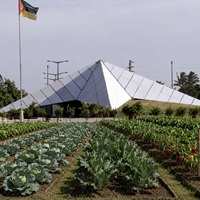
In a revival of the "cabbage era," it is being reported in digital media that on Monday, May 11, 2026, the President of the Republic, Daniel Francisco Chapo, recommended that Mozambican families with fully paved backyards not rule out the possibility of removing or destroying part of the paving and transforming these spaces into small home gardens to produce food, particularly vegetables. In the opinion of the Head of State, removing part of the paving from backyards to produce food would be a strategy to reduce some family expenses and counteract possible impacts resulting from the increased cost of living due to rising fuel prices. Daniel Chapo's suggestion has divided opinions in various segments of society, with some supporting what the President said and others believing that the nation's highest magistrate was unreasonable in suggesting such a measure.
The current Constitution of the Republic reaffirms that agriculture is the basis of development, with the family farming sector playing a crucial role in food security. This vision remains a fundamental premise in the country. What caused the collapse in the continuity of previous agricultural policies to the point where the President appealed to Mozambican families to transform their spaces into small home gardens, a retreat from the incentive for short-term, family-based subsistence farming? Mozambique needs a green revolution, if by green revolution we mean the profound and progressive transformation of institutions and technologies in rural areas, capable of contributing to the growing integration of the rural economy into the national economy. Recent pronouncements by the political and governmental leadership in defense of a green revolution in Mozambique, however enthusiastic they may seem, do not yet reveal sufficient substance and conviction to demonstrate that they represent a genuine commitment to the green revolution in Mozambique.
2025/12/3
Copyright Jornal Preto e Branco All rights reserved . 2025
Copyright Jornal Preto e Branco Todos Direitos Resevados . 2025
Website Feito Por Déleo Cambula