
The President's Christmas: a feast every Mozambican child longs for
Paulo Vilanculo"
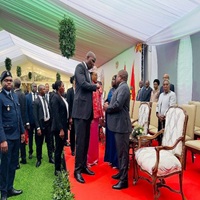
Christmas, as a symbol of sharing, solidarity, and hope, seems to be captured by a political elite who interpret it as a ritual of self-promotion and institutional comfort. For the average citizen, especially Mozambican children, Christmas remains an unfulfilled promise, a distant ideal, observed only through the images of power transmitted in news reports and official speeches. The recent Christmas banquet offered by the Presidency of the Republic to its colleagues, under the symbolic argument of closing a year of mandate, cruelly exposes the distance between official Mozambique and real Mozambique. The central issue is not the holding of a banquet itself, but the deafening silence about the suffering of children that pervades the country. Where are, in the same symbolic space, the children of Cabo Delgado displaced by war, those of Nampula victims of recurring hunger, or those of Sofala and Gaza pushed into urban begging?
The paradox is glaring. Mozambique is among the countries with the highest rates of chronic child malnutrition in the region, with children condemned from an early age to irreversible cognitive, physical, and social limitations. In a country where child poverty has structural and persistent dimensions, the presidential banquet is not merely a protocol act: it is a political symbol. It symbolizes the normalization of abundance for a few, in contrast to the scarcity experienced by millions. Outside the worst areas, in many provinces, hunger is not seasonal, it is permanent. For thousands of children, especially in rural and urban periphery areas, Christmas is not defined by feasts, gifts, or lavish meals, but by the absence of food, basic healthcare, functional schools, and effective social protection. Even so, the political power chooses to celebrate itself, closing cycles of governance with banquets that would be unthinkable for the majority of citizens it claims to represent.
For a country that is a signatory to the United Nations Convention on the Rights of the Child, the holding of a Christmas banquet by the Presidency of the Republic, intended for the governing elite, constitutes a politically shocking and legally questionable act when confronted with the structural reality of hunger, poverty, and malnutrition affecting millions of Mozambican children. This gesture cannot be relativized as a mere institutional protocol; rather, it is an ethical affront and an explicit sign of non-compliance with the international obligations assumed by the Mozambican State. In light of international law, children should be an absolute priority in any public policy. The Convention is unequivocal that States must mobilize "the maximum of their available resources" to guarantee the rights of children.
The contrast between institutional ostentation and child misery is more than morally obscene; it is a clear indicator of the systematic violation of children's rights. While the executive branch celebrates the end of a year in office with abundant food, the State itself fails to ensure consistent school feeding programs, nutritional security in rural communities, and basic social protection for vulnerable children. This disconnect reveals a pattern: the State feeds itself before feeding its children. While the halls of power light up with lavish tables, select delicacies, and celebratory speeches marking the end of a year in government, most Mozambican children spend Christmas with empty stomachs, bare feet, and uncertainty as their only gift.
This banquet is not neutral. This discrepancy is not merely moral, it is political. A state that celebrates lavishly in a context of structural hunger reveals distorted priorities. The President's banquet thus becomes a metaphor for a profoundly unequal country, where governance is confined to restricted circles, oblivious to the daily suffering of the majority. For many Mozambican children, the Christmas they long for is not one of luxury, but of dignity: a complete meal, potable water, a functioning health post, a school with motivated teachers. Faced with this scenario, a clear denunciation to international child protection bodies is imperative, including United Nations agencies, human rights organizations, and cooperation partners. The Mozambican case demands more than humanitarian assistance: it requires political scrutiny, ethical conditioning of international cooperation, and diplomatic pressure so that children's rights cease to be mere rhetoric and become a real priority.
A state that closes the year celebrating itself, while turning a blind eye to the slow death of children condemned from birth to structural poverty. It communicates that child suffering does not constrain the exercise of power; that hunger is no longer a national scandal; that the ruling elite has learned to comfortably coexist with the misery of others. The presidential banquet is, therefore, a true portrait of a state that governs with its back turned to its most vulnerable human base. As long as the state eats well and children go hungry, Mozambique will remain in moral and legal breach before the world. The President's banquet thus becomes an internationally relevant symbol: not only of the gap between rulers and the ruled, but of institutional indifference to the daily violation of the most basic right, the right of the child to live with dignity. Power chose the menu, but refused to swallow the truth.
The contrast is indecent. While the President and his peers raise glasses and share expensive dishes, millions of Mozambican families survive on a single meal a day, but only while it lasts. Christmas, which should symbolize sharing, has been hijacked by political power and transformed into a ritual of self-reward. For the Mozambican child, Christmas never arrives; at best, it passes by in the distance, wrapped in empty speeches about economic growth that never reaches their pot. In this context, champagne toasts, private dinners, and elite gatherings serve an internal symbolic function: to reinforce cohesion among decision-makers, to normalize privileges, and to reward their own power. The choice of champagne instead of saline solution, of a feast instead of children's paracetamol, reveals a clear logic in which hunger, lack of medicine, and preventable death become routine, without ceasing to scandalize those who govern.
As long as those in power continue to celebrate amidst hunger, each banquet will be an insult. And each official Christmas will be a cruel reminder that, in Mozambique, the state table continues to be set for the few, while the future of children is systematically left hungry. As long as those in power insist on celebrating without looking down, Christmas will continue to be a privilege and not a collective symbolic right. And each official banquet, in times of child hunger, will inevitably be read as a portrait of institutional indifference, a photograph that reveals not only what is eaten at the table of power, but, above all, what is missing from the plates of Mozambique's children.
2025/12/3
Copyright Jornal Preto e Branco All rights reserved . 2025
Copyright Jornal Preto e Branco Todos Direitos Resevados . 2025
Website Feito Por Déleo Cambula