
The perpetual power of the old guard of rulers. of the Mozambican “monarch”
Paulo Vilanculo"
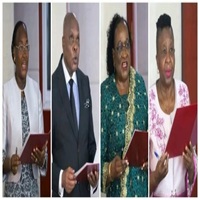
Lúcia da Luz Ribeiro, Eduardo Joaquim Mulémbwè, Verónica Nataniel Macamo Dihovo and Alcinda António de Abreu Mondlane.
Mozambique faces a dilemma: whether to continue valuing the stability provided by the old guard or to embrace a renewal that allows for greater inclusion, dynamism, and democratic legitimacy. For decades, the so-called "old guard" has consolidated itself as the hard core of the country's strategic decisions, occupying key positions in the State, Parliament, and advisory bodies. The so-called Mozambican "monarch," an expression used here in a critical and metaphorical sense, precisely reflects the idea of a power that, although formally republican, exhibits almost hereditary continuity within a restricted circle. The recent suspension of Eneas Comiche's mandate, at age 86, from the position of president of the Planning and Budget Commission, has reignited a debate that has long been necessary in the national political scene: to what extent does Mozambique remain hostage to an aging political elite that recycles itself in power? Does the State serve the collective interest or a restricted group? What space exists for new leadership?
President Chapo has appointed several historical figures, including former presidents of the Assembly of the Republic of Mozambique and influential members of the state apparatus, to the Council of State. This move, while constitutionally legitimate, raises profound questions about the restricted circulation of power. In recent times, this pattern has become even more evident. The model of longevity in political governance is confused with continuous legitimacy. The recurring practice of reappointing the same figures to different public positions creates the perception of a closed political system, where internal alternation is minimal and generational renewal is frequently postponed. This discrepancy generates a deficit of representativeness and hinders the adaptation of public policies to new social realities.
This is not about family succession in the classical sense, but about a systematic reproduction of the same political elite over time. It is important, however, to recognize that the experience accumulated by this generation is not irrelevant. Current leaders have always played decisive roles in the construction of the Mozambican state. The problem lies not in their presence, but in the absence of a clear, transparent, and consistent mechanism for transition and power-sharing. More than a simple question of age, it is a governance model that prioritizes the continuity of the elite at the expense of including new voices.
Added to this is the debate about the accumulation of privileges. Many of these leaders simultaneously benefit from pensions associated with previous positions, advantages stemming from parliamentary functions, and new prerogatives as State advisors. In a country marked by profound social inequalities, this concentration of benefits reinforces the feeling of distance between rulers and the ruled. Comiche's case, of stepping down, even if temporarily, can be interpreted as a symbolic sign that indefinite stay in power has limits.
However, if it is not accompanied by an effective opening of the political system, it risks being merely an isolated episode in a deeply entrenched structure. The balance between historical memory and political innovation is crucial for the country's future. Without reforms that promote the circulation of elites, limit the accumulation of privileges, and encourage the participation of new generations, the risk is evident: power ceases to be an instrument of plural representation and transforms into a space of almost perpetual permanence for the few, an informal "monarchy" in a state that claims to be republican.
2025/12/3
Copyright Jornal Preto e Branco All rights reserved . 2025
Copyright Jornal Preto e Branco Todos Direitos Resevados . 2025
Website Feito Por Déleo Cambula