
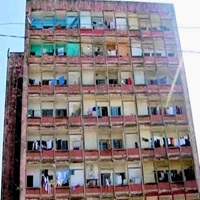
The "Mira Muertos" building in Beira, nationalized, recolonized, and neglected by anonymous individuals
Paulo Vilanculo"
This article critically examines the process of nationalizing housing assets after Mozambique's independence, with an emphasis on the selective appropriation by third parties. The analysis is based on historical sources, legal documents, and academic works dealing with the post-colonial Mozambican state. It argues that nationalization, although legitimized by the revolutionary discourse of breaking with colonialism, was permeated by practices of favoritism and private use of public resources. More than a critique of the past, this article points to the need to critically revisit the foundations of the Mozambican state. Urban inequalities are still felt in the national political imagination in the marks left by nationalizations. Revisiting this past is not merely an exercise in memory, but an ethical imperative for envisioning a more just and inclusive future.
The Mira-Muertos Building, now known as the Committee Building, was during colonial times a building where the world's oldest profession reigned, frequented by Spaniards who called it "mira-muertos" (dead men's eyes) when contemplating the tombs in the adjacent cemetery in Santa Isabel. With the proclamation of Mozambique's independence on June 25, 1975, the revolutionary and independence party of the time, facing the challenge of building a new state, occupied some floors. Justified by the discourse of social justice and the need for urban reorganization, this measure also paradoxically lent itself to the misappropriation of assets by members of the party elite. The dispute between ideology and practice reveals profound contradictions in the Mozambican revolutionary projects. As demonstrated by Pitcher (2002), the management of nationalized assets was characterized by improvisation, clientelism, and party centralization. Houses in upscale areas of Maputo, such as Sommerschield and Polana, began to be occupied by party leaders without any transparent allocation criteria.
The appropriation of nationalized properties by party members was not limited to a functional need of the State, but assumed a systematic character of elitist and patrimonialist occupation. The absence of effective regulation and accountability mechanisms favored the consolidation of a political elite with privileged access to public goods. Michel Cahen (1999) observes that this process of politicization of property occurred under the aegis of a political culture that confused the party with the State. This institutional confusion was one of the pillars of the power structure built in the post-independence period. This practice not only eroded the proclaimed principles of justice and equality, but also created a new ruling class, now based not on colonial origin, but on party loyalty. This institutionalized selectivity undermined the legitimacy of the nationalization policy, transforming it, in many cases, into an instrument of privilege and exclusion.
Despite being supported by legal decrees, the absence of transparent judicial processes and the partisan use of assets call into question the legitimacy of these appropriations. Some nationalization measures were entirely comprehensive, but also marked by favoritism and the partisan allocation of assets, as observed by Christine Messiant (1994). The concept of "revolutionary justice" was mobilized to justify extraordinary measures, often without robust legal backing. Hanlon (1984) argues that certain spheres of the independence elite used the revolution as a shield for the consolidation of power, confusing justice with redistribution and political control. This is not about denying the merits of the anti-colonial struggle, but about questioning the ideological uses of this struggle for the purposes of appropriation. By exposing the limits of revolutionary morality, the metaphor reveals the transformation of the liberating state into an apparatus of exclusion. The revolutionary dress did not cover the inequalities: it only redesigned them. What could have been a legitimate redistributive policy has, in part, turned into a politically motivated and morally controversial expropriation.
The nationalization of real estate in Mozambique was formalized by Decree-Law No. 5/75, which provided for the appropriation by the State of assets considered abandoned. This legal instrument was complemented by other regulations, such as Decree-Law No. 12/75 and Decree-Law No. 37/76, which aimed to regulate the use and management of nationalized properties. According to a speech by President Samora Machel, the objective was to redistribute the assets accumulated by the colonists in a more equitable way, guaranteeing housing for the Mozambican people. However, practice revealed a discrepancy between discourse and execution. In many cases, the line between state assets and party assets became blurred. A critical element that accentuates this controversy is the unequal treatment given to nationalized housing assets. While properties managed by the State Real Estate Park Administration (APIE) are subject to clear rules for leasing and subsequent sale through legal purchase by tenants, according to legislation approved in the 1990s and 2000s where properties are directly appropriated by government members, these assets, although technically nationalized, remained outside the scope of APIE, being treated as de facto "private" assets, without registration, without transparency, and without the possibility of legal sale by ordinary occupants. This duality highlights a rupture in the principle of legal equality and reveals a parallel structure of privilege within the State itself.
Certain properties, although belonging to the State, escaped the legal framework that would make them accessible to the average citizen. The non-inclusion of these assets within the logic of the APIE (Agreement on the Rights of the State) reveals a deliberate political choice: to maintain spaces of privilege hidden under the veil of revolutionary legality. In this way, a legitimate space for legal and political contestation is opened. Citizens discriminated against by this dual regime can activate judicial mechanisms, including administrative litigation and constitutional actions, to claim the principle of equal treatment. In doing so, they are not only demanding the right to housing or property, but also challenging a historical structure of privilege built outside the law. Despite this history of opacity, the current Mozambican legal system offers normative foundations for claiming the right to alienate nationalized properties. The Constitution of the Republic of Mozambique of 2004, in its articles 82 and 109, enshrines, respectively, the principle of equality before the law and the right to property. Furthermore, the regulations governing APIE's activities establish mechanisms for the legal sale of occupied properties, allowing tenants to acquire the properties they have inhabited for decades.
These devices, combined with state asset management legislation, namely the decrees regulating APIE (Asset Protection and Development), support the possibility of regularizing and alienating properties to their legal occupants. In light of these trends, it can be argued that the Mozambican state has an obligation to harmonize its asset policy, correcting distortions inherited from the revolutionary period that maintain partisan privileges without current legal backing. Within the current Mozambican legal framework, there are grounds to claim the right to alienate nationalized properties, especially when considering constitutional principles and legal reforms adopted after the revolutionary period. It is concluded that the process of nationalizing colonial assets in Mozambique has proven to be a field of dispute between ideology and practice, between justice and privilege. Although legitimized by decrees and the rhetoric of liberation, the process was instrumentalized to reinforce structures of partisan power and social exclusion. Thus, the right to sell nationalized properties, such as the "Mira Muertos" building, is not merely a matter of historical or moral revision; it is a requirement of legal coherence and redistributive justice in a state that aspires to be democratic.
2025/12/3
Copyright Jornal Preto e Branco All rights reserved . 2025
Copyright Jornal Preto e Branco Todos Direitos Resevados . 2025
Website Feito Por Déleo Cambula