
Report to the Nation: Chapo amidst applause for a bleak future of social achievements
Paulo Vilanculo"
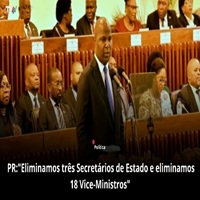
In a country marked by economic uncertainty and social fragility, the Address to the Nation cannot be limited to political abstractions or promises for the future; above all, it should address the immediate anxieties of the people regarding how Mozambicans will get through the festive season. In this context, the President spoke but did not address the real expectations of society, raising the question: does the President govern through reports or the people? In a moment of social hardship, who should speak to the people later—the ministers and administrators or the head of state who governs, the President? Did President Chapo not speak concretely about how he will improve education in Mozambique? Even more objectively, will public servants receive their salaries on time, including the thirteenth-month salary?
After numerous international appearances in his first year in office, many marked by speeches of diplomatic affirmation and a search for external legitimacy, during which power was centralized in the presidential figure for months, the President of the Republic finally made his first major public appearance domestically through a long-awaited Address to the Nation. The symbolic moment of the Address to the Nation turned into a deafening silence on matters of neutral society. At a moment that, due to its constitutional and symbolic solemnity, should represent an honest assessment of governance, a snapshot of the state of the economy, and above all, a clear commitment to the social urgencies of the Mozambican people, the presidential speech nevertheless proved paradoxical.
The Head of State opted for a comfortable discursive register, anchored in a generic narrative of "inclusive governance," a politically attractive concept, but dangerously empty when not supported by concrete public policies, measurable goals, and verifiable results. In a context of persistent inflation, precarious employment, and increasing informality, the silence on GDP is not merely a technical omission: it is a symptom of disconnection between official discourse and the reality experienced on the streets. The absence of clear references to the country's economic performance raises legitimate questions.
Education is both a victim and a cause of underdevelopment; the technical silence surrounding this sector is not a minor oversight, but a political signal. The presidential speech was limited to generic references to the education sector, embedded in a broad rhetoric of inclusive governance and human development, without presenting a clear plan, verifiable goals, or concrete budgetary commitments. There was no mention of profound curricular reforms, effective appreciation of the teaching profession, a serious fight against the precariousness of public schools, or strategies to reduce school dropout rates, especially in rural areas. Improving education requires more than intentions: it demands difficult decisions, sustained investment, and the courage to confront flawed systems, from administrative corruption to the devaluation of teachers.
In a country weary of broken promises, the people do not demand perfect speeches, but hard truths and consequential actions. Because true inclusive governance is not proclaimed: it is built, measured, and felt in the food on the plate, in guaranteed employment, and in the restored dignity of the common citizen. When the Head of State addresses the Nation, he speaks not only as a political coordinator, but as the ultimate guarantor of the functioning of the state apparatus. In the national domain, the President is the one who holds the legitimacy to ensure that public servants' salaries will not be missed, that the thirteenth-month salary will be paid, or, if that is not possible, to explain the reasons frankly and assume the political cost of that truth. Delegating this clarification to ministers is to transform a matter of State into a bureaucratic problem.
The President was everywhere, cutting ribbons, announcing programs, promising solutions, and assuming absolute leadership in governance. Ministers were, in this process, progressively reduced to behind-the-scenes managers, silent executors of an agenda with a single face. The image of the omnipresent President was created, the supreme head of all dossiers, the final decision-maker even on the most technical matters. In a country where the majority of the population is young, ignoring this social drama is equivalent to postponing the future. The challenge of unemployment, particularly among young people and recent graduates, was also relegated to a secondary level. Youth are not nourished by speeches, but by active employment policies, productive investment, and a State that functions as a catalyst for development, not merely as a manager of political rhetoric.
In a functioning state, the President speaks to close cycles, not to open up further clarifications. The irony is evident. Someone who has established himself as head of all ministries cannot, at the moment of accountability, behave as a mere symbolic coordinator. Instead of confronting head-on the indicators that most worry society, such as economic growth measured by GDP, the worsening of youth unemployment, and the absence of a structural project for the effective improvement of living conditions, by pushing a second "report" to ministers without their own political weight, the President weakens the authority of his own discourse. He transforms the National Address into an unfinished preface and the ministers into interpreters of a poorly defined score. This is not institutional decentralization; it is an escape from direct political commitment.
When the Head of State speaks and the ministers need to speak again, something has failed in the leadership. Between the announced hope and the concrete achievements, a dangerous gap opens up, where popular trust fades and disenchantment deepens. And when the people perceive this flaw, they understand that the problem lies not with the ministers who explain too much, but with the President who explained too little, because governing is not just about inaugurating. Governing, after all, is not done only with promises of inclusion, but with the creation of real opportunities, dignified work, and tangible social justice, in a carefully polished discourse, but lacking social depth; politically correct, but socially insufficient. Governing is, above all, about taking responsibility. The Address to the Nation has ended, thus appearing more as an exercise in applause projected towards an indefinite future than an accounting of the present.
2025/12/3
Copyright Jornal Preto e Branco All rights reserved . 2025
Copyright Jornal Preto e Branco Todos Direitos Resevados . 2025
Website Feito Por Déleo Cambula