
Professor Fernando Vaz, “the super honoris causa of the year"
Paulo Vilanculo"
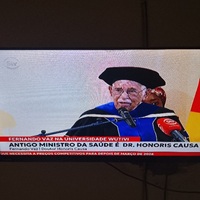
The ceremony for the awarding of the honorary degree took place in an atmosphere of recognition and celebration, bringing together faculty, students, and guests who witnessed the symbolic and practical importance of this distinction. The honorary doctorate, reserved for individuals whose careers transcend the formal boundaries of academia, emerged as a fitting tribute to the intellectual and pedagogical influence of the honoree, Professor Fernando Vaz. Known for his consistent contribution to academic debate and his ability to inspire generations of students and professionals, Professor Fernando Vaz is a leading figure in the university environment in medical education. His work demonstrates a vision of education as an instrument of social transformation, human development, and the consolidation of citizenship—values that align with the mission of higher education institutions committed to the future of the country.
The awarding of an honorary doctorate to Professor Fernando Vaz by Wutivi University represents a particularly significant moment for Mozambican higher education. It is a public recognition of an academic, professional, and personal journey marked by a commitment to knowledge, the training of professionals, and the promotion of critical thinking. By honoring Fernando Vaz, Wutivi University underscores the value of a career built on dedication to teaching, research, and reflection on the contemporary challenges of education and society.
In his insightful lecture, delivered upon receiving an honorary doctorate from Wutivi University, Professor Fernando Vaz offered more than just empty words. He left behind a clear, humanistic vision deeply committed to transforming higher education in Mozambique.
“I have always dreamed of a humanizing higher education in Mozambique (…)”
Professor Fernando Vaz repositions the university in its original place: not merely as a diploma factory, but as a space for the integral formation of the human being. In a context where Mozambican higher education is frequently accused of commercialization, excessive bureaucratization, and social detachment, the idea of a "humanizing higher education" emerges as an ethical and civilizational appeal. To humanize, here, means to teach with social awareness, moral responsibility, and commitment to the common good.
“What counts in a university is the quality of its teachers (…)”
The honoree touches on one of the most sensitive points in national academia. More than showy infrastructures, artificial rankings, or institutional marketing, Fernando Vaz places the professor at the center of university excellence. The argument is clear: strong universities are built with competent, ethically committed, pedagogically prepared, and scientifically active professors. It is a call for the appreciation of the teaching staff and the demand for rigorous criteria in their selection and evaluation.
"May university professionals find a relationship in the evaluation of humanization, in a dignified joint work (...)"
Vaz introduces a frequently neglected relational dimension. Evaluation is not just about measuring grades or technical results, but also about observing attitudes, values, and human practices. "Dignified teamwork" refers to a university culture based on cooperation, mutual respect, and institutional co-responsibility. This vision contrasts with academic environments marked by rivalries, authoritarianism, and fragmentation.
“…so that future doctors can provide true health for the people, treating them with empathy and respect, communicating clearly, and considering the emotional, psychological, and social aspects of their patients.”
In this excerpt, Fernando Vaz articulates university, public health, and humanity. Medical training, according to his vision, cannot be limited to technique and clinical diagnosis. It must integrate empathy, communication, and social sensitivity. In a country where many citizens complain of dehumanization in hospital care, this approach takes on strategic value: to train doctors who are technically competent, but also profoundly human.
"University presidents must be visionaries, making universities brilliant (...)"
Professor Fernando Vaz addresses university leadership directly. For him, rectors should not be mere administrative managers, but leaders with strategic vision, intellectual capacity, and ethical courage. “Brilliant universities” are not built with authoritarianism or improvisation, but with a long-term vision, investment in science, valuing people, and commitment to society. Fernando Vaz's insightful lesson alone justifies the title bestowed upon him. More than an honorary doctorate, it is a recognition of mature, coherent thought, necessary for the present and future of Mozambican higher education. More than a title, the honorary doctorate awarded to Fernando Vaz reaffirms the centrality of merit, academic ethics, and service to the community as pillars of university life.
In a context where higher education faces complex challenges, recognizing figures who have dedicated their lives to knowledge is a positive sign. By honoring Fernando Vaz, Wutivi University not only celebrates an individual but reaffirms the university's role as a space of excellence, recognition of merit, and construction of knowledge in service to society. Professor Fernando Vaz thus emerges as the super honoris causa of the year, not for the number of titles he holds, but for the depth of his intellectual legacy and the lasting impact of his work on the formation of critical consciousness. The "super honoris causa of the year" thus reveals itself not as an excessive title but as the reflection of a voice that insists on reminding us that the university only makes sense when it serves humanity.
2025/12/3
Copyright Jornal Preto e Branco All rights reserved . 2025
Copyright Jornal Preto e Branco Todos Direitos Resevados . 2025
Website Feito Por Déleo Cambula