
Professor Doctor Honoris Causa, for Lula, of memories, struggles, and bridges in the value of Education in Mozambique
Paulo Vilanculo"
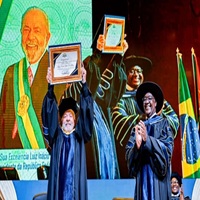
The Pedagogical University of Mozambique awarded His Excellency Luiz Inácio Lula da Silva, President of the Federative Republic of Brazil, the title of Doctor Honoris Causa, a distinction that, on an epistemological level, recognizes the convergence between political authority, symbolic production, and socio-cognitive relevance. This academic act constitutes an institutional recognition of Lula's unique trajectory, marked by his rise from the social peripheries, his unwavering defense of human dignity, and the formulation of public policies guided by an emancipatory rationality—elements that place him within the field of critical pedagogy and the theory of social justice.
The honoree's godfather, Professor Lourenço do Rosário, the magnificent patron of the Polytechnic University of Mozambique, did not shy away from references to the Black movement in Brazil, emphasizing its centrality in the struggle for the regulation of human dignity and the rights that have historically been denied to them. On the other hand, his speech evoked a "moment of repression" which, for many Mozambican observers present, resonated with the post-election period in Mozambique, where social tension and the dispute over the official narrative continue to mark the political situation.
Despite sometimes being received in “hostile” spaces, as Professor Lourenço do Rosário recalled, Lula stands out for his persistence fueled by the conviction that politics should serve the people, a position that reinforces his permanence among the most respected leaders on the international stage. The presence of Rosângela da Silva, the Brazilian First Lady, was noted through her unwavering dedication to the cause of inclusion for excluded peoples in Brazil, a militancy that reinforces the social discourse of the Brazilian government. The resumption of cooperation with Mozambique, especially within the G20 framework, was presented as a renewed commitment to solidarity between nations historically linked by cultural, political, and human affinities.
Between memories and artistic gestures, the meeting transformed into a vivid portrait of the capacity of education and culture to unite peoples and rekindle hope. The ceremony gained even more symbolic force with the participation of Mozambican artist Reinata Sadimba, who presented Lula with a work inspired by her mother's struggle, simultaneously alluding to the resistance of Mozambican women—a cultural bridge that moved those present. Mozambican writer Mia Couto concluded the moment of praise with poetic words, reminding everyone that "Brazil is within us," highlighting the country's role in the global fight against poverty and hunger, causes championed by Lula since his first term.
In his speech, bathed in discreet tears and poignant metaphors, the honoree Lula revisited the paradigms that shape collective memory, contrasting them with the ever-present risk and forgetfulness of his former "comrade," as he insists on identifying himself. His speech moved the audience by recalling narratives of human dignity and the social battles that marked his trajectory. Brazilian President Luiz Inácio Lula da Silva reaffirmed the transformative value of education in a lecture that blended into a lesson of life and struggle. For Lula, "education must be an investment." Lula re-emerges, once again, as a figure who navigates between politics and humanism, reaffirming that the true struggle is always for human dignity.
By granting him the status of PhD professor, the Pedagogical University of Maputo establishes a bridge between experiential and academic knowledge, engaging with theoretical currents such as Freirean humanism, which emphasizes education as a liberating act, and the epistemology of the South, as formulated by Boaventura de Sousa Santos, which advocates for the valorization of knowledge produced in subaltern contexts. Within the university's framework, this tribute signals a commitment to a vision of education that transcends formal instruction and connects with social transformation as an ethical and epistemological imperative.
By symbolically integrating him into the academic body as a Professor Doctor, the Pedagogical University reaffirms the centrality of knowledge as a vector of transformation and underlines the importance of South-South dialogue in the production of contextualized knowledge. This solemn act, imbued with high political and cultural symbolism, also reinscribes the relations between Mozambique and Brazil within a genealogy of historical solidarities, reaffirming the centrality of South-South cooperation in building common agendas for the structural fight against poverty, exclusion, and persistent inequalities in the Lusophone space. Thus, the distinction transcends ceremonial protocol and acquires ontological density: it positions Lula as an epistemic subject whose political praxis becomes a reference for contemporary critical thought.
2025/12/3
Copyright Jornal Preto e Branco All rights reserved . 2025
Copyright Jornal Preto e Branco Todos Direitos Resevados . 2025
Website Feito Por Déleo Cambula