
Mozambique needs government program contracts to rescue the national maritime transport system that connects ports, cultures, tourism, and populations
Paulo Vilanculo"
Mozambique boasts a coastline of over 2,700 kilometers along the Indian Ocean, bathing the country and making it a maritime corridor of enormous economic, geopolitical, and geostrategic importance within Southern Africa. Its ports, even during wartime, successfully operated domestic passenger maritime transport, connecting Maputo, Inhambane, and Beira and vice versa – a reality that, in peacetime, with greater institutional stability and international support, no longer exists. Seriously, in the program contracts adopted by the Government, is there any prospect of investing in national maritime transport as a bridge connecting Mozambique's transport and tourism sectors, linking Maputo, Inhambane, Beira, Quelimane, Nacala, and Pemba?
Historically, the sea has been used selectively. During the colonial period, maritime and river transport served essentially the logic of exporting raw materials and the movement of the administration and the colonist, not territorial cohesion or social inclusion. After independence, the new state inherited a port infrastructure geared towards international trade, not domestic passenger transport. From the early years of independence, the focus was on road and rail transport, seen as symbols of progress and territorial integration. Millions were invested in roads, many of which became dilapidated a few years later, while coastal maritime transport was pushed to the margins of public policy.
With the civil war that broke out in 1976 and worsened in the following years, with widespread insecurity and the destruction of infrastructure, the priorities were the survival of the State and minimal reconstruction. In the midst of the war, the sea was understood as a relatively safer, more stable and functional space to guarantee the circulation of people, essential goods and connections between coastal populations. It is particularly revealing to recall that in the 1980s and 1990s, before the signing of the Rome Peace Accords, when Mozambique was experiencing one of the harshest periods of the civil war, faced with the insecurity of land routes and the collapse of internal connections, the State recognized the sea as a strategic means of mobility. The Government introduced two passenger ships, the Lily and the Estrela do Mar, which crossed the Mozambican coast weekly in opposite directions, connecting cities and regions along the coastline.
When peace arrived, what was possible under bombardments and political instability became nonexistent in peacetime. The disappearance of the Lily and the Estrela do Mar was not merely the end of two ships. The discontinuation of these vessels, without replacement by any structured alternative, had profound and lasting impacts. The State abandoned a mobility infrastructure that had already proven its historical usefulness. This decision not only harmed the populations but also erased from institutional memory the real viability of maritime passenger cabotage. This represents the abandonment of a vision of alternative mobility, more inclusive and territorially intelligent. Coastal populations lost an accessible means of transportation, and territorial integration was weakened.
The country entered a new phase of the economic crisis in which the long-term vision for maritime passenger transport was abandoned, and public maritime transport was seen as unprofitable and with a slow financial return, and was never again treated as a social responsibility of the State. Mozambique currently presents itself as an "exceptional tourist destination." It has one of the most beautiful bays in the world, in Pemba, is home to the Quirimbas and Bazaruto archipelagos, natural heritage sites of global value, and stretches along a coastline of more than 2,700 kilometers where tourism could be a true engine of inclusive development.
A country with Wimbe, Quirimbas, and Bazaruto doesn't need to discover the sea or invent tourism. It only needs to make the political decision to connect the country via the Indian Ocean, linking what already exists. The routes are there, the ports are there, and the tourism is also there. A regular maritime link between Pemba, the Quirimbas archipelago, Nacala, Vilankulo, and the Bazaruto archipelago could transform the Mozambican coast into an integrated tourist corridor, generating direct jobs in maritime transport, naval maintenance, hotels, restaurants, handicrafts, and cultural services. It could also revitalize medium-sized port cities, currently relegated to the role of transit points or abandoned. Traveling from Pemba to Vilankulo is almost impossible without resorting to flights or expensive irregular transport, an absolute contradiction for a coastal country.
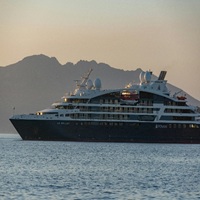
On December 1, 2025, the city of Maputo enthusiastically welcomed the arrival of its first cruise ship, with capacities ranging from 400 to over 2,500 tourists, for the 2025/2026 season, which will extend until May 2026. Visitors had the opportunity to explore the City of Acacias through tours organized by travel agencies, visiting monuments, museums, and showcasing the rich local gastronomy. These tours offered valuable experiences to tourists, showcasing Mozambique's unique hospitality, culture, and flavors to the world. This season represents an excellent opportunity for local tourism, and Mozambique is a fascinating tourist destination that combines history, culture, and unforgettable experiences! (Inatur, IP).
Mozambique, by relying on air travel for each tourist destination, functions as a political and economic island, accessible only to wealthy foreigners but distant from the national citizen and even from other destinations within the country itself. Tourism in Mozambique was conceived as an enclave where foreigners arrive by plane, spend money in an isolated resort, and return abroad. Air transport, often presented as a symbol of modernity, is in fact the most exclusionary form of national mobility, since it only serves the political elites and the business community, and does not serve small traders, informal workers, students, much less farmers. In this context, investing millions in a system that only 5% of the elite population can use is not development, it is institutionalized segregation. Instead of stimulating domestic, regional, and interprovincial tourism, the State remains hostage to a model dependent on high-spending foreign tourists.
Compared to land transport, road transport would be relatively cheaper than air transport, but the reality shows that Mozambique lacks a road network focused on tourism routes. Furthermore, the structural incompetence is evident, with poorly constructed and maintained roads constantly destroyed by floods and cyclones, consuming public budgets and turning this route into a deadly trap. A single vessel can transport hundreds of people at incomparably lower costs than long-distance buses or regional planes. In this scenario, maritime passenger transport emerges as the most rational alternative, and precisely for this reason it has been abandoned. It is cheaper per passenger, more energy-efficient, less polluting, and potentially safer.
While air transport requires expensive fuel, highly specialized maintenance, and fares inaccessible to most of the population, maritime transport allows for lower prices and greater scalability. Maritime passenger transport has significantly lower operating costs per passenger-kilometer. A medium-sized vessel can transport hundreds of passengers with lower energy consumption than dozens of buses or a single regional aircraft. The argument of "lack of conditions" falls apart when one observes that ports are operating at full capacity for coal, gas, minerals, and foreign interests, with state-of-the-art logistics corridors. The deliberate exclusion of maritime passenger transport in Mozambique is not a matter of state incapacity, nor a lack of natural conditions; it is a conscious choice of a mobility model that benefits a few, kills many, and abandons the majority.
Coastal cities and towns remain isolated from each other, dependent on precarious, long, and expensive roads. The sea could shorten distances and reduce regional inequalities; however, it remains a visual luxury, not a right to mobility. Therefore, reviving the debate on national maritime transport is not merely a contemporary invention. It is, in fact, the recovery of a solution already tested by the country's own history. In the current scenario, there is also a functional institutional vision. Maritime transport involves coordination between various sectors, including transport, defense, environment, tourism, and the blue economy. Passenger maritime transport reinforces effective sovereignty over the coast, boosts local economies, stimulates domestic tourism, and creates direct and indirect jobs linked to shipbuilding, maintenance, port logistics, and services. It is up to the Government to assume passenger maritime transport as an essential public service, even when it does not generate immediate profit.
Maritime transport should not appear merely as a commercial port component, within the logic of a purely financial contract-program, outside of a national integration plan, as an instrument for reproducing territorial inequalities. It is clear that millions of Mozambicans will continue to be excluded from the right to mobility. If the current government operates under contract-programs that guide governmental action, defining strategic priorities, then the exclusion of passenger maritime transport reveals a limited, centralist, reductionist, and exclusionary vision of development. If the sea continues to serve foreign ships, megaprojects, and macroeconomic statistics, and not the ordinary citizen, until this logic is reversed, Mozambique will remain a coastal country with abundant sea but scarce mobility—a country where the sea exists but does not truly belong to its people. Thus, the country will continue to bear the unsustainable paradox of a coastal nation where the sea neither liberates, nor connects, nor serves; a country where mobility is planned to exclude, where development will always sail in the opposite direction to the benefit of the people.
2025/12/3
Copyright Jornal Preto e Branco All rights reserved . 2025
Copyright Jornal Preto e Branco Todos Direitos Resevados . 2025
Website Feito Por Déleo Cambula