
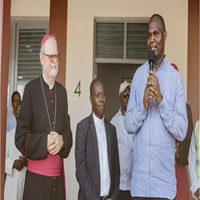
In the city of Dondo, Mozambique, the President of the Republic re-inaugurates the school where he studied, a dream that so many children would like to attend
Paulo Vilanculo"
The visit of His Excellency Daniel Chapo to the Santa Ana de Dondo Parish, marked by the symbolic handover of the Nossa Senhora Auxiliadora School to Archbishop Dom Cláudio Dalila Zuanna, reveals more than a political or institutional gesture. The reference to Cain, the brother who failed to care for his neighbor, exposes, albeit unintentionally, the distance between discourse and governmental practice. While the biblical narrative suggests God questioning Cain about his brother's whereabouts, today the population could ask their leaders: "Where are the other schools for the other children?", those who continue to study outdoors, sitting on the ground, exposed to the sun and rain, while triumphalist speeches celebrate small works as great achievements. This reveals, above all, the abyss that opens between official discourse and the reality lived by the children of the Cain neighborhood, who continue to study outdoors, under the merciless sun, unexpected rain, and dust that with each gust of wind seems to silently erase their rights. Is repairing just one school enough to settle the historical debt left by years of neglect?
The president rehabilitated and reopened the school destroyed by Cyclone Idai in the devastation of 2019, a symbol of rescuing lost hope, a scenario that confronts us with a harsh truth. Leaders dignify themselves more through the shadows of the past than through the future of their people, revealing, in fact, a profound crisis of leadership, vision, and commitment to collective well-being. The past is then reinvented to justify the present. A governing culture is created where it matters more to appear to have done something than to actually do it. Instead of taking responsibility for transforming the harsh realities that affect millions of citizens daily, they prefer to cling to past glories, to political achievements that no longer meet the demands of the present, and to narratives of heroism that serve more to cover up failures than to inspire change. This attachment to the past becomes a convenient shield: in it they find comfort, legitimacy, and protection, while the present exposes incompetence, unfulfilled promises, and a glaring inability to offer concrete solutions.
This disconnect between leaders and reality is even more dramatic when one observes that many do not even remotely experience the hardships faced by the populations they claim to represent. In his homily, the president used the biblical story of Abel and Cain to illustrate values of unity and responsibility, but the metaphor took on unexpected dimensions in light of the concrete reality of the visit: the delivery of only one school rehabilitated after the devastation of Cyclone Idai. The institutional handover, shrouded in formalities and photographs, does not erase the indignity of seeing a system that boasts of rehabilitations while keeping the most vulnerable marginalized; it is contradictory when one knows that, since Idai, countless communities have been waiting for basic works that have never left the drawing board. This detachment creates an abstract leadership, devoid of empathy, where the people cease to be a community of human beings and become merely a word used in speeches of convenience.
The story of Cain, evoked by the president, becomes a reflection of the government itself, a symbol of omission, where those who should protect and serve the people seem to repeat the attitude of their brother, turning their backs on their responsibilities. The evocation of the biblical story reveals itself to be more than a rhetorical figure; it becomes an uncomfortable mirror of the present, where leaders seem distant from the pain of their own people, incapable of fully assuming the role of guardian of the future of new generations. The consequence is a country that cyclically stumbles over the same problems of poverty, exclusion, mismanagement, inequality, and eternally postponed promises. And it is always the most vulnerable who pay the price for leaders who do not lead with creativity and transformation, above all the suffering of children who study outdoors, like Cain, which symbolizes not only the failure of public policies but also the lack of a national project that values human dignity. This truth is imposed on a country that lives trapped in a past that never moves forward, but only prolongs the pain of the present and compromises a future that stubbornly refuses to arrive.
In the current context, Cain ceases to be merely a biblical name and comes to represent all the children who, like Abel, remain invisible and unprotected, victims of unfulfilled promises and institutional indifference. Cain's school is not just a place; it is a silent cry of hope. And every child who dreams there deserves that this dream to finally find firm walls, open windows, and doors that do not close in the face of indifference. The school that has been handed over does not respond to the dream that so many children of Cain carry in their hearts because the promised rehabilitation has not reached those who need it most. It is painful to see children sitting on the floor, improvising desks with stones, notebooks balanced on tired knees. Children who walk long distances and return to homes without water, without electricity, but who still insist on dreaming.
The metaphor becomes particularly poignant when one observes that, faced with a scenario of destruction affecting dozens of schools and thousands of students, the government's response is limited to the rehabilitation of just one educational establishment. In a sea of urgent needs, this gesture becomes a drop of restitution attempting to quench an ocean of deprivation. Ultimately, the truest metaphor is not the one the president intended, but the one imposed by reality itself: a country that continues to wait for leaders who do not respond like Cain, but as true guardians of the future, and especially of the children who still learn in the shadow of exclusion. Cain symbolizes all the children, families, and communities that remain abandoned, forgotten, left to their fate, and in this instance, the people appear as Abel, vulnerable, sacrificed, and the leaders as Cain, incapable of protecting their own, yet still justifying themselves before everyone by saying they do good deeds. Cain's school thus remains a postponed dream, not for lack of will on the part of the children, but for lack of concrete commitment from those who govern. And while speeches celebrate the rehabilitation of colonial works, childhood continues to be sacrificed in the shadow of symbolic glories.
2025/12/3
Copyright Jornal Preto e Branco All rights reserved . 2025
Copyright Jornal Preto e Branco Todos Direitos Resevados . 2025
Website Feito Por Déleo Cambula