
Government normalizes the precarious state of the school system by blaming the floods
Paulo Vilanculo"
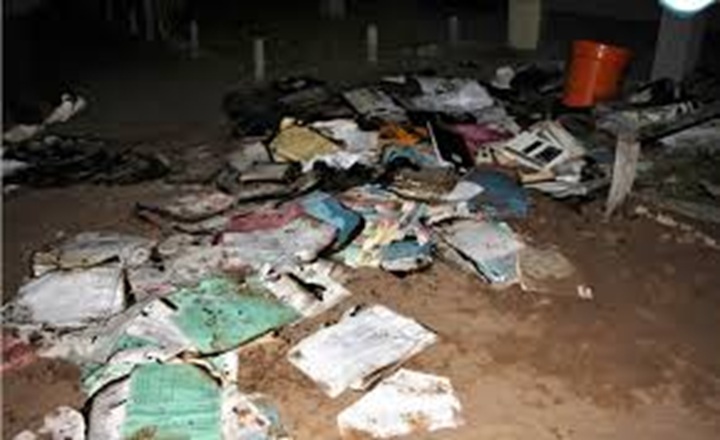
In Mozambique, natural disasters have become central to the government's discourse as the main cause of the precarious state of school infrastructure. With each interrupted school year, destroyed classroom, or non-existent school, the same official explanation is repeated: cyclones, floods, heavy rains, climate change. The problem, however, is that nature always appears in the dock, while the State presents itself only as a powerless victim—an increasingly worn-out and unconvincing narrative. The repetition of the problem suggests not pointing out "surprises," but rather a normalization of the failure. Reconstruction has become a vicious cycle that benefits quick contracts but does not solve the historical deficiency. The viable solution would be to replace the emergency response with a plan. The government discourse also tends to erase an uncomfortable contradiction: if disasters are predictable and recurrent, why does the education system continue without structural strategies for prevention, adaptation, and sustainable reconstruction?
Many of the schools that collapse with the first heavy rain are fragile from the start. Built with precarious materials, without climate resilience standards, and often located in known high-risk areas, these infrastructures reflect decades of poor planning, silent corruption, non-existent oversight, and questionable budgetary priorities. In the province of Nampula alone, more than 1.3 million primary and secondary school students attend classes sitting on the floor due to a lack of desks, a source from the education sector said on July 2nd. According to the head of the Planning Department of the Provincial Directorate of Education in Nampula, Faruk Karim, a total of 1,329,809 students attend classes sitting on the floor, of which 1,029,810 are in primary schools and 299,999 in secondary schools. Samaria Tovela estimated that around 10,000 classes are studying outdoors in the country, pointing to the lack of funding in the country's education sector as the cause. (Lusa - Maputo, July 24).
The province of Nampula will resort to tents and other temporary methods, such as outdoor classes, due to a shortage of conventional classrooms. According to official data, out of 2,819 primary and secondary schools (second cycle), 159 will adopt a three-shift model. This situation affects thousands of students, with plans to use tents provided by cooperation partners to mitigate the lack of infrastructure, especially during the rainy season. Students study under trees, share overcrowded classrooms, or simply drop out of school. Teachers work without minimum conditions, and the school calendar becomes a permanent exercise in improvisation.
There is still a strategic silence surrounding the management of funds allocated to education and post-disaster reconstruction. Millions are announced in plans, strategies, and programs, but on the ground, schools remain absent. In this context, natural disasters become a rhetorical shield that absolves leaders of responsibility and dilutes public accountability. It is difficult to admit that the central problem is not the rain that falls, but the decisions that were never made. The State should build more robust infrastructure, plan for the long term, and protect the right to education as an absolute priority, especially in rural areas, which historically bear the burden of neglect.
“Education has always suffered due to the rainy seasons, as well as the cyclonic season,” stressed William Tuzine, Director of Education in Nampula. The Minister of Education and Culture, Samira Tovela, explained that more than 700 schools remain in difficult conditions, a situation that affects not only students, but also teachers and other stakeholders in the teaching-learning process. “What we are doing at this stage is looking at existing resources and prioritizing the areas where the situation is serious,” said Samira Tovela. “While we don't have classrooms, we will work to provide (…) blackboards so that our children have decent blackboards,” said the Mozambican minister. “We need resources to be able to build schools and quickly put our children in classrooms,” said Samira Tovela. (Lusa - Maputo, July 24, 2025).
It's convenient to blame only nature. The social cost of this negligence rarely enters the official statistics, which indicate higher school dropout rates, greater regional inequality, and more structural poverty. As long as calamities continue to serve as a permanent excuse, and not as a warning for profound reforms, the Mozambican school system will continue to crumble before even fulfilling its mission. In the end, it is not nature that prevents access to education, but the persistent absence of a State that prefers to explain rather than solve.
2025/12/3
Copyright Jornal Preto e Branco All rights reserved . 2025
Copyright Jornal Preto e Branco Todos Direitos Resevados . 2025
Website Feito Por Déleo Cambula