
Blasphemies of the Mummies of Our History
Paulo Vilanculo"
In recent years, Mozambique seems to be witnessing the emergence of a disturbing phenomenon. Monuments intended to celebrate historical figures are multiplying, but, paradoxically, many of them present a disturbing distance between the identity of the honoree and the image attributed to them. The merit of the men and women who were part of national history is not in question, nor is the legitimacy of paying tribute to them. The controversy does not arise from history, but from art. What is perplexing is the inability of some works to reproduce what constitutes the essence of any sculptural portrait: likeness. The issue then ceases to be exclusively artistic and takes on a cultural dimension. What message does a country convey when its own heroes are no longer recognized in the sculptures erected in their honor? What respect does a nation demonstrate when it allows bronze to replace identity with abstraction? What legacy is built when the monument provokes strangeness instead of recognition? When a tribute needs a caption to reveal the identity of the honoree, something has profoundly failed between art and memory.
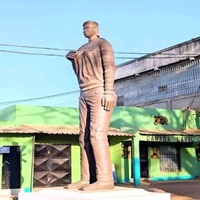
On the city of Chimoio's commemorative day, the government inaugurated a statue in honor of Josina Machel in an act presented as a celebration of national memory. While some praised the recognition of a historical figure in the national liberation struggle, many citizens focused their observations on a fundamental aspect: the limited correspondence between the sculptural image and the widely known physiognomic features of Josina Machel. The controversy is not limited to politics; it reaches the realm of aesthetics, artistic ethics, and respect for the visual memory of a historical figure. A people can accept different interpretations of their history; they hardly accept that the face of one of their greatest symbols should become unrecognizable. The recent inauguration of the Josina Machel statue in Chimoio was not the first time this has happened. The country's capital has already experienced a similar situation with the Eduardo Mondlane statue. The Eduardo Mondlane statue was the target of strong public opposition, both for its aesthetic representation and for the doubts raised about its execution and the costs involved. The controversy sparked public debates, prompted investigations, and led to promises from the authorities to correct and upgrade the artwork. Regardless of the administrative outcomes, the episode reveals a deeper issue: when a monument intended to honor one of the greatest symbols of independence ends up generating outrage, and the problem ceases to be merely artistic. In both cases, a portion of public opinion questions not the merit of those being honored, but the inability of the sculptures to faithfully reproduce their physiognomic features.
Blasphemy is the act of insulting, defaming, or demonstrating extreme disrespect towards sacred things. The term originates from the Greek word blasphēmia and means to speak irreverently about divinity, ridiculing it. In Hebrew religions (such as Christianity and Judaism), blasphemy is seen as a serious offense and can manifest itself through words, gestures, or thoughts of hatred and defiance. In a broader sense, the word is also used to describe irreverence towards dogmas or any deeply respected belief. The blasphemies of the mummies in our historyThis text doesn't focus on the heroes themselves, but on their representations: faces that have lost their gaze, smiles that never existed, features belonging to strangers, where cities begin to be inhabited by figures that resemble everything except those they claim to represent. The metaphor of "mummies" doesn't refer to mummies preserved by time, disfigured figures, bodies without identity, sculptures that have lost their humanity and resemblance to those they intend to immortalize, but rather to images and figures without recognizable identity, bronze bodies inhabited by unknown faces, which retain only the name inscribed on the base of the monument, while the face does not belong to the person being honored; sculptures that force the observer to read the plaque to discover who should be represented there. Mummies are not merely bodies preserved by time; they are also symbols of a past that insists on remaining immobile, incapable of engaging with the demands of the present. It is precisely here that the blasphemies of the mummies of our history emerge.
Civilizations have always used sculpture to defy time. From Ancient Egypt to contemporary democracies, statues have been conceived to immortalize faces, preserve identities, and keep alive the memory of those who marked the history of their peoples. A statue is not just a piece of bronze, marble, or cement; it is a visual testimony of history, a silent language that allows future generations to recognize their heroes without the need for words. The French historian Pierre Nora (1989) argues that monuments are "places of memory" (lieux de mémoire), spaces where the State seeks to crystallize a particular interpretation of history. Mummies represent the preserved past. But they also symbolize that which has ceased to breathe and yet continues to occupy space among the living. Monumental art demands much more than technical skill. It requires historical rigor, aesthetic sensitivity, and profound respect for the human heritage it seeks to preserve. The great sculptors of humanity understood that physical fidelity is not simply artistic virtuosity. It represents an ethical commitment between the artist, the honoree, and society. When this language fails, the tribute itself fails as well.
A statue is not merely a block of bronze or cement. It is an attempt to immortalize a face, an expression, an identity, and a memory. When the face disappears, the monument ceases to represent the hero; the person disappears as well, and it comes to represent only the artistic inadequacy of its creator. When the work ceases to reproduce the physiognomy of the one it honors, it ceases to be a monument and becomes a caricature, and the homage becomes a profanation. A public sculpture is not an exercise of free imagination. It is a work of historical responsibility. The sculptor does not work only with matter; he works with memory. Each line of the face, each expression in the eyes, each detail of the posture carries an identity constructed throughout life. The first obligation of a sculptor is to respect the visual identity of the person portrayed. Physical resemblance is not a mere technical detail; it is an ethical condition of the homage itself. When these elements disappear, the sculpture ceases to represent a concrete person and becomes an anonymous figure. The monument remains standing, but the hero disappears.
The monumentalization of memory demands transparent processes, public competitions of high artistic merit, and the participation of experts in visual arts, historians, family members of those being honored, and cultural institutions. The construction of a statue should not be merely a work of engineering or urban architecture; it should constitute an exercise of patrimonial responsibility towards the whole of society. Perhaps the problem lies in the way projects are conceived, stemming from a crisis of the State in how it conceives, finances, and legitimizes the construction of public memory, frequently without broad dialogue with the society that this memory intends to represent. This focus allows for a critique of the artistic production process: lack of public sculpture competitions; absence of juries composed of sculptors, historians, and family members; low aesthetic standards; devaluation of visual arts in Mozambique; and disrespect for cultural heritage.
Benedict Anderson (1983)It has been demonstrated that nations are "imagined communities." Historical heritage does not exist to impose silence, but to stimulate reflection. A statue that cannot be questioned is closer to a dogma than an educational tool. National symbols, such as flags, anthems, monuments, and commemorative dates, help to build this collective imagination. However, when these symbols cease to represent a significant part of the population, they also cease to fulfill their integrating function. The indignation expressed by various sectors of society does not necessarily mean a rejection of national history; it reveals a growing weariness in the face of blasphemous distortions of the historical images of our liberation and independence. It may represent a plea for history to be truly remembered and immortalized. Monuments exist to bring the past closer to the present. When they fulfill this mission, they awaken admiration, respect, and learning. When they fail, they produce the opposite effect: they confuse, divide, and trivialize those they intended to exalt.
The blasphemies of the mummies of our history do not lie in the men and women who gave their best for Mozambique. They remain greater than any sculpture. The blasphemies of the mummies of our history lie in the inability to allow national memory to breathe, to dialogue with the present, and to welcome new protagonists. A nation that cannot recognize the faces of its own heroes risks forgetting not only their features but also their ideals. The true blasphemy lies in the inability to transform art into a faithful memory of a hero. A hero may die only once, but their image can continue to die every day, whenever a monument ceases to reveal their true face. History should inspire the future, not imprison it. Monuments should serve to unite a nation, not to deepen divisions. If the unveiling of Josina Machel's statue in Chimoio sparked a national debate, perhaps its greatest legacy lies not in the bronze that now occupies a public space, but in the opportunity for Mozambique to discuss, with maturity, who we are, who we want to honor, and above all, what kind of country we want to leave to future generations.
2025/12/3
Copyright Jornal Preto e Branco All rights reserved . 2025
Copyright Jornal Preto e Branco Todos Direitos Resevados . 2025
Website Feito Por Déleo Cambula