
Lusophone Observatory
Adriano S. Kansala"
GUINEA-BISSAU: The key to the solution is not in Dakar!
ECOWAS, Senegalese tutelage, and the attempt to transform Guinea-Bissau into a political and strategic backyard.
Diplomacy cannot turn into tutelage.
An article published on November 1, 2026 by the Senegalese portal Exclusif.net, under the title "Axe Dakar-Bissau: Les coulisses d'un marchandage politico-sécuritaire entre Bassirou Diomaye Faye et la junte", raises issues that go far beyond the bilateral relations between Senegal and Guinea-Bissau.
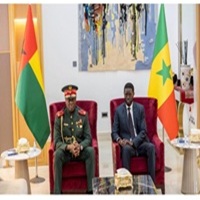
According to the article, General Horta Inta-A's trip to Dakar on October 31st allowed for discussions on an agreement involving the postponement of Guinea-Bissau's elections, democratic guarantees, and security commitments related to Casamance.
The narrative presents the Senegalese President, Bassirou Diomaye Faye, as a virtually indispensable interlocutor for the political survival of the military authorities in Bissau.
But since when has the key to solving a Guinean constitutional crisis been in the hands of the President of a neighboring country?
And, above all, how can such bilateral prominence be reconciled with the responsibilities of impartiality inherent in the mediation mandate entrusted to Senegal by ECOWAS?
The article cites unidentified diplomatic sources. The alleged quid pro quo between Dakar and Bissau cannot, therefore, be treated as a proven agreement. But the political logic described deserves serious consideration.
Guinea-Bissau is not an administrative dependency of Senegal. It is a sovereign state, a member of the United Nations, the African Union, ECOWAS, and the CPLP.
ECOWAS and the attempt to turn Guinea-Bissau into Senegal's backyard.
ECOWAS must answer a fundamental question: is it working to restore the democratic sovereignty of Guinea-Bissau or is it contributing to its transformation into a political and strategic backyard of Senegal?
The persistence of Senegalese mediation, despite its clear loss of political credibility among important sectors in Guinea-Bissau, fuels the perception that Dakar's strategic interests are progressively overriding the sovereign will of the Guinean people.
It is equally legitimate to question the influence that the political relationships between Emmanuel Macron, Macky Sall, Bassirou Diomaye Faye, and Umaro Sissoco Embaló may have on the regional handling of the crisis.
France, a former colonial power in Senegal and a historically influential actor in West Africa, cannot be ignored in an analysis of regional power relations.
Naturally, historical influence and convergence of interests do not, in themselves, constitute proof of a concerted strategy among these leaders. But it would be equally naive to analyze the Guinean crisis as if it were completely isolated from the geopolitical interests that permeate the region.
Guinea-Bissau is not Senegal's backyard, nor an extension of the French sphere of influence. Much less can it be treated as politically available territory for agreements between foreign leaders and national elites.
ECOWAS was created to promote regional cooperation and integration, not to grant certain states the privilege of managing the political destiny of their neighbors.
The principle of subsidiarity cannot serve as a diplomatic cover for the perpetuation of political dependencies.
Guinean sovereignty cannot be delegated in Dakar, negotiated in Paris, or subordinated to the interests of those who claim to speak on behalf of the Guinean people.
Senegal cannot simultaneously be a mediator and an interested party without raising legitimate concerns.
No one disputes Senegal's right to protect the security of its borders, combat armed threats, and preserve the stability of Casamance.
These are legitimate interests of a sovereign state.
Guinea-Bissau also has a duty to prevent its territory from being used for armed activities against neighboring countries.
But bilateral cooperation on security matters is one thing. It is quite another, and profoundly different, to make the solution to the Guinean constitutional crisis dependent on political and strategic agreements between Dakar and the military authorities in Bissau.
International mediation requires independence of judgment, impartiality, transparency, and trust among the parties involved.
The mere fact that ECOWAS has designated Senegal as mediator does not automatically make its actions impartial.
The fact that Bassirou Diomaye Faye holds the Presidency of Senegal concurrently with the current presidency of the Conference of Heads of State and Government of ECOWAS makes it even more important to distinguish Senegalese national interests from regional institutional responsibilities.
ECOWAS is not Senegal. Senegal is not ECOWAS. And Guinea-Bissau is not a protectorate of either of them.
Casamance cannot become a bargaining chip for Guinean democracy.
The Exclusif.net article places the security of Casamance at the center of the alleged negotiations.
It is understandable that Dakar prioritizes this issue.
What would be unacceptable would be to transform border security commitments into a quid pro quo for the political tolerance of a prolonged military transition.
Security in Senegal and democracy in Guinea-Bissau are not incompatible objectives.
On the contrary, a democratic, institutionally stable and sovereign Guinea-Bissau constitutes a far more lasting guarantee of regional security than any short-term agreement between political and military leaders.
True stability does not result solely from controlling borders. It results from the legitimacy of institutions, respect for the popular will, and trust between rulers and the ruled.
Stability should not be confused with political stagnation, nor regional security with the preservation of a regime.
The danger of turning a constitutional rupture into a diplomatic bargaining deal.
The fundamental problem in Guinea-Bissau did not begin with the announced impossibility of holding elections on December 6, 2026.
It began with the interruption of the November 2025 electoral process, the subsequent military takeover, and the progressive replacement of democratic legitimacy with a political order imposed by force.
The central question, therefore, is not how many additional months the military authorities need to organize elections.
It consists of determining the legitimacy with which they continue to exercise power, what guarantees they offer to citizens, and how an effectively democratic constitutional order will be restored.
If the postponement of the election becomes a negotiated concession between Dakar and Bissau, without a solution for institutional legitimacy and without verifiable guarantees, we will be facing a dangerous reversal of priorities.
Diplomacy will have shifted from seeking to resolve a constitutional rupture to managing its consequences.
And indefinitely managing a rupture is not restoring democracy.
The current mediation process has lost the necessary political credibility.
The current mediation process does not inspire the confidence, credibility, and impartiality necessary to resolve the Guinean crisis.
The accumulation of regional mediation responsibilities with Senegal's bilateral strategic interests, the persistence of the constitutional crisis, and the explicit opposition from important Guinean political and social sectors demonstrate that the current mediation model is politically exhausted.
The public criticisms presented by Guinean political and social organizations cannot continue to be ignored.
ECOWAS must explain what concrete results have been achieved since Senegal was appointed as mediator.
The crisis persists. The electoral calendar has been compromised. Restrictions on political activity continue to provoke protests. Trust in mediation is deeply weakened.
It is not up to the Guinean people to indefinitely adapt to a mediation that has lost the trust of a significant portion of the protagonists in the crisis.
It is up to ECOWAS to recognize the limitations of the existing mechanism and proceed with its replacement by a truly independent, inclusive and internationally credible formula.
Replacing the current mediation is no longer just a diplomatic option. It has become a political necessity to restore trust and create conditions for a legitimate and lasting solution.
The regional military presence should be reevaluated.
Another significant element of the article is the reference to the weight of the Senegalese contingent in the ECOWAS Stabilization Support Mission in Guinea-Bissau.
If an international military presence intended to contribute to institutional stability ends up being perceived as an element of protection or support for authorities who came to power through a constitutional rupture, an independent assessment is necessary.
This is not about indiscriminately accusing the foreign military personnel deployed for the mission.
This involves examining the mandate, composition, chain of command, results, and political appropriateness of this presence.
An international force should contribute to protecting the civilian population and creating conditions for the functioning of legitimate institutions.
It should not serve, nor appear to serve, as a guarantee of the political survival of any regime.
Therefore, I advocate a thorough review of the current regional mission, including the possibility of its progressive replacement by a more balanced international presence, preferably without contingents from countries directly involved in the crisis or with immediate border interests, endowed with a precise mandate, civilian oversight, an appropriate legal framework, and an exit strategy.
Subsidiarity is neither dogma, nor religion, nor a silver bullet.
ECOWAS frequently invokes the principle of subsidiarity to justify its leading role in resolving crises in West Africa.
But subsidiarity does not confer a perpetual right to diplomatic exclusivity.
Much less does it transform a regional organization into an authority superior to the sovereignty of states and the democratic will of their people.
When a regional mechanism demonstrates persistent difficulties in achieving the objectives for which it was mobilized, the responsible response does not consist of automatically perpetuating the same model.
It consists of recognizing its limitations and seeking a more credible institutional architecture.
The African Union, the United Nations, and the Community of Portuguese-Speaking Countries cannot continue to be relegated to secondary positions in a crisis that involves fundamental principles of the African constitutional order.
The CPLP is not ECOWAS. It has its own identity, responsibilities, and instruments.
And international solidarity does not constitute interference when it is legitimately requested, legally framed, and aimed at protecting the sovereign will of citizens.
There are alternatives: Sonko, Botswana, Nordic countries, and independent mediators.
Guinea-Bissau is not condemned to choose between a politically exhausted Senegalese mediation and the absence of any mediation.
There are alternatives.
We have previously argued that figures like Ousmane Sonko, whose critical stance towards the interruption of the Guinean electoral process was publicly known, could contribute to a different approach.
Sonko denounced the military takeover in November 2025 and advocated for the completion of the interrupted electoral process.
But why limit the alternatives to Senegal?
Botswana, with its tradition of institutional stability and democratic constitutionalism, could be invited to play a facilitating role in independent African development.
The Nordic countries, namely Norway, Sweden, Finland, and Denmark, also offer possibilities for diplomatic, technical, and institutional support, without the same immediate border interests that constrain neighboring countries.
The participation of international figures of recognized independence, including those from outside the African continent, with proven experience in political mediation, transition processes, and conflict prevention should also not be excluded.
What matters is not the mediator's nationality, but their credibility, independence, acceptance by the parties, and unequivocal commitment to restoring democratic legitimacy.
A particularly suitable formula would be the establishment of an international facilitation mechanism under the joint auspices of the African Union, the United Nations and the CPLP, with the participation of ECOWAS, but without a Senegalese monopoly.
Ousmane Sonko could contribute to this effort, provided his role is accepted by the main stakeholders and placed within a multilateral framework capable of preserving the independence of the mediation.
Guinea-Bissau doesn't need mentors. It needs credible partners.
A concrete political alternative for Guinea-Bissau
The solution requires a change in method and priorities.
First: to establish an international political facilitation mechanism, involving the African Union, the United Nations and the CPLP, with the participation of ECOWAS, but without Senegal having exclusive control over it.
Second: to promote an independent assessment of the electoral events of November 2025, including the interruption of the vote counting process and the conditions under which the seizure of power occurred.
Third: to ensure the release of those detained for political reasons, through appropriate legal mechanisms, the freedom of political parties, the press and civil society, and the lifting of restrictions incompatible with a democratic transition.
Fourth: to examine the restoration of the parliamentary legitimacy of the 11th Legislature of the National People's Assembly and the status of mandates resulting from the November 2025 elections, including claims relating to Fernando Dias da Costa, through independent verification mechanisms and legal guarantees.
Fifth: to convene a genuinely inclusive national dialogue capable of establishing a civil transitional solution, a realistic electoral timetable, clearly defined responsibilities, and international monitoring mechanisms.
Sixth: to restore the role of the Armed Forces to their constitutional functions, with institutional security guarantees and without granting the military a permanent veto right over national political life.
Seventh: to thoroughly review the mandate and composition of the current regional military presence, studying its replacement with a truly impartial international security mechanism.
Eighth: to provide for accountability measures and, when legally justified, individual sanctions directed against those who deliberately obstruct the restoration of constitutional order.
None of these proposals calls for hostility towards Senegal.
They all demand respect for the sovereignty of Guinea-Bissau.
Senegal is our brother. But brotherhood is not about patronage.
It is important to reaffirm a principle that should never be the subject of controversy.
The peoples of Guinea-Bissau and Senegal are linked by history, geography, culture, family ties, and shared aspirations.
This brotherhood is permanent.
But friendship between peoples does not require the unconditional acceptance of the political choices of their rulers.
Criticizing the way President Bassirou Diomaye Faye or Minister Cheikh Niang conducted the mediation does not imply hostility towards Senegal.
This means arguing that the legitimacy of mediation should be constantly assessed based on its independence, credibility, and effectiveness.
If Dakar truly intends to contribute to the restoration of democracy in Guinea-Bissau, it could render a historic service by facilitating broader, more impartial international mediation focused on the Guinean people themselves.
This would be a gesture of African leadership, not diplomatic weakness.
Conclusion — The key lies in Bissau, not in Dakar!
President Bassirou Diomaye Faye can contribute to solving the Guinean crisis.
It can facilitate dialogue. It can support democratic commitments. It can mobilize ECOWAS and help create conditions for security.
But it does not hold, nor should it be attributed to it, the exclusive key to the political future of Guinea-Bissau.
This key belongs to the Guinean people and must be exercised through their legitimate institutions, credible elections, and a constitutional process free from military impositions or external tutelage.
Regional stability is important. The security of Casamance is legitimate. Cooperation between Dakar and Bissau is indispensable.
But none of these objectives can be used to relativize the democratic sovereignty of Guinea-Bissau.
Guinea-Bissau does not need a political godfather. It needs legitimate institutions, credible mediation, and the effective right to decide its own future.
ECOWAS should help open the door to a solution, not claim ownership of the key.
Guinean sovereignty cannot be delegated in Dakar, negotiated in Paris, or subordinated to the interests of those who claim to speak on behalf of the Guinean people.
The key is in Bissau. And it belongs to the people of Guinea-Bissau.
Guinea-Bissau belongs to the Guinean people. Period.
We are together — but our sovereignty is not negotiable.
2025/12/3
Copyright Jornal Preto e Branco All rights reserved . 2025
Copyright Jornal Preto e Branco Todos Direitos Resevados . 2025
Website Feito Por Déleo Cambula