
YELLOW CARD: TO THE MOZAMBICAN ACADEMY — THE SILENCE THAT BETRAYED THE CONSTRUCTION OF THE NATION
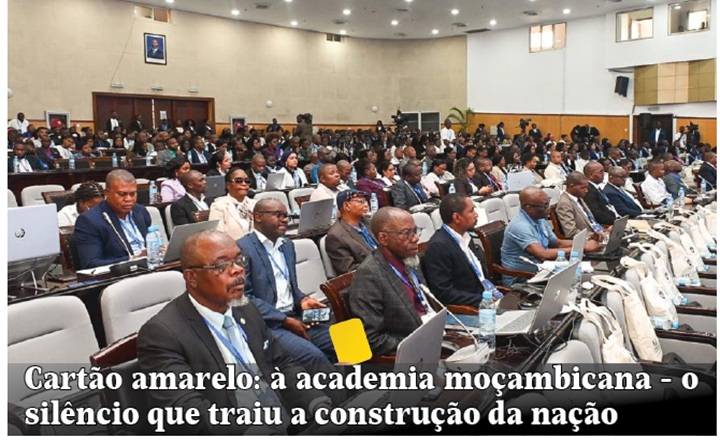
For decades, the expansion of higher education in Mozambique was presented as one of the pillars of building a more enlightened, critical society, better able to face the challenges of development. Universities, higher institutes, postgraduate programs, and research centers multiplied, while the number of graduates, masters, and doctoral degree holders grew exponentially. In theory, this process should have given rise to an intellectual elite prepared to interpret national reality independently, challenge consensus when necessary, and offer the country alternative paths to solve its problems, rather than becoming part of the problem of the country walking blindly. However, the larger the Mozambican academy has become in terms of the number of institutions, courses, and degrees, the more persistent the feeling seems to be that it has become less influential as a critical conscience of society. It is a contradiction difficult to ignore: we have never had so many academics and, paradoxically, rarely does the voice of academia seem so absent from major national debates, and academics prefer to serve the court or feign ignorance when charlatans invade the public sphere.
The problem does not lie in a lack of intelligence or technical skills. It would be unfair to deny that Mozambique possesses highly meritorious researchers, professors, and specialists, many of whom are recognized both within and outside the country, such as Professor Severino Nguenha, Professor Luís de Brito, Professor José Macuane, Professor João Mosca, Professor Elísio Macamo, and others who have strived to show the ideal path to achieving social justice, which is the foundation for socio-economic development considering the country's specificities. However, the central issue seems deeper and more troublesome than it appears. Higher education seems to be failing in its noblest objective: to form an intellectual elite capable of placing knowledge above political expediency and immediate interests. The university fails to fully fulfill its mission when it produces highly qualified professionals to perform technical functions, but who are incapable or unwilling to exercise the critical thinking that has always distinguished the true academic. A country can produce excellent engineers, lawyers, economists, or doctors and still fail to train intellectuals committed to truth, freedom of thought, and the public interest. It is precisely at this point that a legitimate concern arises. Instead of being a space where free debate flourishes and ideas are confronted without fear, part of academia gives the impression of being excessively close to political power, replacing intellectual independence with a relationship of accommodation that weakens its credibility in the eyes of society. The proximity between university and state is not, in itself, a problem; on the contrary, institutional cooperation is desirable for the benefit of national development. The problem begins when this proximity seems to reduce the willingness to question public decisions, scrutinize policies, or present critical readings of reality. At such times, the university ceases to be a space for the autonomous production of knowledge and risks being perceived as a place where dissenting opinions give way to excessive prudence, and excessive prudence often ends up being confused with conformism.
It's hard not to notice that whenever the country faces moments of high political, economic, or social tension, the academic voices that intervene publicly tend to be relatively few compared to the size of the university universe. This silence becomes particularly noticeable because it contrasts with the gravity of the problems debated by society. It's not expected that every university professor should become a permanent commentator or political opponent. However, it is expected that academia fulfill its historical vocation of producing independent reflection, questioning simplistic narratives, and enriching the public sphere with well-founded analyses. When this happens only residually, the perception arises that the university is abdicating an essential part of its social responsibility.
It is equally necessary to recognize that this phenomenon cannot be explained solely by individual choices. Many academics develop their careers in institutions heavily dependent on public funding, state administrative decisions, and structures where professional stability can be influenced by institutional factors. This context can create incentives for self-censorship and a highly cautious stance towards politically sensitive topics. Understanding these pressures does not mean accepting them as inevitable, nor does it mean concluding that all academics succumb to them. It simply means recognizing that intellectual independence often demands personal and professional costs that not everyone is willing or able to bear.
The history of thought demonstrates, however, that the value of an intellectual has never been measured by their ability to please those in power, but by their courage to subject power to the scrutiny of reason. The university was born to ask difficult questions, not to provide comfortable answers; to critically examine reality, not to automatically confirm the most convenient interpretations. When academics systematically avoid uncomfortable topics, limit their intervention to politically safe areas, or reduce knowledge to an instrument of professional advancement, they risk impoverishing the very idea of the university. Knowledge ceases to fulfill an emancipatory function and becomes merely a means of individual ascension, losing the ethical dimension that has always accompanied intellectual activity.
This is also why a society should be concerned when the space for public debate narrows and when some of those who formulate well-founded criticisms claim to face pressure, intimidation, or other forms of coercion. In such an environment, fear can become a factor conditioning the exercise of academic freedom, favoring self-censorship and reducing the diversity of perspectives available in the public sphere. A strong democracy does not fear critical universities; on the contrary, it benefits from them. Governments come and go, parties change, and political cycles end, but the mission of the university remains the same: to rigorously seek the truth, even when that truth is inconvenient for those in power.
Perhaps this is precisely where the greatest question of our time lies. If academia ceases to fully exercise its critical function, who will occupy that space? Social networks, dominated by emotion and misinformation? Partisan discourses, inevitably conditioned by political agendas? Or a public opinion deprived of the contribution of those who have dedicated years to research and study? A society that loses the independent voice of its intellectuals also loses one of its most important forms of self-correction, because a community sufficiently respected to separate serious analysis from propaganda, facts from expediency, and reason from the mere repetition of slogans ceases to exist.
This yellow card is not directed at academia because it lacks knowledge; it is directed because more is expected of it. Independence is expected where there seems to be excessive prudence, courage is expected where reserve so often prevails, and commitment to the truth is expected where, at times, the public perception is one of prolonged silence. There are still Mozambican academics who fully honor this mission, producing rigorous research and freely participating in the national debate. It is precisely these voices that demonstrate that another kind of academia is possible: one that does not confuse institutional cooperation with intellectual conformity, that understands that reasoned criticism strengthens institutions rather than weakens them, and that recognizes that the researcher's greatest loyalty does not belong to governments, parties, or influential groups, but to knowledge and the public interest.
Mozambique needs an academic community that regains the courage to think aloud, because no nation transforms itself solely through university buildings, graduate statistics, or graduation ceremonies. Societies advance when their intellectuals refuse to be mere witnesses of their time and accept the often uncomfortable duty of interpreting, questioning, and challenging it. Academic titles may open doors and confer prestige, but only intellectual independence confers true greatness. And it is precisely this independence, more than any other indicator, that continues to be the measure of a university's social utility.
Outras noticias
Culture
Launched at BCI, a book that immortalizes memories and humor of Zambézia
2026-10-02

Society
International Coffee Day
2026-10-02
Society
Minister Mathlombe squanders his term on empty promises
2026-10-02
policy
Constitutional Council Awards Purchase of Luxury Vehicles for 49.5 Million Meticais
2026-10-01

Culture
International Coffee Day: Aroma, Flavor, and History
2026-09-30
Copyright Jornal Preto e Branco All rights reserved . 2025