
Yellow Card: The Lies of Truth — President Chapo and the Dialogue That Never Happened
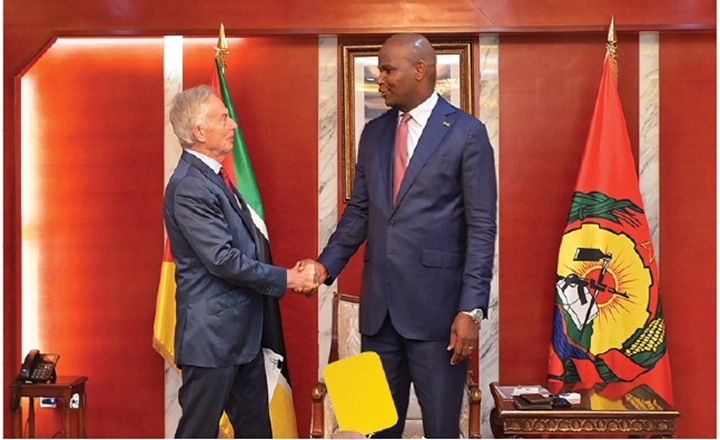
No president in Mozambique's history has dared to venture abroad in search of solutions for the country's development as President Chapo has done, in a scenario of near diplomatic begging. However, these reckless trips are not accompanied by a coherent foreign policy, and the indecision opens space for various interpretations, with international players paying close attention to this chameleon-like posture. Nevertheless, the yellow card in this edition is due to the President's stance on a reality that worries the world: his relationship with Venâncio Mondlane and the latter's role in stabilizing the country. This card comes precisely at a moment when the distance between the political narrative and reality becomes too evident to continue being ignored. This was the case during President Daniel Chapo's recent visit to Portugal, when, confronted about the political relationship with Venâncio Mondlane and the possibility of direct dialogue between them, the Head of State found himself facing a simple, concrete question known to all Mozambicans. However, instead of clarifying the true state of this relationship to the country and the international community, he preferred to refer to the Technical Commission for National Dialogue (COTE) and the Council of State, as if these mechanisms alone were the embodiment of the political dialogue that continues to be lacking. And it is precisely there that the concern lies: because there are times when how a leader responds is as important as what he actually decides to do. It is difficult to understand the need to misrepresent the truth about a matter whose reality is widely known. To date, there is no public evidence of a direct political dialogue between Daniel Chapo and Venâncio Mondlane. There are institutional mechanisms, forums, platforms, and various initiatives, but none of them replaces what the country has long awaited: a serious, frank, and open political conversation between actors who represent different sensibilities and who have real influence over national destinies. To transform the COTE (Commission for Economic and Social Development) or the Council of State into synonyms for direct dialogue is, at the very least, putting the cart before the horse, because before talking about reconciliation, understanding or inclusion, it is necessary to honestly acknowledge that dialogue has not yet taken place in the terms that society demands.
The inevitable question arises: why this headlong rush? Why insist on a narrative that hardly withstands the facts? What leads a President of the Republic to convey to the outside world the idea of a political rapprochement that, internally, has yet to happen? These are legitimate questions, especially since Daniel Chapo has sought to establish himself, from the beginning of his term, as a leader committed to inclusion, listening, and building consensus. However, between the carefully constructed image and the concrete actions, a contradiction remains that is becoming increasingly difficult to ignore. Too often, the official discourse continues to obey an excessively partisan logic, incapable of recognizing that the political and social crisis the country is going through has deep and accumulated causes, some of them predating the demonstrations and others related to the institutions' own inability to respond to citizens' concerns. The insistence on almost exclusively blaming the protests for the delay in economic development, the slowdown in investment, or the country's difficulties constitutes a dangerous simplification, because it deliberately ignores the structural factors that fuel instability and ends up transforming discontented citizens into scapegoats for much more complex problems. The demonstrations did not arise by whim. They did not emerge from nothing. They result from accumulated tensions, persistent distrust, and a growing perception of distance between rulers and the ruled. Ignoring this reality will not make it disappear. On the contrary, it may only deepen it. And it is precisely in this context that the refusal to engage directly with relevant political actors ceases to be a partisan problem and becomes a risk to national cohesion itself. Venâncio Mondlane cannot be treated as an irrelevant or circumstantial political actor. Regardless of the sympathies or antipathies he arouses, there is an objective reality that no narrative will be able to erase: he is one of the most influential political figures in present-day Mozambique. His popularity, the mobilization capacity he has demonstrated, and the political capital he has accumulated over more than two decades of public life demand seriousness in how he is viewed by his adversaries and, above all, by state institutions. Processes of political stabilization are rarely built by ignoring those who represent significant segments of society. History demonstrates exactly the opposite. Great national reconciliations have occurred when leaders have understood that political legitimacy does not belong exclusively to those who govern, but also to those who can mobilize, represent, and interpret the aspirations of relevant sectors of the population. Denying this reality has never produced stability; it has only prolonged conflicts.
That is why the absence of direct dialogue is worrying. Not because dialogue is a magic solution capable of resolving all differences, but because its absence prevents any serious possibility of building consensus. Political stability does not arise from silence. It does not arise from exclusion. It does not arise from the attempt to artificially reduce the importance of certain actors. It arises from the ability to recognize differences and build bridges, even when those bridges require political discomfort.
Meanwhile, President Daniel Chapo continues to travel to foreign capitals, seeking to restore Mozambique's image in international economic and diplomatic circles. This is a legitimate and necessary effort. No country can prosper in isolation, and investor confidence remains important for economic growth. However, there is a reality that cannot be ignored: the civil societies of these countries are increasingly attentive to the unfolding political situation in Mozambique. Universities, international organizations, the media, and parliaments are closely following events in the country and formulating questions that do not disappear simply because official responses attempt to circumvent the facts.
When a President presents a version of events that contradicts what is widely known, the problem ceases to be merely internal. It also becomes a matter of external credibility. And credibility is an extremely valuable political asset, because once weakened, it becomes very difficult to recover.
The perniciousness of a false narrative lies precisely there. It may produce momentary gains in political communication, but it exacts a high price in the future. It erodes citizens' trust, fuels suspicion among international partners, and weakens the moral authority of those who govern. The truth, however uncomfortable it may be, remains far less costly than maintaining versions that the facts insist on refuting. We are facing a delicate situation. Almost two years after the beginning of the profound political crisis that shook the country, Mozambique still has not achieved the political stability necessary for peaceful and predictable governance. And without political stability, there will hardly be lasting conditions for achieving the economic and social objectives that the President himself claims to pursue.
It is in this context that COTE deserves particularly serious reflection. What was presented as an instrument of national reconciliation risks becoming a political hoax doomed to failure. Not because dialogue is unnecessary, but because the process seems to avoid precisely what divides Mozambicans. Instead of placing at the center of the debate issues related to trust in institutions, electoral processes, the credibility of justice mechanisms, and the deep reasons for political polarization, the choice is made to introduce parallel agendas, many of them cloaked in an apparently consensual discourse, but deeply marked by obscure and carefully camouflaged partisan interests.
The feeling that remains is that of a poisoned gift: the country is offered a process of dialogue, but the essential issues are avoided. And when the essential is permanently postponed, the result can hardly be reconciliation. Daniel Chapo still has time to correct this trajectory. No leader is diminished by acknowledging difficulties. No President is weakened by telling the truth. On the contrary, it is precisely the ability to recognize reality, however uncomfortable it may be, that distinguishes authentic leadership from the simple management of narratives. Mozambique does not need an imagined dialogue. It needs a true dialogue. It does not need a proclaimed inclusion. It needs a practiced inclusion. And it does not need speeches intended to convince the world that everything is fine when the country itself continues to search for the stability that was promised to it. Because the truth may cause momentary discomfort, but its absence has the power to compromise the entire future of a nation.
Outras noticias
Culture
Launched at BCI, a book that immortalizes memories and humor of Zambézia
2026-10-02

Society
International Coffee Day
2026-10-02
Society
Minister Mathlombe squanders his term on empty promises
2026-10-02
policy
Constitutional Council Awards Purchase of Luxury Vehicles for 49.5 Million Meticais
2026-10-01

Culture
International Coffee Day: Aroma, Flavor, and History
2026-09-30
Copyright Jornal Preto e Branco All rights reserved . 2025