
YELLOW CARD Malhampswene: The Municipality of Matola and Capitulation in the Face of Chaos
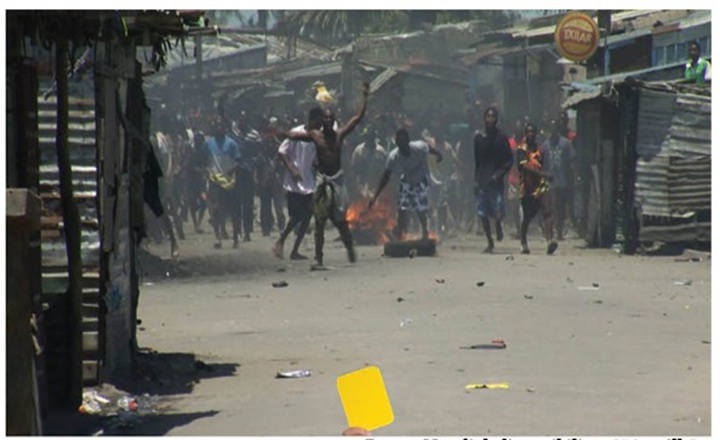
There are moments in a city's life when poverty ceases to be a sufficient explanation for its problems, the scarcity of resources stops serving as a justification, and the economic crisis loses its capacity to support the usual excuses of those in power. At these times, what emerges with uncomfortable clarity is the absence of leadership, the inability to plan, and the resignation of institutions in the face of problems that should be confronted with determination. It is precisely this feeling that overwhelms any attentive observer who walks through the Malhampswene Market and its surroundings today. What one finds there is not just a growing informal market. It is the portrait of a municipal authority that seems to have given up on organizing the territory, allowing disorganization to gradually become the main identifying mark of one of the busiest areas in the Municipality of Matola.
The degradation observed in Malhampswene cannot be analyzed as an isolated phenomenon. It constitutes the visible manifestation of an explosive combination of growing urban poverty, persistent unemployment, continuous migration to urban centers, and the inability of the authorities to keep pace with the speed at which the city expands. However, recognizing these structural causes cannot absolve the municipality of its responsibilities. Governing a city precisely implies confronting these pressures, anticipating trends, and building responses. When the municipality passively observes the growth of informality without presenting consistent solutions, it ceases to be part of the solution and becomes part of the problem itself.
Anyone visiting Malhampswene encounters a scene that defies any basic notion of urban organization. The sidewalks have been taken over by informal commerce, the verges have become makeshift extensions of stalls, and in many cases, the roads themselves are now shared by cars, vans, vendors, and buyers. The formal market built to house commercial activity watches, almost silently, as its spaces are gradually abandoned, while thousands of operators prefer to set up shop outside, where oversight is practically nonexistent and the occupation of public space occurs without any apparent criteria.
What is most worrying is that the disorganization is no longer limited to the market. Little by little, the entire Malhampswene neighborhood seems to be becoming hostage to the chaotic dynamics that the market produces daily. Streets, intersections, residential areas, and circulation spaces are being absorbed by disordered commercial activity that reconfigures the urban landscape, alters behaviors, and redefines priorities. The image of an organized and functional neighborhood is gradually disappearing, replaced by a reality in which improvisation prevails over any attempt at planning.
The consequence of this transformation is profound. The market has ceased to be merely an economic space and has become a force capable of shaping the social environment, territorial occupation, and even the collective perception of what is acceptable in terms of urban management. Where there were once references to community organization, there are now congested corridors, accumulated waste, permanent dust, and a growing feeling that no one is actually in charge. The neighborhood is losing its beauty, its identity, and its urban nobility, while informality advances as a seemingly inevitable process.
It would be unfair to blame vendors exclusively for this reality. Most of them are simply trying to survive in an extremely adverse economic context. The expansion of informal commerce is, to a large extent, a direct consequence of the formal economy's inability to absorb the growing mass of citizens seeking income opportunities. Each makeshift stall represents a story of struggle, unemployment, or precariousness. However, understanding the reasons that push people towards informality does not mean accepting that the city should be abandoned to the logic of spontaneous occupation.
It is precisely here that the responsibility of municipal governance emerges. A city cannot be managed only when circumstances are favorable. True administrative capacity is revealed in moments when challenges increase. In Malhampswene, however, the dominant impression is of an authority that has lost initiative, the capacity for intervention, and the confidence to enforce its own rules. The absence of structured measures conveys the idea that the municipality has merely watched the problem grow until it reached proportions that are difficult to control.
The issue of formal unemployment is one of the central roots of this crisis. For years, thousands of young people and adults have been pushed into survival activities due to the inability of the labor market to generate sufficient opportunities. Informality has come to play an essential economic role, but its uncontrolled expansion has brought devastating urban consequences. What should have been a temporary escape valve has become a dominant model of economic organization, with direct impacts on territorial planning, mobility, and quality of life.
Meanwhile, rural exodus and the expansion of peripheral neighborhoods have significantly increased the pressure on Matola. Families from different regions continue to seek better life prospects in the city. However, the speed of this population growth has not been accompanied by proportional investments in markets, sanitation, transport, and public infrastructure. The result is constant pressure on already limited resources and an increasingly intense occupation of available spaces.
Malhampswene has become an extreme example of this reality. The place functions simultaneously as a market, transport terminal, center of people circulation, and space for economic survival for thousands of citizens. This multiplicity of functions demands sophisticated management capacity, but what is observed is precisely the opposite. There is a lack of coordination, a lack of planning, and, above all, a lack of a strategic vision capable of reconciling economic inclusion with urban organization.
Another unsettling element is the growing perception that authorities are afraid to confront the problem. The expansion of informality seems to have created a power dynamic in which the municipality hesitates to act for fear of social conflict or political fallout. This hesitation has a high cost. When rules cease to be consistently applied, the idea takes hold that public space belongs to whoever occupies it first. Little by little, institutional authority loses legitimacy and opens the door to a culture of permanent improvisation.
The environmental and health impacts of this reality cannot be ignored. The accumulation of waste, the exposure of food to dust, the lack of adequate conditions for handling food products, and the increasing degradation of public spaces constitute real risks to public health. This is not merely an aesthetic issue. It is a public health problem that tends to worsen as disordered occupation intensifies.
The situation becomes even more serious when one considers that Malhampswene is an important entry and transit point for people from various parts of the municipality. The image conveyed daily to thousands of citizens is that of a city incapable of organizing one of its main centers of economic activity. This perception erodes trust in institutions and contributes to the normalization of chaos as a permanent characteristic of urban life.
Over the past few years, the Zimpeto Market has frequently been cited as one of the biggest symbols of informality in the Maputo metropolitan area. Today, however, Malhampswene is rapidly approaching that status. The continuous growth of informal activity and the inability to regulate the occupation of public space are causing the area to become one of the biggest examples of urban disorder in the province.
For all these reasons, this Yellow Card is addressed to the Mayor of Matola and his governing team. Not because they are solely responsible for the structural problems affecting the city, but because they are primarily responsible for the management of the municipal territory. Governing means making difficult decisions, planning for the future, and protecting the collective interest. When these functions are abandoned, problems accumulate until they reach proportions that threaten governability itself.
Malhampswene has become an uncomfortable symbol of a city that seems to passively witness the expansion of informality, environmental degradation, and the erosion of public authority. The neighborhood is being slowly transformed by the disorganizing force of a market that grows without direction, reconfiguring the landscape, altering behaviors, and weakening references to order and urban coexistence. If nothing is done, the risk is that this reality will cease to be an exception and become the dominant model of urban development in Matola.
A city that relinquishes its ability to manage its territory risks losing much more than control over its markets. It risks losing its identity, its functionality, and its dignity. And it is precisely this risk that hangs over Malhampswene today and, by extension, over the entire Municipality of Matola.
Outras noticias

Culture
Launched at BCI, a book that immortalizes memories and humor of Zambézia
2026-10-02
Society
International Coffee Day
2026-10-02

Society
Minister Mathlombe squanders his term on empty promises
2026-10-02
policy
Constitutional Council Awards Purchase of Luxury Vehicles for 49.5 Million Meticais
2026-10-01

Culture
International Coffee Day: Aroma, Flavor, and History
2026-09-30
Copyright Jornal Preto e Branco All rights reserved . 2025