
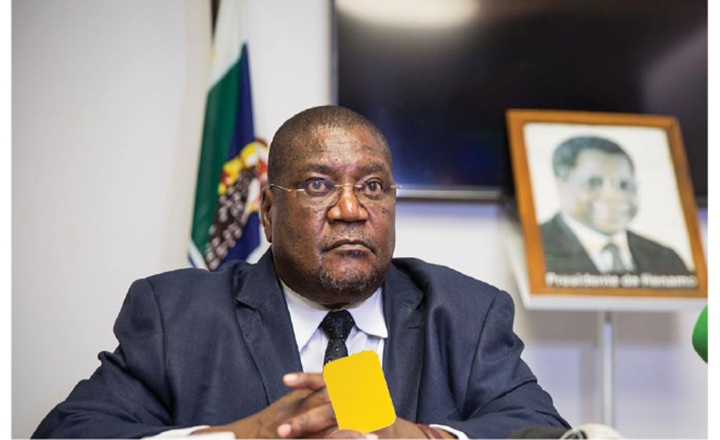
YELLOW CARD FOR OSSUFO MOMADE: WHAT DOES THE RENAMO LEADER GAIN BY DESTROYING THE INTERNAL COHESION OF HIS PARTY?
For decades, RENAMO occupied an unavoidable place in the political history of Mozambique. Its origins are inevitably linked to the armed conflict that marked the country for many years, but it would be intellectually dishonest to reduce its contribution solely to the war. After the signing of the General Peace Agreement in 1992, RENAMO became the main opposition party and played a decisive role in opening up democratic space, institutionalizing multi-party politics, and consolidating political alternation as a legitimate possibility within the Mozambican state.
Regardless of ideological differences, the existence of a strong opposition forced successive governments to face greater scrutiny, allowed thousands of citizens to find a political alternative, and created conditions for the national debate to cease being the monopoly of a single party. It was precisely this capacity to represent opposing viewpoints that made RENAMO indispensable to Mozambican democracy.
Unfortunately, the current reality reveals a party profoundly different from the one that for many years mobilized millions of Mozambicans. The organization that once inspired hope in a large part of the electorate is now immersed in a crisis of leadership, identity, mobilization, and, above all, internal cohesion. Fragmentation has become the dominant image of RENAMO.
That is precisely why this week's Yellow Card is directed at the leadership of RENAMO, particularly its president, Ossufo Momade, for what many observers consider to be a continuous process of political weakening of the party and for the demonstrated inability to preserve internal unity and reaffirm the organization's relevance on the national political scene.
Political leadership is not measured solely by tenure in office. It is measured by the ability to inspire trust, unite different perspectives, produce strategic vision, and project a collective future. A leader exists to strengthen the institutions they lead; when the opposite happens, it becomes inevitable to question the effectiveness of their leadership.
Under the presidency of Ossufo Momade, RENAMO seems to have lost precisely these attributes. Successive internal disputes have ceased to be isolated episodes and have become a permanent feature of the party's functioning. Disagreements that were previously resolved through internal mechanisms have now reached the courts, publicly exposing a worrying inability to engage in political dialogue among leaders of the same party.
When an organization frequently needs judicial intervention to overcome impasses related to meetings, internal bodies, or administrative procedures, this is a clear sign of institutional weakness. Courts should resolve legal disputes, not replace the political mechanisms inherent to political parties.
The situation becomes even more worrying because these divisions are occurring precisely at a time when Mozambique is facing enormous political, economic, and social challenges. One would expect a strong, organized opposition, prepared to present consistent governance alternatives. Instead, we are witnessing an organization absorbed by internal conflicts, seemingly detached from the concrete concerns of citizens.
A democratic opposition doesn't exist solely to criticize those in power. It exists to convince citizens that it possesses better solutions for the country. This exercise requires the production of ideas, concrete proposals, permanent public intervention, and a consistent political presence.
Unfortunately, it is precisely this dimension that seems absent from the current leadership of RENAMO. The debate on governance programs has been replaced by the debate on internal conflicts. Political proposals have disappeared from the public agenda, giving way to disputes between leaders.
It is equally difficult to identify a clear vision for Mozambique presented by the current party leadership. What are the economic priorities? What is the strategy to combat unemployment? What institutional reforms does it propose? How does it intend to improve education, health, agriculture, or the management of natural resources?
These are legitimate questions that, to a large extent, remain without sufficiently consistent answers.
Meanwhile, the political space previously occupied by RENAMO is being filled by new actors, new movements, and new public figures. In politics, a vacuum never remains empty for long.
The last general elections highlighted this process of loss of influence. The election results were interpreted by numerous analysts as a demonstration of the weakening of RENAMO's mobilizing capacity. Although any election can be subject to different political interpretations, it is difficult to ignore that the party has ceased to represent the electoral force that for many years characterized the Mozambican opposition.
Naturally, election results depend on multiple factors. However, responsible leadership must also assume its share of responsibility when political objectives are not achieved.
Another aspect frequently mentioned by analysts and supporters concerns the limited public presence of the party president. In a democracy, leadership is also exercised through constant communication with citizens. A political leader needs to occupy public spaces, respond to national concerns, convey confidence, and demonstrate the ability to mobilize.
When this presence becomes scarce, the perception of political absence inevitably sets in.
This perception is compounded by the persistent internal criticism regarding the process that led to the current leadership of RENAMO. Various sectors of the party have raised concerns about how certain internal processes unfolded, pointing to alleged shortcomings in terms of participation and transparency. Regardless of the validity of these criticisms, the mere fact that they have persisted for so long demonstrates that internal reconciliation was never fully achieved.
Democratic parties survive when they manage to transform differences into political debate. They die slowly when they transform differences into permanent wars between factions.
There is a deeper reflection that Mozambique needs to undertake.
The country's two largest parties were born in contexts marked by armed struggle. FRELIMO emerged from the national liberation struggle; RENAMO was born in the context of civil war. This historical origin has profoundly marked the national political culture.
For a long time, both parties favored strongly hierarchical structures, personalized leadership, and limited institutionalization of internal mechanisms for political renewal. Although important differences exist between them, organizational traits inherited from their respective contexts of origin remain present.
Established democracies depend not only on holding periodic elections, but also on the existence of strong, institutionalized, transparent parties capable of regularly renewing their leadership without traumatic ruptures.
Mozambique needs precisely this kind of evolution.
Political parties must stop depending excessively on the figure of the leader and strengthen internal institutions. Congresses should constitute true spaces for debate. Internal elections need to generate trust between winners and losers. Differences of opinion cannot be seen as acts of disloyalty, but as a natural expression of democratic plurality.
In the specific case of RENAMO, this means recovering what for many years constituted its greatest strength: the ability to represent millions of Mozambicans who were looking for a credible political alternative.
This recovery is unlikely to happen without a deep reflection on the quality of the current leadership.
This is not about advocating for change based on mere emotional impulse, nor about denying the formal legitimacy of the current leadership. It is about recognizing that political legitimacy also depends on the results achieved, the ability to mobilize, unite, and persuade.
No political organization remains relevant simply because it had a glorious past. Historical legitimacy needs to be continually renewed through present performance.
Mozambican democracy needs a robust opposition. Not to weaken the government, but to strengthen the democratic system itself. A country benefits when it has a strong government, a strong opposition, independent institutions, and engaged citizens.
Therefore, this Yellow Card is not intended to celebrate RENAMO's difficulties. On the contrary. The weakening of the main opposition party represents a loss for the entire Mozambican democracy.
The letter is addressed to the leadership of Ossufo Momade because many of the current problems converge on the inability to restore internal unity, project a mobilizing vision, and politically reposition a party that was decisive in building pluralism in Mozambique.
History grants opportunities, but it also demands responsibilities. RENAMO helped open the doors to multi-party democracy; now it needs to demonstrate that it remains capable of fully thriving within that same democracy. Otherwise, it risks remaining merely a historical reference, incapable of exerting effective influence on the present and, above all, on the political future of the country.
A democracy without an organized, credible opposition prepared to govern will always be a poorer democracy.
Outras noticias

Culture
Launched at BCI, a book that immortalizes memories and humor of Zambézia
2026-10-02

Society
International Coffee Day
2026-10-02

Society
Minister Mathlombe squanders his term on empty promises
2026-10-02
policy
Constitutional Council Awards Purchase of Luxury Vehicles for 49.5 Million Meticais
2026-10-01

Culture
International Coffee Day: Aroma, Flavor, and History
2026-09-30
Copyright Jornal Preto e Branco All rights reserved . 2025