
Wazimbo and José Mucavele sing together again after four decades
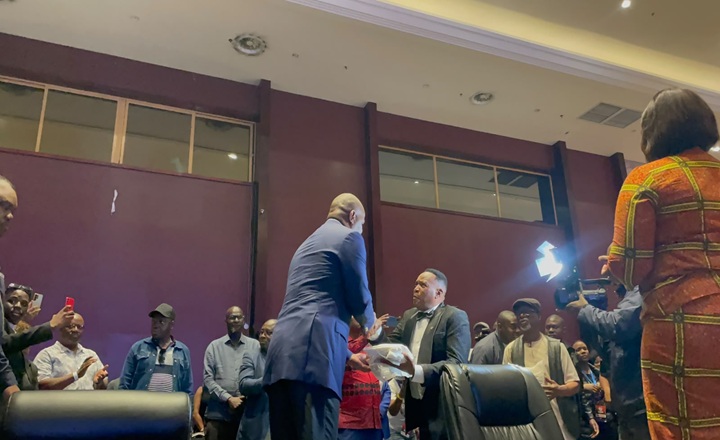
One of the most anticipated moments of the evening occurred when Wazimbo and José Mucavele shared the same stage again, some 40 years after an artistic separation. The reunion, marked by the joint performance of Xibomba Xa Romos and Nwahulana, transformed the Tlhangano – The Reunion concert into a celebration of the memory and identity of Mozambican music.
Organized by the Karingana Wa Karingana Association and SH Consultoria e Serviços, the Tlhangano – The Reunion concert brought together two of the greatest figures in national music. For about four hours, Wazimbo and José Mucavele starred in one of the most symbolic moments in the recent history of Mozambican music, before an enthusiastic audience that filled the venue.
Artistically separated for approximately four decades, following disagreements related to their musical careers and, in particular, Nwahulana music, the two artists reunited to sing together from the very beginning of the show. José Mucavele began performing Xigutsa Xa Utome solo, at which point Wazimbo emerged from the audience to join in the singing, before returning to the main stage.
From then on, the two artists alternated between solo moments and joint performances, revisiting a repertoire that spanned several generations. The atmosphere gained particular intensity when, late in the concert, Wazimbo invited the audience to turn on their mobile phone lights to join in the joint performance of songs they hadn't sung together in a long time. This was followed by Xibomba Xa Romos and Nwahulana, performed as a duet.
Emotion filled the room, especially since it was an artistic union that many of those present had never witnessed. Wazimbo and José Mucavele, seated side by side at different moments of the show, recovered not only songs, but also an important part of the memory of Mozambican music.
The show was conceived precisely from this dimension of memory and transmission between generations. At one point, Wazimbo highlighted that the songs presented would transcend several generations, justifying the presence of children, parents, and grandparents in the same audience. José Mucavele, in turn, proposed a symbolic toast to friendship, memory, and Mozambican music, in a moment justified by much dancing and singing, with particular emphasis on the songs "Balada para as Minhas Filhas" and "Sapateiro".
The journey through the national repertoire was not, however, limited to the two protagonists. The concert featured special appearances by Banda Ghorwane, Xixel Langa, Tchakaze, Alvim Cossa, as well as comedians Eduh All Talents and Borges Macuácua and DJ Elísio, who contributed to a diverse program combining music, poetry, humor and performance.
Xixel Langa and Tchakaze, in one of the most interactive phases of the show, took on the mission of revisiting hits from different generations of Mozambican music. In a format of artistic competition, but marked by complicity, the two performers alternated songs known to the public, including Mulher Tem Força, Mahungo, Nikazalile Nkata, Josua, Likirikita and Lirandzo. The proposal allowed for a kind of musical map of the country through songs from different artists and eras. In the second segment, the journey through the Mozambican repertoire continued with Nikome Nkata, Felismina, Xikongolotana and Sibosise, before the artists and teams gathered on stage for the final bow.
Another highlight was the participation of Alvim Cossa, who delivered a poetic recitation at the opening, followed by a choreographic performance by the Xindiro Group.
The humorous element was provided by Eduh All Talents and Borges Macuácua, who opened the show with a staged microphone duel. Through their dialogue, they revisited stories and references related to the careers of Wazimbo, José Mucavele, and other names in Mozambican music, creating a relaxed introduction to an evening dominated by memory and cultural identity.
The very concept of the show sought to bring the music closer to the audience. The staging included an extension of the stage installed in the middle of the audience, allowing for musical interludes and moments with the spectators, creating a closer relationship between artists and audience.
After the various performances by Wazimbo, José Mucavele, Xixel Langa and Tchakaze, it was Banda Ghorwane's turn to close the live performances. With their repertoire, the band brought the room to its feet, getting the audience to sing and dance and prolonging the celebratory atmosphere that marked the entire night.
The concert also featured a highly significant institutional presence. Among the guests were the President of the Republic of Mozambique, accompanied by the Minister of Education and Culture, the Mayor of Maputo, and other officials from the Mozambican government structure, who witnessed firsthand the reunion between two key figures in national music.
For approximately four hours, Tlhangano – The Reunion transformed the stage into a place of artistic reconciliation and celebration of collective memory. More than simply reuniting Wazimbo and José Mucavele, the concert sought to recover repertoires, stories, and references that helped build Mozambican musical identity, bringing together different generations of artists and audiences in the same space.
Promoted by the Karingana Wa Karingana Association and SH Consultoria e Serviços, the concert thus transformed a long-standing separation into a new chapter in the history of Mozambican music. Decades after an artistic split, Wazimbo and José Mucavele sang together again before an audience that accompanied, with applause and emotion, what for many years seemed to belong only to memory.
Outras noticias

Society
CIM challenges the legality of the suspension announced by ICM
2026-10-15

Society
CoWork Lab celebrates 14 years in Mozambique and inaugurates its seventh business center in Maputo
2026-10-15
Society
BCI reinforces support for female entrepreneurship in Beira
2026-10-15

policy
Edson Macuácua is the new Minister of Education and Culture
2026-10-15
policy
Morocco: King Mohammed VI demands mobilization and responsibility in the formation of the new government
2026-10-14
Copyright Jornal Preto e Branco All rights reserved . 2025