
Mozambique Future Green Business Expo advocates for its own path to environmental transformation
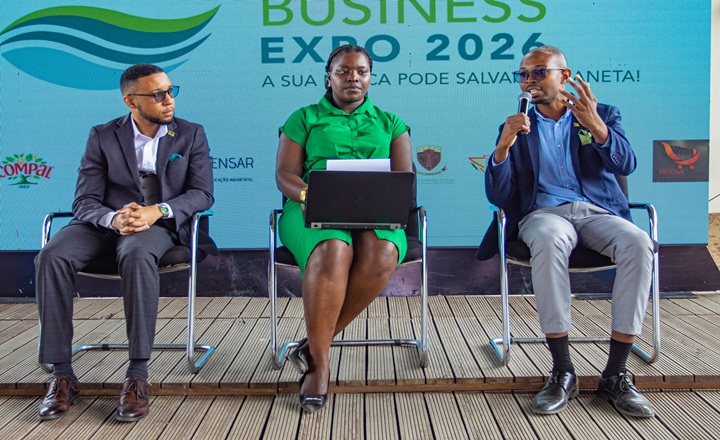
The first edition brought together government agencies, companies, experts, civil society and children in a debate on regulation, innovation, corporate responsibility and solutions tailored to the Mozambican reality.
The first edition of the Mozambique Future Green Business Expo 2026 focused the debate on the need for Mozambique to forge its own path to environmental transformation. The event brought together representatives from government agencies, the private sector, academia, civil society, experts, and new generations, focusing on solutions that reconcile economic growth, environmental protection, and the creation of opportunities.
In his opening remarks, the Director-General of Ecobrand Mozambique, Faustino Quissico, stated that sustainability must move from discourse to practice and become part of business and institutional decisions. “Sustainability should not be a discourse about the future. It must be a practice in the present and a concrete opportunity to transform lives,” he said, advocating for a closer relationship between the business sector and environmental challenges.
The regulatory component was addressed by João Cipriano and Leonardo Solila, from the National Directorate of Environment and Climate Change (DINAMC). Their interventions drew attention to the legal framework that guides the management of waste, plastics and chemicals in Mozambique, in a context where the application of the rules also depends on the participation of companies, institutions and citizens.
Among the highlighted instruments were the Regulation on the Management and Control of Plastic Bags, approved by Decree No. 16/2015, and the Regulation on the Management of Hazardous Waste, approved by Decree No. 83/2014. The Regulation on the Management of Chemical Products and Organic and Persistent Pollutants, approved by Decree No. 25/2024, was also included.
In turn, the jurist and environmentalist Carlos Serra argued that the country's environmental transformation should not result from simply reproducing external models. Mozambique, he stated, "will have to find its own process, suited to the country's economic, social and institutional conditions, and capable of transforming environmental challenges into development opportunities."
The same idea was reinforced by James Robinson, who participated in the event via videoconference. Drawing on experiences from the United Kingdom and Rwanda, Robinson addressed the role of the State and institutions in leading change processes and emphasized the importance of each country making sovereign decisions, tailored to its reality and the trajectory of its institutions.
The event also sought to give space to new generations. A representative from the organization Children and Successors of Mozambique reminded everyone that the decisions made today will define the conditions in which children will live, work, and lead in the future. “We believe in Mozambique, we believe in its people, and we believe that together we can build a greener, more prosperous Mozambique with more opportunities for all. Our future is in our hands,” she stated.
The children's participation thus reinforced the educational dimension of the meeting and the idea that sustainability is not the exclusive responsibility of the government or companies. Change requires environmental education, behavioral change, community involvement, and a closer relationship between public policies, investment, and innovation.
The Mozambique Future Green Business Expo 2026 combined a forum for debate, an exhibition of green solutions, and environmental workshops. The organization aims to consolidate the event as a platform connecting companies, public institutions, investors, experts, entrepreneurs, and communities, creating conditions for sustainable ideas to find partners and evolve into concrete solutions.
For Faustino Quissico, the challenge lies in creating an economy that generates wealth without compromising the resources that make that wealth possible. The meeting concluded with an appeal for shared responsibility, in which companies, the State, communities, and citizens assume an active role in building a more sustainable Mozambique.
Outras noticias
Culture
Launched at BCI, a book that immortalizes memories and humor of Zambézia
2026-10-02
Society
International Coffee Day
2026-10-02
Society
Minister Mathlombe squanders his term on empty promises
2026-10-02
policy
Constitutional Council Awards Purchase of Luxury Vehicles for 49.5 Million Meticais
2026-10-01
Culture
International Coffee Day: Aroma, Flavor, and History
2026-09-30
Copyright Jornal Preto e Branco All rights reserved . 2025