
Morocco inaugurates $5.5 billion MegaPort
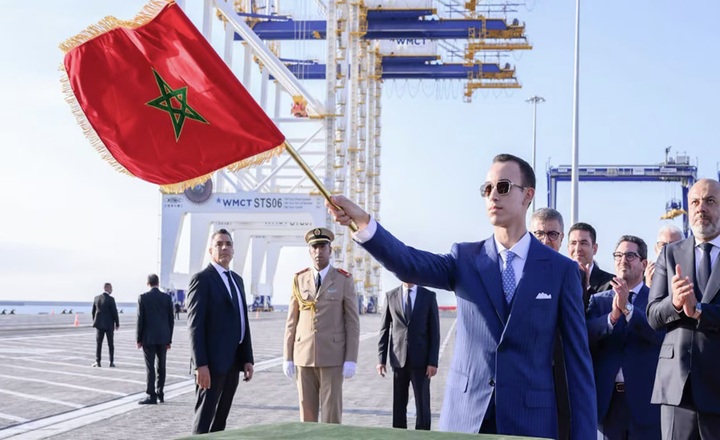
NADOR, October 31, 2026 – Morocco inaugurated the first container terminal at the port of Nador West Med this Saturday, in a ceremony presided over by Crown Prince Moulay El Hassan, on the high instructions of King Mohammed VI. The project, valued at approximately $5.5 billion, is expected to position the country as one of the main logistics and commercial hubs between Africa, Europe, the Middle East and Asia.
The industrial-port complex, which represents approximately $5.5 billion in public and private investment, is expected to reach an annual capacity of 5.3 million containers and generate 34,000 direct and indirect jobs. The project includes two large container terminals, energy infrastructure, and a 700-hectare industrial and logistics platform.
The ceremony, held in the municipality of Iaâzzanène, Nador province, marks the start of operations for an ambitious industrial-port complex, designed to transform the eastern region of Morocco into a new center for industrial, logistical, energy and commercial development, with projections for the European, Mediterranean, African, Asian and Middle Eastern markets.
Valued at 54 billion dirhams in public and private investments, Nador West Med represents one of the Kingdom's main strategic bets to diversify its port infrastructure, attract productive investment and strengthen the competitiveness of the Moroccan economy.
The central moment of the inauguration was marked by the start of the first unloading operation of a container from a commercial ship at the terminal called "East," symbolizing the effective entry of the project into the operational phase.
First terminal with capacity for 3.5 million containers.
The East Terminal, whose construction and equipment required an investment of approximately five billion dirhams, has 1,520 meters of quay, a depth of 18 meters, and an area of 70 hectares dedicated to container operations and storage.
The infrastructure is expected to reach an operational capacity of 3.5 million TEUs (twenty-foot equivalent units) by 2030, positioning Nador West Med as a relevant platform on international shipping routes.
The concession for the operation and maintenance of the terminal was granted, for a period of 25 years, to the consortium formed by Marsa Maroc and Terminal Investment Limited (TIL), a subsidiary of the MSC group, one of the world's leading operators in container shipping.
The partnership combines the experience of a Moroccan port operator with the operational capacity and international network of the MSC group, allowing the new port to be integrated into key global supply chains.
The second terminal will increase capacity to 5.3 million TEUs.
The project also includes a second container terminal, called "Oeste," which is scheduled to become operational in April 2027.
With an estimated investment of three billion dirhams, the terminal will be operated by a consortium formed by Marsa Maroc and CMA CGM, one of the world's largest container shipping companies.
The new infrastructure will have 900 meters of quay and 38 hectares of operational area, with an annual capacity of 1.8 million TEUs.
When both terminals are fully operational, the port of Nador West Med is expected to reach a combined capacity of 5.3 million containers, significantly enhancing Morocco's ability to receive large commercial vessels and move goods destined for major international markets.
Energy and industrial hub of international importance.
In addition to container terminals, the complex includes infrastructure for handling different types of goods and for developing energy-related activities.
Among the main investments planned are:
Bulk cargo terminal: capacity to handle seven million tons, with operation scheduled to begin in June 2027.
Diverse cargo terminal: 22 hectares in area and capacity for three million tons, with operations scheduled to begin in December 2028.
Roll-on/Roll-off (Ro-Ro) cargo terminal: capacity for 400,000 units, with 380 meters of quay.
Liquefied natural gas (LNG) terminal: capacity of five billion cubic meters, with 360 meters of quay.
Hydrocarbon terminal: handling capacity of 25 million tons, equipped with three berths of 125 meters each.
The energy component is one of the most important dimensions of the project, as it will strengthen the capacity for receiving, storing, and transporting energy products, creating conditions to attract international operators and investors in the sector.
The energy terminals are scheduled to become operational in April 2027.
The project is expected to create 34,000 direct and indirect jobs.
One of the most significant socioeconomic impacts of Nador West Med is related to job creation and the boost to the regional economy.
According to the data presented in the official statement, the complex should allow the creation, in the short term, of approximately 14,000 direct jobs and 20,000 indirect jobs, with special attention to opportunities aimed at young people.
The initiative also includes an industrial and logistics platform spanning 700 hectares, which is expected to attract around 12 billion dirhams in private investment.
This component aims to attract industrial companies, logistics operators, service providers, and investors linked to international trade, creating an economic ecosystem around port activity.
The project also includes vocational training and technical skills development programs, geared towards the needs of the new economic activities that will be developed in the complex.
The strategy seeks to ensure that young people in the region can directly benefit from the employment opportunities generated by the project, through the acquisition of skills suited to the demands of the industrial, port, energy and logistics sectors.
Rail and road links enhance connectivity.
The operationalization of Nador West Med will be accompanied by the development of transport infrastructure designed to ensure the port's connection to the country's main economic and industrial centers.
Among the key infrastructure projects are a 49-kilometer railway line between Selouane and Nador West Med and a 105-kilometer road link via a highway originating in the city of Guercif.
These infrastructures should facilitate the flow of goods, reduce logistical constraints, and improve the integration of the complex into national and international transport networks.
Rail and road connectivity is of particular importance to the competitiveness of the project, as it will allow for the integration of maritime operations with industrial production, distribution, and consumption centers.
Nador West Med complements the strategy initiated with Tanger Med.
The new port is part of a national strategy for the development of large port infrastructures, the most consolidated expression of which is the Tanger Med complex.
The investment in Nador West Med aims to expand the country's logistical capacity and establish complementarity between different port platforms, allowing the Kingdom to respond to the growing demand for maritime transport and goods handling services.
Moroccan ambition extends equally to the Atlantic coast, through the Dakhla Atlantique port project, designed to strengthen the country's economic ties to the African continent and provide Sahel countries with better access to international markets.
With this infrastructure network, Morocco seeks to consolidate its position as a connecting platform between Africa, Europe, the Mediterranean, the Middle East, and Asia.
Nador West Med thus emerges not only as a port investment, but as part of a broader strategy for the geoeconomic, industrial and commercial positioning of the country.
Strategic investment to transform the Eastern region
The choice of Nador to host a complex of this size also represents a commitment to the decentralization of Moroccan economic development.
Historically, a significant portion of the country's industrial, financial, and logistical activity has been concentrated in the main economic centers along the Casablanca-Tangier axis. The opening of Nador West Med aims to strengthen the economic weight of the Eastern region, creating new opportunities for investment and business development.
The expectation is that the establishment of international operators and industrial companies will contribute to boosting the local business sector, stimulating demand for specialized services, and increasing the region's integration into international production and distribution chains.
The creation of thousands of jobs, coupled with the expansion of transport and energy infrastructure, should also have an impact on other sectors, including construction, commerce, vocational training, industrial maintenance, and services.
Crown Prince received by high-ranking government and business officials.
Upon arrival at the Nador West Med Industrial-Port Complex, Crown Prince Moulay El Hassan reviewed a detachment of the Royal Guard who rendered the protocol honors.
His Royal Highness was received by members of the Moroccan Government, public administration officials, regional authorities, and representatives of the main institutions involved in the implementation of the project.
Among the personalities present were the ministers responsible for the areas of Economy and Finance, Equipment, Water and Forests, as well as Industry, Commerce, Investment and Economic Inclusion.
Also participating were the Wali of the Eastern region, the governor of Nador province, representatives of the Regional Council, officials from the National Agency for Strategic Management of State Holdings and the Hassan II Fund for Economic and Social Development.
At the business level, representatives from TMSA, the National Ports Agency, the Customs and Indirect Taxes Administration, and Marsa Maroc were present.
The international private sector was represented by senior officials from the MSC group and Terminal Investment Limited, including Diego Aponte, Ammar Kanaan and David ElBez, as well as executives from CMA CGM and companies involved in the execution of the infrastructure projects.
A new stage in Morocco's international economic projection.
The start of operations at the first container terminal in Nador West Med marks a milestone in Morocco's strategy to modernize its economic infrastructure.
With global investments of 54 billion dirhams, an industrial and logistics platform of 700 hectares, a projected capacity of 5.3 million TEUs, and prospects for creating 34,000 direct and indirect jobs, the complex presents itself as one of the main drivers of economic transformation in the Eastern region.
The initiative seeks to leverage Morocco's strategic geographic location, alongside important international shipping corridors, to attract new trade flows, industrial investments, and global-scale logistics operators.
More than just increasing national port capacity, Nador West Med aims to strengthen Morocco's presence in major international supply chains and consolidate the country as a link between continents.
Outras noticias
policy
Government raises $95 million to mitigate the effects of "El Niño"
2026-11-10
Society
BCI brings Christmas Solidarity to the Arco-Íris Shelter Center
2026-11-10

policy
Paraguayan president faces impeachment
2026-11-07

Society
Tropical Depression Formed in the Indian Ocean
2026-11-07
Society
BCI hosts Inter-University Conference on Access to Justice
2026-11-07
Copyright Jornal Preto e Branco All rights reserved . 2025