
Mohammed VI inaugurates new Moroccan government under the leadership of Fatima Ezzahra El Mansouri
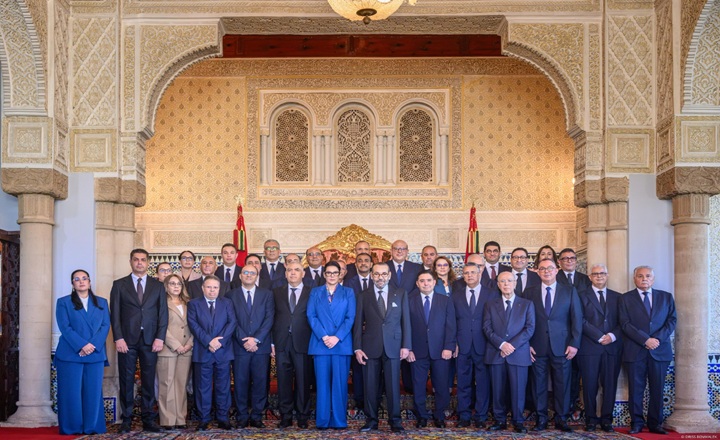
The new government team comprises four parties and promises concrete measures to meet citizens' expectations, with priorities defined by the King's directives.
Rabat, October 16, 2026King Mohammed VI presided this Friday at the Royal Palace in Rabat over the ceremony appointing the members of the new Moroccan government, led by Fatima Ezzahra El Mansouri, who pledged to develop an action program aimed at meeting the expectations of citizens and addressing the country's main challenges.
The ceremony marked the formalization of the new governing team, whose members took an oath before the sovereign, before posing for an official photograph. The King's chamberlain, Sidi Mohammed El Alaoui, was present at the event.
In her first press statement after her appointment, the head of government thanked Mohammed VI for the trust placed in the new team and announced the preparation of an ambitious program, in accordance with royal directives, particularly those expressed in the Throne Day speeches and the opening of the legislative year.
According to Fatima Ezzahra El Mansouri, the new government brings together four political parties with common principles and converging programs, which had already collaborated in different configurations. The official stated that the majority is based on a shared vision and a common action plan.
The head of government also highlighted the integration of qualified and experienced professionals, as well as the representation of women and young people in the composition of the Executive branch.
The program will be submitted to Parliament.
One of the commitments announced by the new head of government is the presentation of a government program to both chambers of Parliament. The document should include concrete measures and solutions to respond to the aspirations of citizens and address national challenges.
The implementation will be carried out through public policies designed to produce tangible and positive results in society, according to El Mansouri's statement.
The announcement places the execution of the program, the responsiveness of public services, and the results of government policies among the aspects to be monitored during the new political cycle. The effectiveness of the Executive will depend, in particular, on translating the announced commitments into concrete measures and verifiable results.
Economy, security, and digital transformation among government areas.
The composition of the new government includes sectors such as the economy and finance, internal security, diplomacy, justice, agriculture, health, education, energy, transport, employment, and social protection.
Fouzi Lekjaa takes over the Economy, Finance and Public Performance portfolio, while Abdelouafi Laftit remains at the head of the Ministry of the Interior and Nasser Bourita leads Foreign Affairs, African Cooperation and Moroccans Residing Abroad.
The team also includes Ahmed Rahhou as Minister of Artificial Intelligence, Digital Transformation and Administrative Reform, giving institutional prominence to the digitization and modernization of public administration.
In the social sphere, the Executive branch includes ministries responsible for Health and Social Protection, National Education, Vocational Training, Employment, Family, Social Development, and Equality. Agriculture, maritime fisheries, and food sovereignty are also areas expressly contemplated in the government structure.
The new team also includes heads of the Youth, Culture and Sports, Higher Education, Scientific Research and Innovation, Tourism, Crafts, and Social and Solidarity Economy sectors.
Composition of the new Government
Key members of the Executive branch include:
· Fatima Ezzahra El Mansouri— Head of Government;
· Abdelouafi Laftit— Minister of the Interior;
· Nasser Bourita— Minister of Foreign Affairs, African Cooperation and Moroccans Residing Abroad;
· Abdellatif OuahbiMinister of Justice;
· Fouzi LekjaaMinister of Economy, Finance and Public Performance;
· Nizar BarakaMinister of Equipment, Water and Forests;
· Nabil Benabdallah— Minister of National Education, Pre-school Education, Vocational Training and Skills Development;
· Youns BjijouMinister of Health and Social Protection;
· Khalid HatimyMinister of Agriculture, Maritime Fisheries and Food Sovereignty;
· Ryad MezzourMinister of Industry, Trade, Investment and Economic Inclusion;
· Charafat AfailalMinister of Energy, Mines and Sustainable Development;
· Abderrahim Chahid— Minister of Employment and Social Dialogue;
· Ahmed Rahhou— Minister of Artificial Intelligence, Digital Transformation and Administrative Reform;
· Najwa KoukoussMinister of Family, Social Development and Equality;
· Samir Belfkih— Minister of National Territorial Planning, Urban Development, Housing and Urban Policy, and spokesperson for the Government.
The structure also includes delegate ministers responsible for specific areas, including National Defense Administration, relations with Parliament and civil society, foreign trade, maritime fishing, pre-school education, vocational training, housing, youth, social inclusion, administrative reform, and the social and solidarity economy.
Expectations and challenges of the new Executive
The formation of the Government marks a new stage in the implementation of the Kingdom's political and economic priorities. The commitment to presenting concrete measures and producing positive impacts places the implementation of the government program at the center of public evaluation of the new team.
Presenting the program to both chambers of Parliament should allow for a more detailed understanding of the priorities, implementation instruments, and goals that the Executive intends to establish.
Beyond the ministerial composition, the main test will be the ability to transform the announced guidelines into public policies with concrete results for the population, within a framework of coordination between the different government sectors and accountability to institutions and citizens.
Outras noticias

Society
CIM challenges the legality of the suspension announced by ICM
2026-10-15

Society
CoWork Lab celebrates 14 years in Mozambique and inaugurates its seventh business center in Maputo
2026-10-15
Society
BCI reinforces support for female entrepreneurship in Beira
2026-10-15
policy
Edson Macuácua is the new Minister of Education and Culture
2026-10-15
policy
Morocco: King Mohammed VI demands mobilization and responsibility in the formation of the new government
2026-10-14
Copyright Jornal Preto e Branco All rights reserved . 2025