
Forquilha and members removed for being out of office
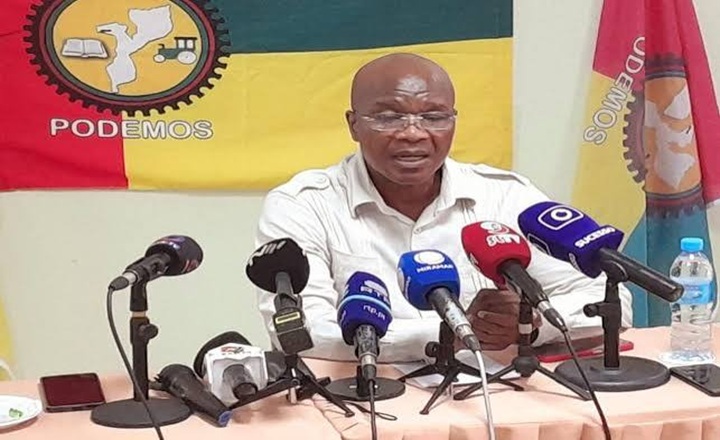
The court decision affecting PODEMOS is a precautionary measure, not a final ruling. The party can survive institutionally without Forquilha in active leadership, but its political capital is deeply tied to the figure of the president.
According to available information, case number 24/26-W, currently underway in the KaMavota Judicial Court, has resulted in an unspecified precautionary measure against PODEMOS. The measure orders party members, including president Albino Forquilha, to refrain from engaging in any party activity until the main case is judged.
The basis of the action is the alleged expiration of the mandates of the party's central bodies. The applicant, Hélder Mendonça, argues that the mandates expired in 2024 and that, therefore, the current leadership no longer has the statutory legitimacy to remain in office.
We are dealing with a provisional measure, not a final decision. The court has not yet assessed the merits of the case, that is, it has not yet decided whether the mandate has actually expired or not. The precautionary measure only prevents the performance of acts until the court rules on the merits of the case.
The PODEMOS party therefore has legal grounds to contest the measure, present its arguments regarding the validity of the mandates and, if necessary, appeal the decision. The party stated that it has not yet been formally notified and is awaiting the outcome of the process.
The existence of a statute that must be assessed by the court is precisely the central point of the dispute. The applicant invokes the statute to argue that the mandates have ended. PODEMOS invokes the same statute to defend its position, probably alleging that there were circumstances that justify the continuation or that the deadlines did not expire in the way the applicant claims.
The court's decision on the interpretation of the statute will be crucial in determining whether Forquilha and the other members can resume their duties or whether internal elections will have to be held.
The PODEMOS party exists as a legal entity; it has statutes, governing bodies, and representatives in the Assembly of the Republic. The party does not cease to exist simply because its president is temporarily prevented from exercising his duties. If the court confirms the need for internal elections, the party can hold a congress and elect a new leadership.
According to analysts, Mozambique's need for political-partisan or financial courts reflects a real frustration with the technical capacity and independence of existing courts. The Administrative Court, for example, has been criticized for its limited oversight capacity and the budgetary constraints it faces.
But creating new courts in itself, without addressing the underlying problems of judicial independence, adequate resources, and technical training, may only be a superficial solution. The issue is not just specialization, but the real capacity to judge impartially and effectively.
Outras noticias
Society
Kenya on alert: 10 people in quarantine after death linked to Ebola virus
2026-10-08

economy
Cashew nut smuggling causes a loss of 457 million Meticais to the State
2026-10-08

Culture
BCI joins in celebrating the literary career of Sónia Sultuane
2026-10-08

policy
Supreme Court orders the unfreezing of Venâncio Mondlane's accounts
2026-10-08
policy
African Union launches continent's first credit rating agency
2026-10-07
Copyright Jornal Preto e Branco All rights reserved . 2025